The Unbearable Lightness of Being Review: Worth It?
TL;DR
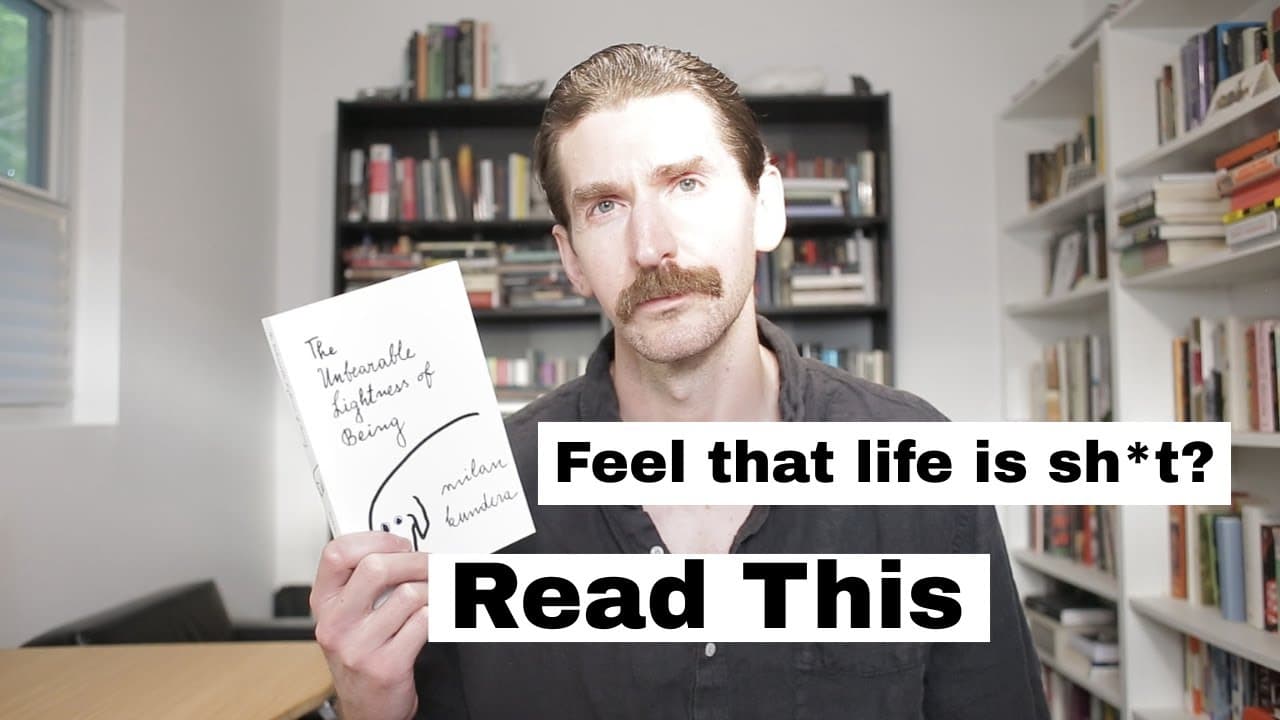
Milan Kundera’s novel is worth reading for its accessible blend of existential inquiry, troubled romance, political turmoil, and emotional ambiguity. Its greatest strength is not supplying definitive answers, but showing why love, freedom, fidelity, identity, and major life choices resist certainty when each person lives only once and has no reliable basis for comparison.
Transcript
Do you love me like I love you? Good evening everyone. Welcome to Better Than Food Book Reviews. I'm your host Cliff Le Sergeant. Great to see you as always. Hope you're doing well. Get that coffee. I recently uploaded my first patron only monthly AMA video which turned out to be an hour and a half long. That was a lot of fun and I'll be gathering ... Read More
Key Insights
- The novel is an existential love story set partly during the Prague Spring of 1968, when the Soviet Union invaded Czechoslovakia to suppress political liberalization. Political upheaval surrounds the characters and mirrors the uncertainty, conflict, and pressure within their intimate relationships.
- The central relationship is the troubled marriage between Tomas and Tereza. Tomas loves Tereza but repeatedly sleeps with other women, while Tereza loves him yet feels trapped, wounded, and unable either to accept the relationship or fully escape it.
- The opposition between lightness and weight frames the novel’s central philosophical question. Weight can mean commitment, consequence, and responsibility, while lightness suggests freedom, but Kundera keeps both possibilities open and refuses to identify either condition as unquestionably preferable.
- Human choice is uncertain because each person lives only one life. Without previous lives to compare or future lives in which to revise decisions, people cannot test whether staying, leaving, loving, or remaining alone would have produced a better result.
- The novel treats ambiguity as a path toward truth rather than a defect. Kundera examines fidelity and infidelity, love and betrayal, and freedom and responsibility from competing perspectives, showing that important questions can support several interpretations without yielding a single conclusive answer.
- Kundera’s narrator creates warmth by speaking as though the characters were people he once knew. His direct reflections and fourth-wall breaks resemble an intimate conversation or documentary recollection, while his admitted uncertainty reinforces the book’s larger concern with incomplete understanding.
- The slightly nonlinear structure reveals the characters’ fate before the ending. This choice shifts attention away from suspense and toward bittersweet reflection on time, mortality, memory, and the fleeting experience of people trying to understand what they want.
- Kundera’s treatment of bodily functions and kitsch challenges idealized accounts of existence. The reviewer connects the novel’s deliberately blasphemous discussion of God and the body with George Bataille’s base materialism, which returns abstract thought to corporeal, earthly, and unassimilable realities.
Install to Summarize YouTube Videos and Get Transcripts
Explore YouTube Video Summarizer or Get YouTube Transcript Extractor
Questions & Answers
Q: What is The Unbearable Lightness of Being about?
The novel follows the interconnected lives of Tomas, his wife Tereza, their dog Karenin, Tomas’s lover Sabina, and Sabina’s other lover, Franz. Set partly amid the Prague Spring of 1968 and the Soviet invasion of Czechoslovakia, it focuses primarily on Tomas and Tereza’s passionate but painful relationship while examining love, sex, betrayal, freedom, political pressure, and existential uncertainty.
Q: Is The Unbearable Lightness of Being worth reading?
The reviewer considers it a great and extremely readable novel, especially for a politically and metaphysically perplexing period. It combines intimacy, emotion, tragedy, philosophical inquiry, transgressive material, and surprising warmth. Although some of its sentimentality did not move him, its ambiguity, incisive thought, accessibility, and willingness to confront uncomfortable subjects ultimately made the book more impressive than he expected.
Q: What do lightness and weight mean in Kundera’s novel?
Lightness and weight represent opposing ways of understanding existence. Lightness can suggest freedom from commitments and consequences, while weight can suggest attachment, responsibility, and significance. The novel asks which condition is preferable but does not settle the matter. Its method is to preserve the tension between competing answers, demonstrating how freedom can become empty and commitment can become both meaningful and painful.
Q: Why can people never know which life choice is best?
People cannot know which choice is best because they live only one life and therefore have no controlled basis for comparison. A person cannot experience both staying with a partner and remaining alone, then compare the complete results. Decisions arrive without warning or rehearsal, so people improvise as they proceed. Stories and history offer partial comparisons, but individual circumstances prevent them from delivering certainty.
Q: How does the novel portray Tomas and Tereza’s relationship?
Tomas and Tereza share genuine love, but Tomas repeatedly sleeps with other women, causing Tereza intense unhappiness. She feels she must leave yet cannot leave, while Tomas experiences a related conflict for different reasons. Kundera compares love and sex with war and combat, making their relationship feel like an exhausting struggle between desire, fidelity, freedom, dependence, tenderness, and betrayal.
Q: How does Kundera use ambiguity in the story?
Kundera uses ambiguity by presenting several perspectives and resisting final judgments about the characters’ behavior or the novel’s philosophical oppositions. The narrator openly investigates rather than confesses, and he sometimes acknowledges uncertainty about what events mean. This approach encourages empathy for conflicting viewpoints and suggests that questions can bring a person closer to truth than rigid convictions or absolute answers can.
Q: What makes the novel’s narrative style distinctive?
The story unfolds in a slightly nonlinear fashion and discloses the main characters’ fate well before the ending. Kundera also breaks the fourth wall and narrates as if recalling people he once knew. The result resembles a thoughtful conversation or documentary recollection. This distance supports the themes of memory and uncertainty while preserving a warm, friendly, and authoritative tone.
Q: Why does the novel discuss the body, God, and kitsch?
The novel uses bodily material and blasphemous humor to challenge idealized visions of human existence. Its discussion of God’s responsibility for the human body brings abstract theology into contact with visceral reality. The reviewer links this approach to George Bataille’s base materialism, which emphasizes earthly and unassimilable aspects of life and death. Kundera’s related analysis of kitsch is described as brilliant and insightful.
Summary & Key Takeaways
-
Set partly during the Prague Spring of 1968 and the Soviet invasion of Czechoslovakia, the novel follows Tomas, Tereza, Sabina, Franz, and the dog Karenin. Its central relationship is the passionate but painful marriage of Tomas and Tereza, whose competing desires turn intimacy into a state resembling war and emotional exhaustion.
-
Kundera examines fidelity, betrayal, freedom, responsibility, lightness, and weight without declaring one side correct. Because people live only once, they cannot test alternative lives or determine which choice would have been better. The resulting uncertainty makes existence tragic, mysterious, and beautiful while encouraging empathy for radically different points of view.
-
The novel combines philosophical reflection with an accessible, warm, and slightly nonlinear narrative. Kundera addresses the reader, reveals important outcomes early, and treats his characters as remembered acquaintances. Although some sentimentality did not move the reviewer, the book’s incisive thought, transgressive humor, emotional intimacy, and reflections on kitsch made it an impressive read.
Read in Other Languages (beta)
Share This Summary 📚
Summarize YouTube Videos and Get Video Transcripts with 1-Click
Try YouTube Summary with ChatGPT & Claude or YouTube Transcript Generator
Explore More Summaries from Better Than Food 📚
Summarize YouTube Videos and Get Video Transcripts with 1-Click
Try YouTube Summary with ChatGPT & Claude or YouTube Transcript Generator