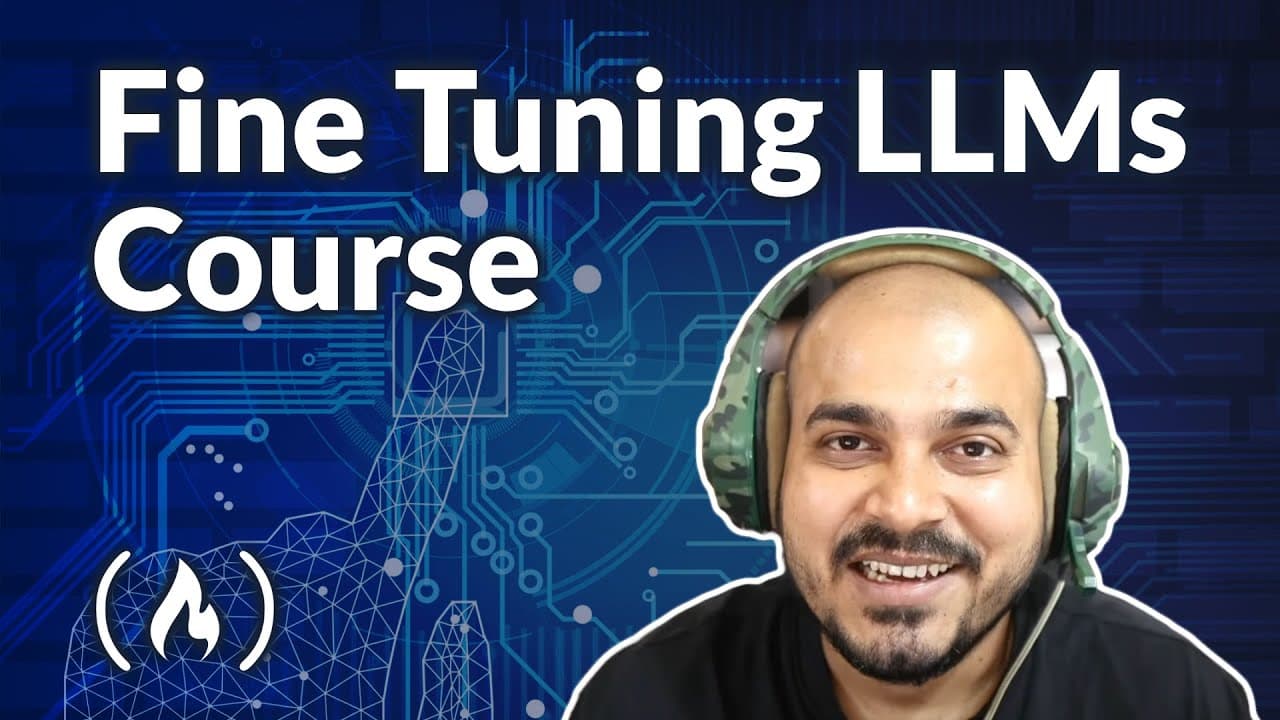
Fine Tuning LLM Models – Generative AI Course
TL;DR
Learn to fine-tune LLM models like Llama 2 using Google Gradient for practical applications.
Transcript
learn all about fine-tuning llm models in this course Chris will teach you fine-tuning using Cura and Laura as well as quantization using llama 2 gradient and the Google Gemma model this crash course includes both theoretical and practical instruction to help you understand how to perform fine-tuning so guys uh here is an amazing crash course to he... Read More
Key Insights
- 🥠 Fine-tuning large language models is essential for tailoring them to specific tasks and improving performance.
- 😒 Quantization significantly reduces model size and enhances inference speed, making LLMs more accessible for practical use.
- 💦 The Laura and CLA techniques are crucial for achieving parameter-efficient transfer learning, enabling users to work with extensive model parameters.
- 🤗 The course combines theoretical knowledge with practical implementation, reinforcing learning through hands-on projects.
- 🎰 Understanding machine learning principles is foundational for successfully navigating the course material and applying techniques effectively.
- 🧘 Knowledge of model fine-tuning drastically improves a candidate's eligibility for AI-related job positions, aligning with industry requirements.
- 🈸 The gradual approach to learning—starting from theory and moving to practical applications—provides a comprehensive educational experience.
Install to Summarize YouTube Videos and Get Transcripts
Explore YouTube Video Summarizer or Get YouTube Transcript Extractor
Questions & Answers
Q: What is the main focus of the course on fine-tuning LLM models?
The course focuses on imparting skills necessary for fine-tuning large language models (LLMs) like Llama 2 and Google Gamma. It combines theoretical knowledge with practical coding sessions, covering essential techniques such as quantization and efficient model adaptation methods like Laura.
Q: How does quantization aid in fine-tuning large models?
Quantization reduces the size of model weights from higher precision formats, like 32-bit floating points, to lower precision ones (e.g., 4-bit). This process not only eases memory usage but also enhances inference speed, making it feasible to run complex models on limited hardware resources.
Q: What are the key techniques discussed in the crash course?
The crash course covers several essential techniques, including quantization for optimizing memory, parameter-efficient transfer learning methods like Laura, and CLA, focusing on adapting large models with minimal computational resource requirements while retaining performance.
Q: Why is understanding theoretical intuition important in model fine-tuning?
Understanding the theoretical intuition behind model fine-tuning techniques allows individuals to grasp why certain methods work and how they can apply them effectively. It enhances problem-solving skills and prepares learners to discuss these concepts in technical interviews confidently.
Q: What prerequisites are suggested for starting this fine-tuning course?
While not explicitly stated, a basic understanding of machine learning concepts, deep learning models, and programming skills, particularly with Python, would be beneficial for prospective learners to maximize their learning experience in the fine-tuning course.
Q: How will the course aid in developing practical skills for AI roles?
The course emphasizes hands-on project work and problem-solving, ensuring that participants not only learn the theoretical principles of fine-tuning LLMs but also gain skills in implementing these techniques in real-world scenarios, which is highly valued in AI positions.
Summary & Key Takeaways
-
This course provides comprehensive instruction on fine-tuning LLM models like Llama 2 and Google Gamma, combining theory with practical coding.
-
Key techniques covered include quantization, parameter-efficient transfer learning, and state-of-the-art methods like Laura and CLA for optimizing model performance.
-
The instructional series includes project implementations with real-world examples to help learners develop applicable skills in AI roles.
Read in Other Languages (beta)
Share This Summary 📚
Summarize YouTube Videos and Get Video Transcripts with 1-Click
Try YouTube Summary with ChatGPT & Claude or YouTube Transcript Generator
Explore More Summaries from freeCodeCamp.org 📚


Summarize YouTube Videos and Get Video Transcripts with 1-Click
Try YouTube Summary with ChatGPT & Claude or YouTube Transcript Generator