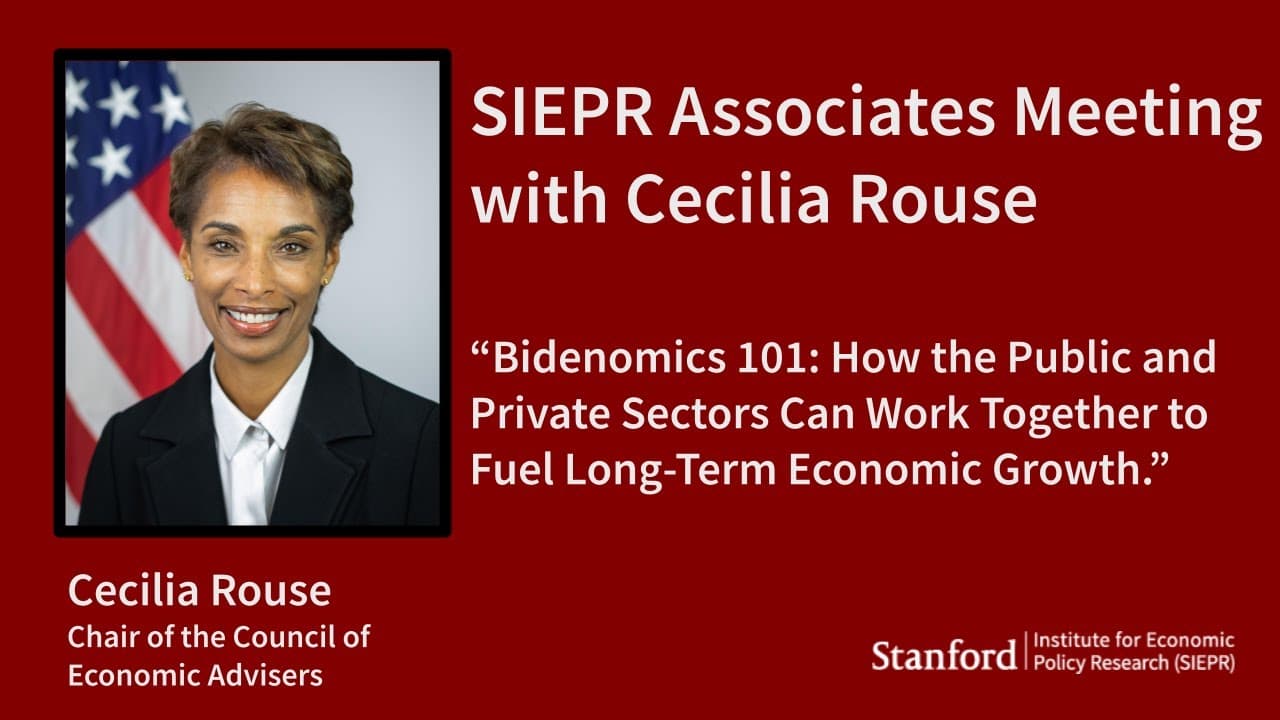
What Did Cecilia Rouse, Chair of the Council of Economic Advisers, Discuss at the Associates Meeting?
TL;DR
Cecilia Rouse explains that the public sector and private sector can work in partnership to support economic growth, stability, and recovery. Speaking as the 30th chair of the Council of Economic Advisers, she connects this argument to long-standing economic challenges that became clearer during the pandemic, including slowing growth and declining labor force participation. Read on for her background, policy focus, and reasons for returning to government.
Transcript
welcome everyone to today's super associates meeting with the chair of president biden's council of economic advisors cecilia rouse i'm mark duggan the triony director of the stanford institute for economic policy research and i'm thrilled that you're able to join us today for the really special event seber's mission is to support research that can... Read More
Key Insights
- 🇨🇫 The pandemic has highlighted the importance of the public sector's role in supporting the economy and ensuring stability.
- 🎓 Investments in childcare, education, and clean energy are crucial for economic growth and reducing inequality.
- 🔬 Immigration can address labor force challenges and contribute to innovation and productivity.
Install to Summarize YouTube Videos and Get Transcripts
Explore YouTube Video Summarizer or Get YouTube Transcript Extractor
Questions & Answers
Q: Who is Cecilia Rouse, and what does she discuss at the Associates Meeting?
Cecilia Rouse is the 30th chair of the Council of Economic Advisers and President Joe Biden's chief economist. At the meeting, she discusses the public sector's role in economic growth, the pandemic's impact, market failures, economic stability, and inequality.
Q: What is Cecilia Rouse's main argument about the public sector?
Rouse argues that the public and private sectors can work in partnership. She says the pandemic brought the importance of that relationship into sharp relief and helped draw her back into the administration.
Q: What economic problems existed before the pandemic?
Rouse says the pandemic highlighted long-standing challenges that predated the recession. The page identifies slowing economic growth and decreasing labor force participation among those challenges.
Q: Why did Cecilia Rouse return to the administration?
Rouse says she had not expected to complete another government tour. She returned because she believed President Biden understood and valued the partnership between the public and private sectors, a goal she shared.
Q: What is Cecilia Rouse's role in the Biden administration?
Rouse serves in the president's cabinet as Joe Biden's chief economist. As chair of the Council of Economic Advisers, she advises the administration during the economy's recovery from the pandemic-induced shock.
Q: What positions did Cecilia Rouse hold before becoming chair?
Before joining the Biden administration, Rouse was dean of the Princeton School of Public and International Affairs. She also served on President Barack Obama's Council of Economic Advisers from 2009 to 2011 and worked at the National Economic Council from 1998 to 1999.
Q: What has Cecilia Rouse studied as an academic?
Her research has focused on the economics of education. The introduction specifically mentions the benefits of community colleges, discrimination, and forces that hold some Americans back in the economy.
Q: How does the event connect academic research with economic policy?
Mark Duggan describes the Stanford Institute for Economic Policy Research as a bridge between academia and the policy world. The meeting gives scholars, students, supporters, and researchers an opportunity to hear directly from Rouse and submit questions for the discussion.
Summary & Key Takeaways
-
Chair Rouse emphasizes the importance of the public sector's role in economic growth and stability.
-
The COVID-19 pandemic has highlighted long-standing challenges in the economy, such as slowing economic growth and decreasing labor force participation.
-
Market failures, including externalities and liquidity constraints, require government intervention to achieve optimal outcomes.
Read in Other Languages (beta)
Share This Summary 📚
Summarize YouTube Videos and Get Video Transcripts with 1-Click
Try YouTube Summary with ChatGPT & Claude or YouTube Transcript Generator
Explore More Summaries from Stanford Institute for Economic Policy Research (SIEPR) 📚




Summarize YouTube Videos and Get Video Transcripts with 1-Click
Try YouTube Summary with ChatGPT & Claude or YouTube Transcript Generator