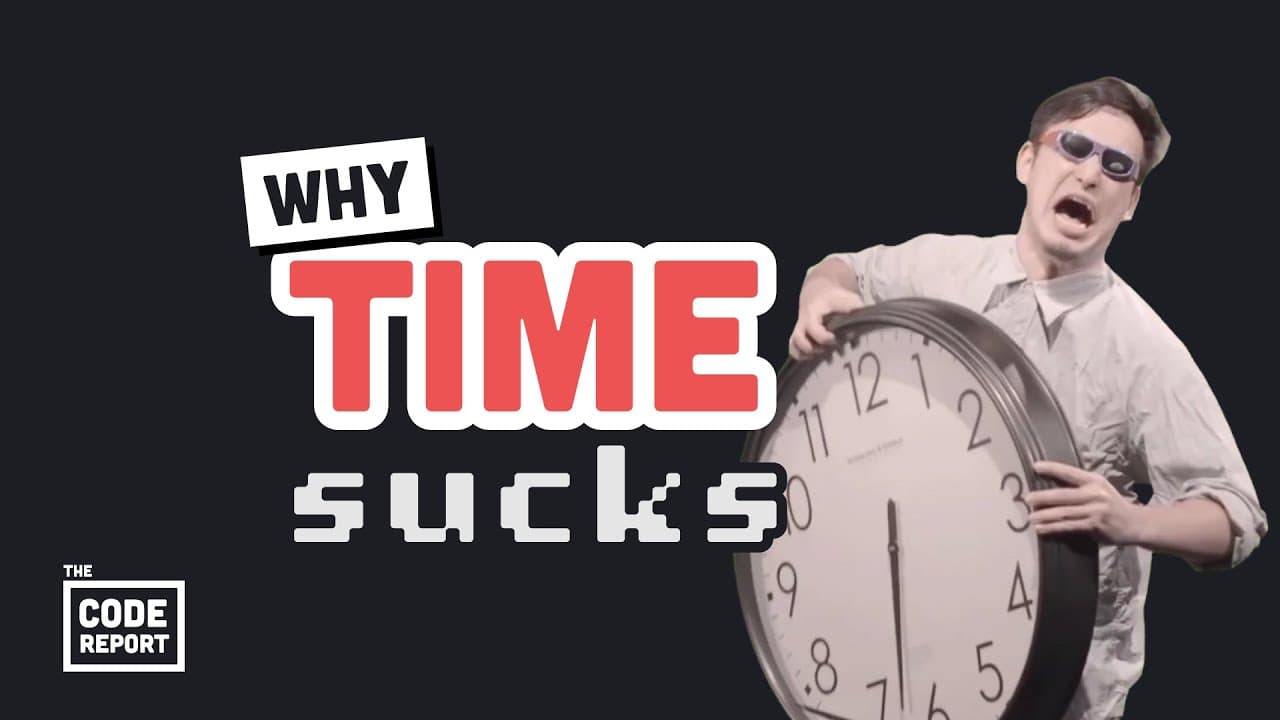
Time… a programmer's worst enemy // The Code Report
TL;DR
Time is a convoluted concept with varied calculations, time zones, and proposals for better date handling in JavaScript.
Transcript
it is march 17 2022 and you're watching the code report it's about time we had a talk about time you would think it's a pretty simple concept time began on january 1st 1970 with the unix epic at any moment we can get the number of milliseconds elapsed from this date on any computer using a method like date now this is called incremental time but on... Read More
Key Insights
- ⌛ The Unix epoch started time in 1970, but leap seconds adjust for Earth's rotation irregularities.
- ⌛ Time zones globally vary, with daylight savings adding further complexity to time calculations.
- 📅 The Gregorian calendar has inconsistent month lengths, unlike other consistent interval counting systems.
- 🌱 Proposals like the Cotsworth plan suggest calendar reforms for better alignment with natural cycles.
- 🧑🤝🧑 The Temporal API in JavaScript aims to simplify date handling and improve time computations in programming.
- ⌛ The current JavaScript date implementation lacks precision and time zone support, making time calculations challenging.
- 🧑🤝🧑 Moment.js and other libraries address JavaScript's date handling shortcomings, but built-in solutions like the Temporal API are preferable.
Install to Summarize YouTube Videos and Get Transcripts
Explore YouTube Video Summarizer or Get YouTube Transcript Extractor
Questions & Answers
Q: Why does time calculation start from January 1st, 1970?
Time calculation begins from this date due to the Unix epoch, making it easy to measure time elapsed from a specific point in computer systems.
Q: How do different time zones complicate time tracking?
Time zones vary worldwide, with adjustments like daylight savings creating inconsistencies in calculating time differences between locations.
Q: What is the proposed Cotsworth plan for reforming the calendar?
The Cotsworth plan suggests a 13-month calendar with consistent 28-day months, aligning better with lunar cycles and simplifying date calculations.
Q: How would the Temporal API in JavaScript improve date handling?
The Temporal API aims to enhance date handling in JavaScript by providing better time zone support, additional precision in time formats, and improved date computations.
Summary & Key Takeaways
-
Time began in 1970 with the Unix epoch, but the Earth's rotation irregularities lead to leap seconds causing discrepancies.
-
Time zones, daylight savings, and the Gregorian calendar add further complexity to timekeeping globally.
-
Proposals like the Cotsworth plan and the Temporal API aim to simplify time calculations and improve date handling in programming.
Read in Other Languages (beta)
Share This Summary 📚
Summarize YouTube Videos and Get Video Transcripts with 1-Click
Try YouTube Summary with ChatGPT & Claude or YouTube Transcript Generator
Explore More Summaries from Fireship 📚





Summarize YouTube Videos and Get Video Transcripts with 1-Click
Try YouTube Summary with ChatGPT & Claude or YouTube Transcript Generator