Lecture 1 | The Theoretical Minimum
TL;DR
Classical mechanics is intuitive and based on visualizable concepts, while quantum mechanics requires abstract thinking and mathematical descriptions.
Transcript
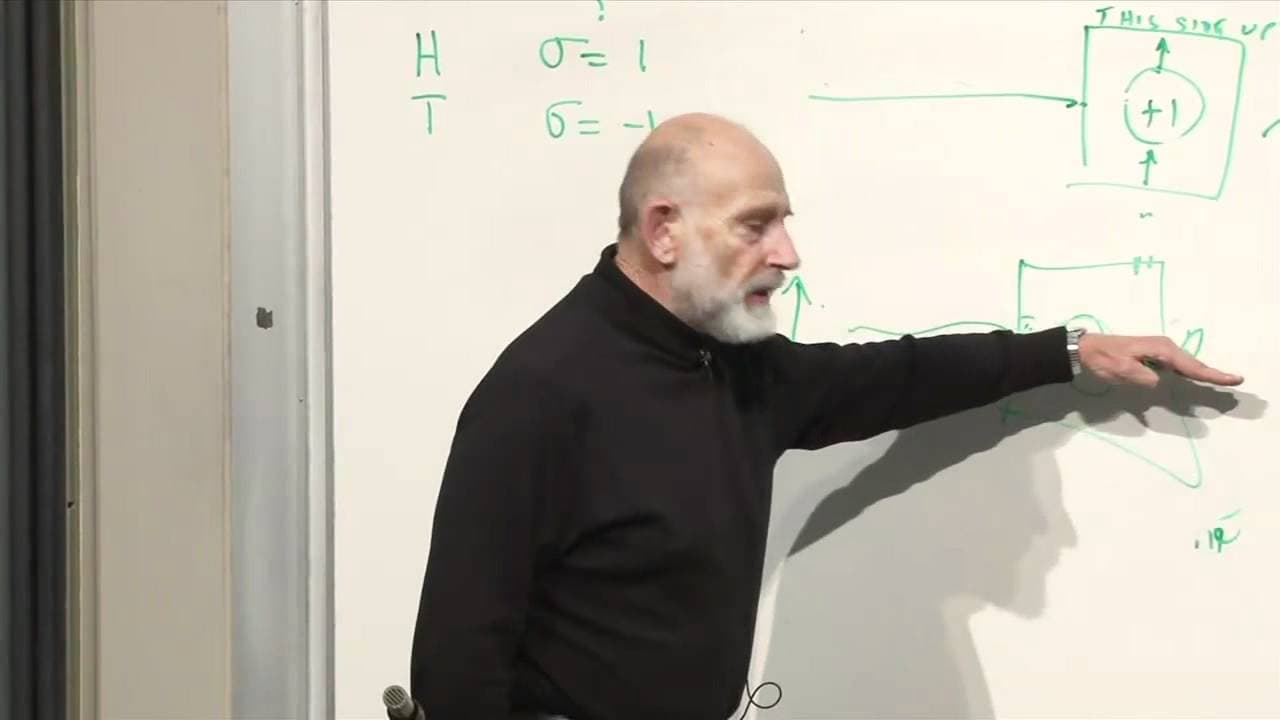
stanford university all right so last quarter we studied classical mechanics and classical mechanics is fairly intuitive the basic ideas are things that you can visualize you can picture in your head motion of particles motion of objects it gets a little hard when you start thinking of 10 particles all at the same time but nevertheless the whole th... Read More
Key Insights
- 🦾 Classical mechanics is based on visualizable concepts, while quantum mechanics requires abstract thinking and mathematical descriptions.
- 🦾 The concept of a system is fundamental in classical mechanics, and its state can be updated over time using equations of motion.
- 😒 Visualizing concepts in quantum mechanics is challenging due to the abstract nature of particle behavior and the use of mathematics to describe quantum systems.
- 👾 The idea of a vector space is an important concept in mathematics and can be applied to describe the state of quantum systems.
Install to Summarize YouTube Videos and Get Transcripts
Explore YouTube Video Summarizer or Get YouTube Transcript Extractor
Questions & Answers
Q: Why is classical mechanics considered intuitive?
Classical mechanics is based on concepts that can be easily visualized and understood, such as the motion of objects and the updating of their state over time.
Q: What is the difference between classical mechanics and quantum mechanics?
Classical mechanics is based on deterministic and visualizable concepts, while quantum mechanics is more abstract and requires the use of complex mathematics to describe and predict the behavior of quantum systems.
Q: Why is it difficult to visualize concepts in quantum mechanics?
Quantum mechanics involves concepts such as superposition and entanglement that go beyond our everyday experience and cannot be visualized in the same way as classical concepts like the motion of objects.
Q: How does the concept of a system relate to classical mechanics?
In classical mechanics, a system refers to a closed and isolated entity whose state and motion can be predicted using equations of motion. The concept of a system is foundational to classical mechanics.
Summary
In this video, the lecturer introduces the concept of classical mechanics and its intuitive nature. They explain how classical mechanics is based on concepts that are drawn from the everyday world and how it involves the concepts of a closed system and the state of a system. The lecturer emphasizes the importance of understanding that once physics moves beyond the realm of parameters familiar from ordinary experience, visualization becomes difficult and abstract mathematics becomes necessary. They also discuss the difference between classical and quantum mechanics, highlighting that quantum mechanics is more abstract and requires a different logic than classical mechanics.
Questions & Answers
Q: What are the basic concepts of classical mechanics?
The basic concepts of classical mechanics include the idea of a closed system, the state of a system, and equations of motion.
Q: How is the concept of a closed system defined?
A closed system is one that is temporarily isolated and not interacting with anything else.
Q: What is the concept of the state of a system in classical mechanics?
The state of a system refers to the collection of possible states that the system can be in. For example, in the case of a coin, the possible states are "heads" and "tails".
Q: What is the significance of equations of motion in classical mechanics?
Equations of motion in classical mechanics describe the laws of evolution for the system. They determine how the state of the system updates over time.
Q: How does classical mechanics differ from quantum mechanics?
Classical mechanics is based on concepts that can be visualized and understood intuitively, while quantum mechanics deals with phenomena that cannot be directly visualized and require abstract mathematics for their description.
Q: How does the lecturer emphasize the importance of abstract mathematics in understanding physics beyond classical mechanics?
The lecturer emphasizes that once physics moves beyond the realm of familiar parameters, abstract mathematics becomes necessary to describe the phenomena accurately. They also caution against relying on visualization techniques that are not compatible with abstract concepts.
Q: Why is the concept of visualization limited in quantum mechanics?
Visualization is limited in quantum mechanics because the phenomena being studied, such as the motion of electrons or multidimensional spaces, go beyond the capabilities of human neural architecture to visualize directly.
Q: How does the lecturer explain the concept of a qubit?
The lecturer introduces the concept of a qubit as a system that can be in two states, similar to the concept of a classical bit. They describe how a qubit can be prepared or measured, leading to the determination of its state.
Q: What is the relevance of the experiments described by the lecturer?
The experiments involving the measurement and preparation of a qubit help illustrate the difference between classical and quantum mechanics. They show that quantum mechanics exhibits different behavior, such as the randomness of outcomes and the need for statistical analysis.
Q: What is the significance of the detected outcomes in relation to the qubit's orientation?
The detected outcomes, such as plus one or minus one, provide information about the qubit's orientation or directionality. Different orientations and measurements can result in varied outcomes and average values.
Takeaways
The video highlights the difference between classical and quantum mechanics, emphasizing the need for abstract mathematics to understand quantum phenomena. It also stresses the limitations of visualization in quantum mechanics and the importance of using mathematics to describe abstract concepts accurately. Additionally, the experiments with qubits demonstrate the randomness and statistical nature of quantum outcomes, as well as the relevance of measurements in determining the state of a system.
Summary & Key Takeaways
-
Classical mechanics is based on concepts that can be visualized, such as the motion of particles and objects.
-
Classical mechanics relies on equations of motion to update the state of a system over time.
-
Quantum mechanics, on the other hand, is more abstract and requires the use of complex mathematics to describe systems and predict their behavior.
Read in Other Languages (beta)
Share This Summary 📚
Summarize YouTube Videos and Get Video Transcripts with 1-Click
Try YouTube Summary with ChatGPT & Claude or YouTube Transcript Generator
Explore More Summaries from Stanford 📚



Summarize YouTube Videos and Get Video Transcripts with 1-Click
Try YouTube Summary with ChatGPT & Claude or YouTube Transcript Generator