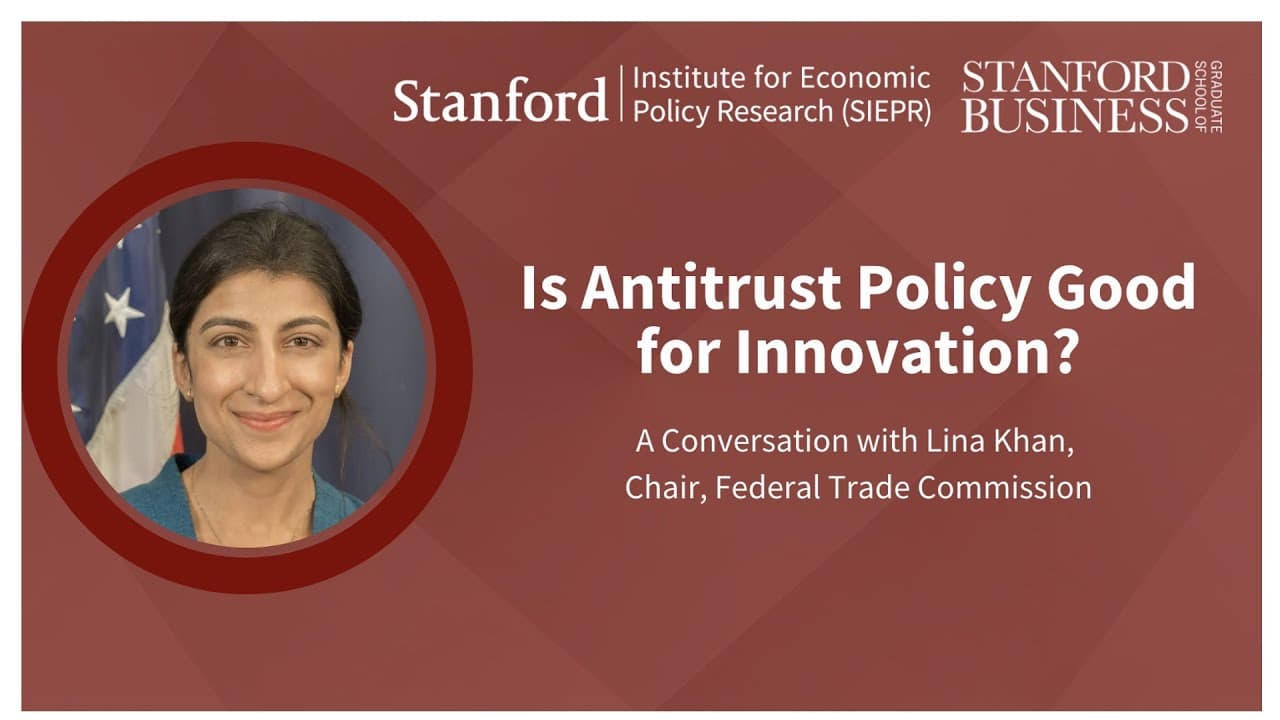
Is Antitrust Policy Good for Innovation? A Conversation w Lina Khan, Chair, Federal Trade Commission
TL;DR
Chair Khan of the FTC discusses the agency's actions against Big Tech companies, the need for more regulation, and the potential impact on competition and innovation.
Transcript
uh welcome everyone to Seer the Stanford Institute for economic policy research I'm thrilled to have lenina Khan the chair of the Federal Trade Commission with us here at Stanford today and a big thank you to The Graduate School of Business here at Stanford and to the business government and Society Initiative for co-sponsoring today's event with u... Read More
Key Insights
- 😃 The FTC, under Chair Khan's leadership, is actively pursuing antitrust cases against big tech companies to protect fair competition and prevent monopolistic practices.
- 👀 The agency is looking beyond traditional markets and addressing new challenges in areas like AI and data privacy to ensure a level playing field.
- 🗯️ Finding the right balance between regulation and fostering innovation is crucial for creating a vibrant and competitive market.
- 🇨🇷 Addressing the limitations in remedies and the cost of antitrust litigation are areas that require attention from policymakers.
Install to Summarize YouTube Videos and Get Transcripts
Explore YouTube Video Summarizer or Get YouTube Transcript Extractor
Questions & Answers
Q: How has Chair Khan's background and previous work influenced her approach to antitrust regulation?
Chair Khan's research and perspective on antitrust laws have shaped her focus on protecting fair competition, promoting innovation, and ensuring consumer welfare. Her work has contributed to an "Antitrust Revolution" and reframed decades of monopoly law.
Q: What are some potential drawbacks of regulating big tech companies to promote competition and innovation?
One concern is that overregulation may inhibit the funding and growth of startups if it becomes more difficult for them to be acquired by larger companies. Regulators need to find a balance between preventing monopolistic practices and fostering a healthy ecosystem for startups.
Q: How does the lack of comprehensive data protection and privacy laws impact the FTC's enforcement of antitrust laws against big tech companies?
The absence of robust privacy laws can influence the dimensions on which companies can compete. Stronger data protection measures could reduce the race to the bottom in terms of data collection and encourage companies to compete on other factors, potentially leading to more competition and innovation.
Summary & Key Takeaways
-
Chair Khan discusses the FTC's focus on regulating big tech companies and their actions to maintain fair competition in the market.
-
The FTC has filed lawsuits against companies like Amazon for monopolistic tactics, and is also addressing non-compete clauses and the impact of new technologies like AI.
-
The agency's efforts aim to protect open and competitive markets, encourage innovation, and ensure that consumers have access to fair prices and quality products.
Read in Other Languages (beta)
Share This Summary 📚
Summarize YouTube Videos and Get Video Transcripts with 1-Click
Try YouTube Summary with ChatGPT & Claude or YouTube Transcript Generator
Explore More Summaries from Stanford Institute for Economic Policy Research (SIEPR) 📚






Summarize YouTube Videos and Get Video Transcripts with 1-Click
Try YouTube Summary with ChatGPT & Claude or YouTube Transcript Generator