Neural networks learning spirals
TL;DR
Neural networks' ability to classify data sets depends on their architecture and hyperparameters. This video illustrates how varying the number of neurons and hidden layers influences their performance, using simple and complex data distributions like circles and spirals. Understanding these dynamics helps in grasping how to design effective networks for different tasks.
Transcript
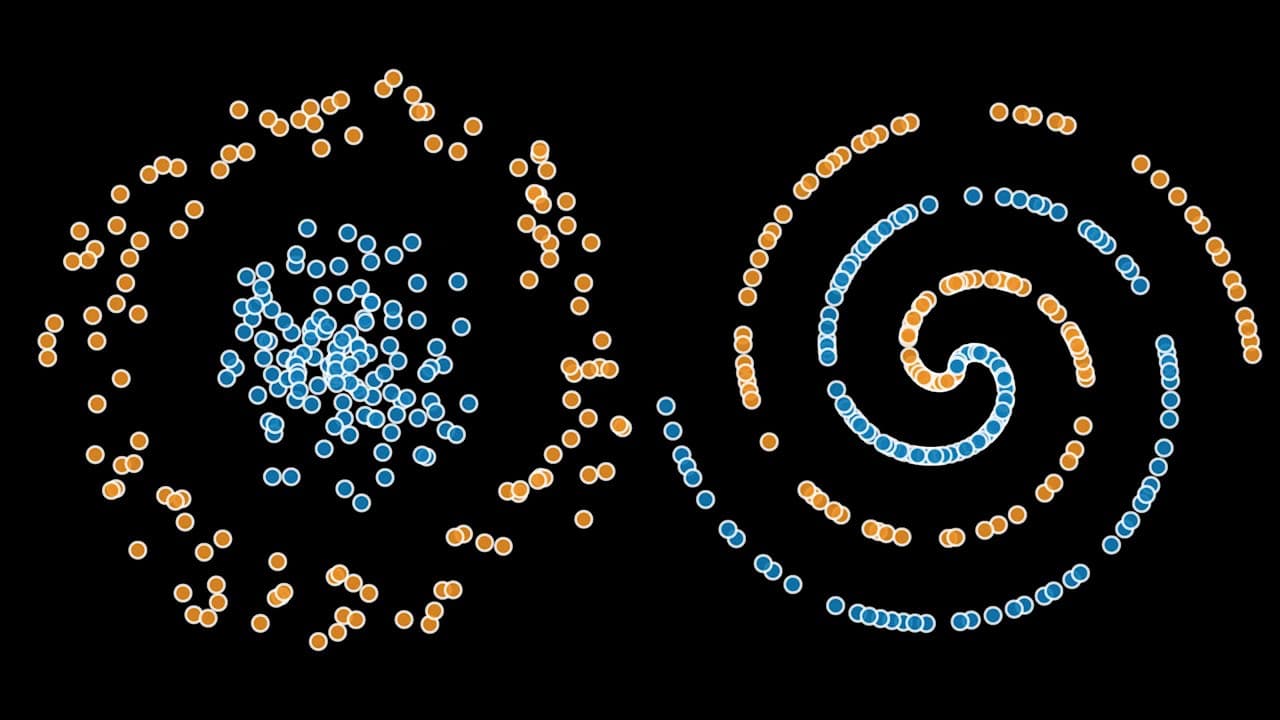
let's use tensorflow playground to see what kind of neural network can learn to partition the space for the binary classification problem between the blue and the orange dots first is an easier binary classification problem with a circle and a ring distribution around it second is a more difficult binary classification problem of two dueling spiral... Read More
Key Insights
- 😫 The size of the neural network, in terms of neurons and hidden layers, impacts its ability to learn and classify different data sets.
- ☠️ The choice of hyperparameters, such as learning rate and activation function, also influences the network's performance.
- 😫 The initialization of the neural network plays a significant role in its ability to learn complex data sets.
Install to Summarize YouTube Videos and Get Transcripts
Explore YouTube Video Summarizer or Get YouTube Transcript Extractor
Questions & Answers
Q: What does the input and output of the neural network represent in the provided experiments?
The input represents the position of a point in a 2D plane, and the output represents the classification of whether it's an orange or blue dot.
Q: What hyperparameters are kept constant in the experiments?
The hyperparameters that remain constant are a batch size of one, learning rate of 0.03, Rayleigh activation function, and L1 regularization with a rate of 0.001.
Q: How does the network architecture affect the network's ability to classify the circle and ring distribution?
With one hidden layer and one neuron, the network struggles to accurately classify the data. As the number of neurons increases, the network gradually improves its ability to separate the orange and blue dots.
Q: Why is the spiral data set more challenging to classify?
The spiral data set requires additional features to be added to the input, which include the squares of coordinates, their multiplication, and their sign. Even with this added information, the network requires more neurons and hidden layers to accurately classify the spirals.
Key Insights:
- The size of the neural network, in terms of neurons and hidden layers, impacts its ability to learn and classify different data sets.
- The choice of hyperparameters, such as learning rate and activation function, also influences the network's performance.
- The initialization of the neural network plays a significant role in its ability to learn complex data sets.
- The provided experiments offer a visual intuition of the relationship between network architecture, data set characteristics, and training hyperparameters.
Summary
This video uses TensorFlow Playground to explore the capabilities of neural networks in partitioning space for binary classification problems. The experiment involves two datasets: one with a circle and a ring distribution, and another with two dueling spirals. The hyperparameters for the experiment are constant, except for the number of neurons and hidden layers, which are gradually increased. The video also highlights the impact of network initialization on the results.
Questions & Answers
Q: What is the purpose of using TensorFlow Playground in this video?
The purpose of using TensorFlow Playground is to gain intuition about how the size of the network and the various hyperparameters affect the representations that the network can learn.
Q: What is the input to the network in this experiment?
The input to the network is the position of the point in the 2D plane.
Q: What is the output of the network?
The output of the network is the classification of whether the point is an orange or blue dot.
Q: How are the hyperparameters chosen for this experiment?
The experiment holds most hyperparameters constant, including a batch size of one, learning rate of 0.03, Rayleigh activation function, and L1 regularization with a rate of 0.001.
Q: How does the experiment vary the network architecture?
The experiment starts with one hidden layer and one neuron and gradually increases the size of the network by adding more neurons and hidden layers.
Q: What is the purpose of the right side of the screen in the visualization?
The right side of the screen displays the test loss and training loss, providing a measure of how well the network is performing on the data.
Q: How is the partitioning function visualized in the experiment?
The partitioning function is represented by the shading in the background of the plot, which shows how the neural network is learning to separate the orange and blue dots.
Q: What happens when the size of the network increases in the experiment?
As the size of the network increases with more neurons and hidden layers, the network becomes more capable of learning complex representations and partitioning the space effectively.
Q: How does the experiment introduce more difficult data sets?
The experiment involves a second data set with dueling spirals, which is more challenging for the neural network to classify.
Q: What is the impact of network initialization on the results?
The video acknowledges that network initialization has a significant impact on the results of the experiment, but it is not the focus of the video, which aims to provide visual intuition about which networks are able to learn specific types of data sets.
Takeaways
The video demonstrates the relationship between neural network architecture, data set characteristics, and different training hyperparameters. It emphasizes the importance of network size and initialization in determining the network's ability to learn and classify different types of data. The experiment provides valuable insights into the capabilities of neural networks and encourages viewers to challenge themselves and learn something new every day.
Summary & Key Takeaways
-
The video uses the Tensorflow Playground tool to visualize how neural networks learn to classify data sets.
-
The first data set is a simple circle and ring distribution, while the second is a more complex spiral distribution.
-
The video explores the impact of increasing the number of neurons and hidden layers on the network's ability to accurately partition the data.
Read in Other Languages (beta)
Share This Summary 📚
Summarize YouTube Videos and Get Video Transcripts with 1-Click
Try YouTube Summary with ChatGPT & Claude or YouTube Transcript Generator
Explore More Summaries from Lex Fridman 📚






Summarize YouTube Videos and Get Video Transcripts with 1-Click
Try YouTube Summary with ChatGPT & Claude or YouTube Transcript Generator