Did JWST SOLVE The Mystery of Supermassive Black Hole Origins?
TL;DR
JWST may have solved the mystery of supermassive black holes.
Transcript
This is what we astronomers call a blob, or a smudge, if you want to get really technical. It may not look like much from here, but what do you expect for something near the literal edge of the observable universe. If you were there when this light was emitted, you’d A. be at the beginning of time, and B. be looking at an entire galaxy containi... Read More
Key Insights
- The James Webb Space Telescope (JWST) has observed a distant galaxy, UHZ1, potentially solving the mystery of supermassive black hole origins.
- UHZ1, located near the edge of the observable universe, contains a supermassive black hole, making it the most distant quasar ever discovered.
- The gravitational lensing effect of the Abell 2744 galaxy cluster allowed astronomers to observe UHZ1, enhancing our understanding of the universe's early stages.
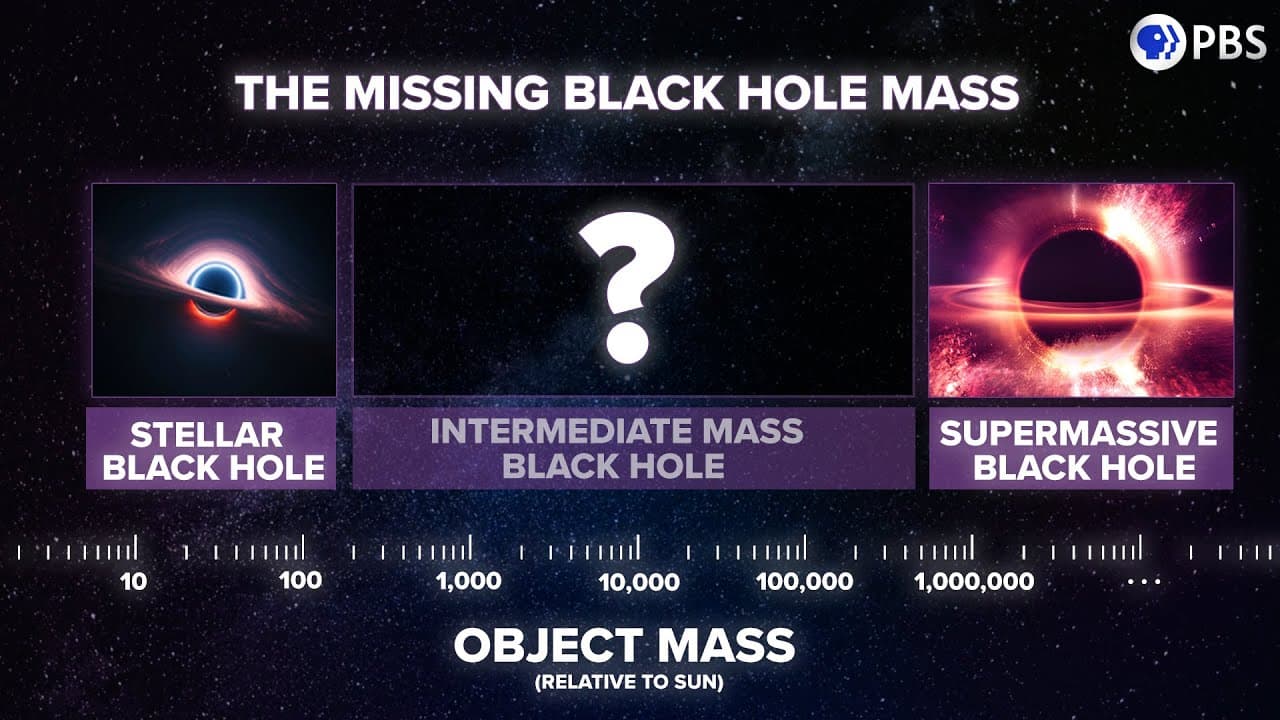
- The discovery challenges the 'small seed' model of black hole formation, suggesting that supermassive black holes may form from 'heavy seeds' in the early universe.
- The 'heavy seed' model posits that dense gas clouds in the early universe could directly collapse into black holes without forming stars first.
- UHZ1 is classified as an OBG (overly-massive black hole galaxy), where the black hole and stellar masses are roughly equal, supporting the heavy seed model.
- The detection of X-rays from UHZ1 indicates the presence of a quasar, highlighting the intense activity around its central black hole.
- Further observations by JWST and other telescopes are expected to uncover more such objects, providing deeper insights into the universe's formative years.
Install to Summarize YouTube Videos and Get Transcripts
Explore YouTube Video Summarizer or Get YouTube Transcript Extractor
Questions & Answers
Q: What is the significance of UHZ1's discovery?
UHZ1's discovery is significant because it represents the most distant quasar ever detected, offering insights into the early universe's conditions. Its presence challenges existing models of black hole formation, particularly the 'small seed' model, and supports the idea that supermassive black holes may form from 'heavy seeds' directly from dense gas clouds in the early universe.
Q: How does UHZ1 challenge the 'small seed' model?
UHZ1 challenges the 'small seed' model by existing at a time when it seems implausible for a black hole to have grown from stellar remnants to its current size. The 'small seed' model suggests black holes grow from smaller stellar black holes, but UHZ1's massive size and early existence imply that it might have formed from a larger initial mass, supporting the 'heavy seed' model.
Q: What role does gravitational lensing play in observing UHZ1?
Gravitational lensing, caused by the Abell 2744 galaxy cluster, plays a crucial role in observing UHZ1 by bending and magnifying the light from this distant galaxy. This effect allows astronomers to see beyond the capabilities of human-made telescopes, enabling the detailed study of UHZ1 and its central supermassive black hole.
Q: What is an OBG and how does it relate to UHZ1?
An OBG, or overly-massive black hole galaxy, is a type of galaxy where the black hole and stellar masses are roughly equal. UHZ1 is classified as an OBG, supporting the 'heavy seed' model of black hole formation. This classification suggests that its central black hole formed directly from dense gas clouds in the early universe, rather than from stellar remnants.
Q: What evidence supports the 'heavy seed' model over the 'small seed' model?
The 'heavy seed' model is supported by the existence of UHZ1, which has a supermassive black hole at a time when it seems unlikely to have grown from smaller stellar black holes. Theoretical calculations suggest that direct collapse of dense gas clouds in the early universe could form black holes of significant mass, bypassing the smaller intermediate stages proposed by the 'small seed' model.
Q: How does the discovery of X-rays from UHZ1 contribute to our understanding?
The discovery of X-rays from UHZ1 indicates the presence of a quasar, which is a sign of intense activity around its central supermassive black hole. This observation helps confirm the existence of an active galactic nucleus, providing further evidence for the 'heavy seed' model and offering insights into the energetic processes occurring in the early universe.
Q: What are the implications of UHZ1's discovery for future astronomical research?
UHZ1's discovery has significant implications for future astronomical research, as it suggests that there may be more such objects waiting to be discovered. As telescopes like JWST and Chandra continue their observations, they are likely to uncover additional distant quasars and black holes, further illuminating the conditions of the early universe and refining our understanding of black hole formation.
Q: What future observations are expected following UHZ1's discovery?
Following UHZ1's discovery, future observations by JWST and other telescopes are expected to focus on identifying more distant quasars and supermassive black holes. These observations will help build a clearer picture of the early universe, providing valuable data to test and refine models of black hole formation and the evolution of galaxies in the universe's formative years.
Summary & Key Takeaways
-
JWST's observation of UHZ1, a distant galaxy with a supermassive black hole, offers insights into the origins of these cosmic giants. UHZ1 challenges the 'small seed' model, suggesting that supermassive black holes may form from dense gas clouds in the early universe.
-
UHZ1's discovery was facilitated by the gravitational lensing effect of the Abell 2744 galaxy cluster, allowing astronomers to observe this quasar and its central black hole. This finding supports the 'heavy seed' model of black hole formation.
-
The classification of UHZ1 as an OBG, where the black hole and stellar masses are similar, aligns with theoretical predictions of direct black hole collapse in the early universe. Further studies by telescopes like JWST are expected to reveal more about these early cosmic phenomena.
Read in Other Languages (beta)
Share This Summary 📚
Summarize YouTube Videos and Get Video Transcripts with 1-Click
Try YouTube Summary with ChatGPT & Claude or YouTube Transcript Generator
Explore More Summaries from PBS Space Time 📚



Summarize YouTube Videos and Get Video Transcripts with 1-Click
Try YouTube Summary with ChatGPT & Claude or YouTube Transcript Generator