How to Use Dynamic DCA for Bitcoin Investment
TL;DR
Dynamic DCA navigates Bitcoin by scaling purchases up as the risk metric falls and selling progressively as it rises, rather than trying to identify the exact market bottom. In the example, a $100 purchase at 0.4–0.5 risk increases to $200 at 0.3–0.4 and $300 at 0.2–0.3. The full framework shows why disciplined action matters more than perfect timing, so read on for the buying and selling rules.
Transcript
Hey everyone and thanks for jumping back into the cryptoverse. Today we're going to talk about Bitcoin and we're going to be discussing something I've talked about six years ago which is dynamic DCA and it is what I use to navigate buying and selling Bitcoin. If you guys like the content, make sure you subscribe to the channel. Give the video a thu... Read More
Key Insights
- Dynamic DCA involves adjusting investment amounts based on market risk levels, increasing investment as risk decreases.
- The key to successful investing is not timing the exact market bottom but capitalizing on low-risk periods.
- Bitcoin risk metrics help identify attractive buying and selling points, though they don't predict exact price movements.
- Investors should avoid overanalyzing and instead focus on trading the trends available in the market.
- The strategy of Dynamic DCA requires patience and discipline, as it may involve holding cash during high-risk periods.
- Historical data shows that Bitcoin spends most time in the 0.3 to 0.4 risk band, making it a crucial range for investment decisions.
- Risk metrics incorporate various factors, including price, on-chain data, and social sentiment, to provide a comprehensive market view.
- Dynamic DCA can significantly enhance investment returns compared to a fixed DCA approach, provided investors can remain patient.
Install to Summarize YouTube Videos and Get Transcripts
Explore YouTube Video Summarizer or Get YouTube Transcript Extractor
Questions & Answers
Q: How do you use Dynamic DCA for Bitcoin investment?
Choose a regular baseline investment, then increase it as Bitcoin’s risk level falls. The example starts with $100 at 0.4–0.5 risk, rises to $200 at 0.3–0.4, and reaches $300 at 0.2–0.3, allowing purchases to grow as market conditions become tougher.
Q: How is Dynamic DCA different from fixed DCA?
Fixed DCA would invest the same amount on each schedule, while Dynamic DCA changes the amount according to Bitcoin’s risk level. The speaker’s example increases a planned $100 investment to $200, $300, $400, or $500 as risk moves progressively lower.
Q: How does the Bitcoin risk metric work in this strategy?
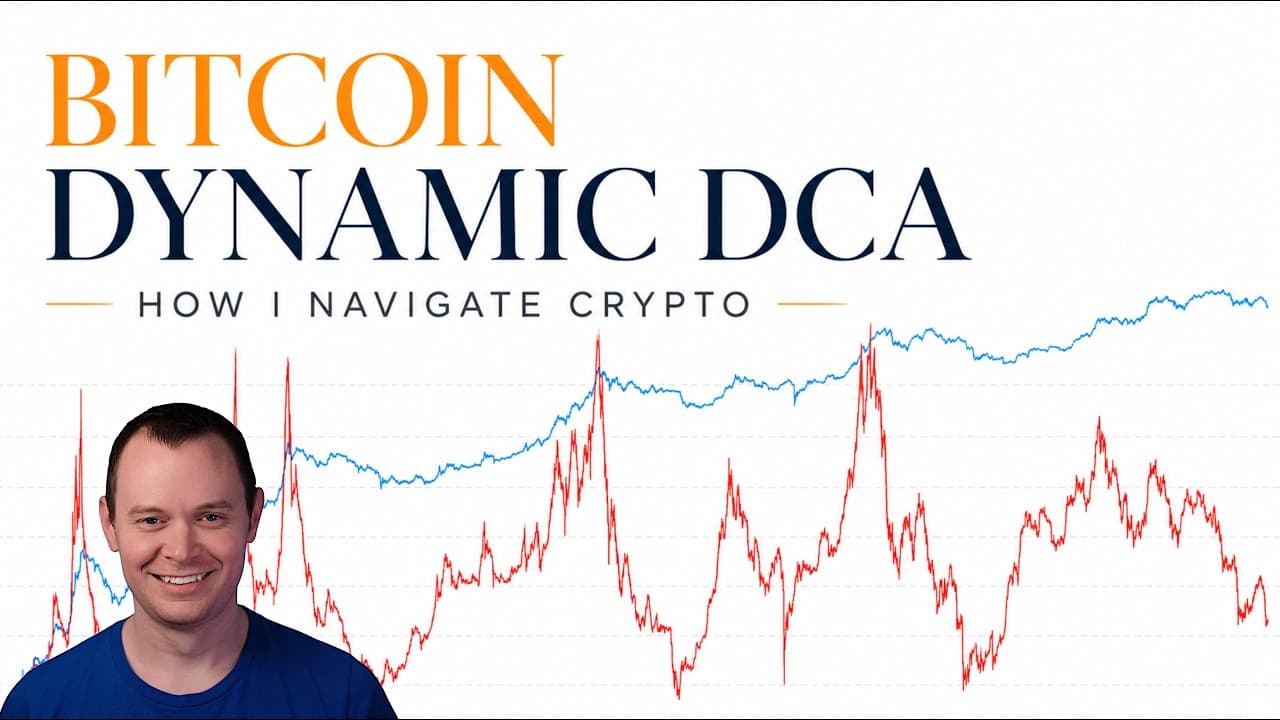
The chart displays Bitcoin’s price as a blue line and risk as an orange line. In the version discussed, risk is based on Bitcoin’s price alone and accounts for diminishing returns from one cycle to another.
Q: What are the Dynamic DCA buying amounts at different risk levels?
The example buys $100 at 0.4–0.5 risk, $200 at 0.3–0.4, and $300 at 0.2–0.3. It then increases the purchase to $400 at the next lower range and $500 if risk falls all the way down.
Q: How does the strategy sell Bitcoin as risk rises?
The speaker describes dividing the entire Bitcoin position into fifteenths. The plan sells 1/15 at 0.5–0.6 risk, 2/15 at 0.6–0.7, 3/15 at 0.7–0.8, 4/15 at 0.8–0.9, and 5/15, or one-third, at 0.9–1 risk.
Q: Do you need to time Bitcoin’s exact bottom with Dynamic DCA?
No. The speaker argues that investors often overanalyze the market and that most money is made in the middle of trends rather than by identifying the precise bottom.
Q: What simpler Bitcoin DCA rule does the speaker suggest?
One simplified strategy is to DCA into Bitcoin whenever its risk falls below 0.2. The speaker presents this as a way to stop overcomplicating buying decisions.
Q: Why do patience and discipline matter in Dynamic DCA?
The method requires investors to preserve buying capacity instead of putting everything into the market at once. In the earlier example, DCA purchases continued for a year or two without requiring perfect bottom timing before the subsequent bull market.
Summary & Key Takeaways
-
Dynamic Dollar-Cost Averaging (DCA) optimizes Bitcoin investments by adjusting amounts based on risk levels. More is invested during low-risk periods, enhancing long-term returns. This method requires patience and discipline, contrasting with traditional DCA, where fixed amounts are invested regularly, regardless of market conditions.
-
Bitcoin risk metrics, which include price, on-chain, and social data, guide Dynamic DCA by highlighting low-risk buying opportunities. This approach helps investors capitalize on market trends without needing to time exact market bottoms, emphasizing the importance of strategic planning over emotional reactions.
-
Dynamic DCA's effectiveness lies in its ability to adapt to market conditions, investing more during downturns and less during upswings. Historical analysis shows that Bitcoin's most lucrative investment periods occur in low-risk bands, underscoring the strategy's potential to outperform traditional investment methods over time.
Read in Other Languages (beta)
Share This Summary 📚
Summarize YouTube Videos and Get Video Transcripts with 1-Click
Try YouTube Summary with ChatGPT & Claude or YouTube Transcript Generator
Explore More Summaries from Benjamin Cowen 📚






Summarize YouTube Videos and Get Video Transcripts with 1-Click
Try YouTube Summary with ChatGPT & Claude or YouTube Transcript Generator