How Could AI Deliver Global Abundance by 2040?
TL;DR
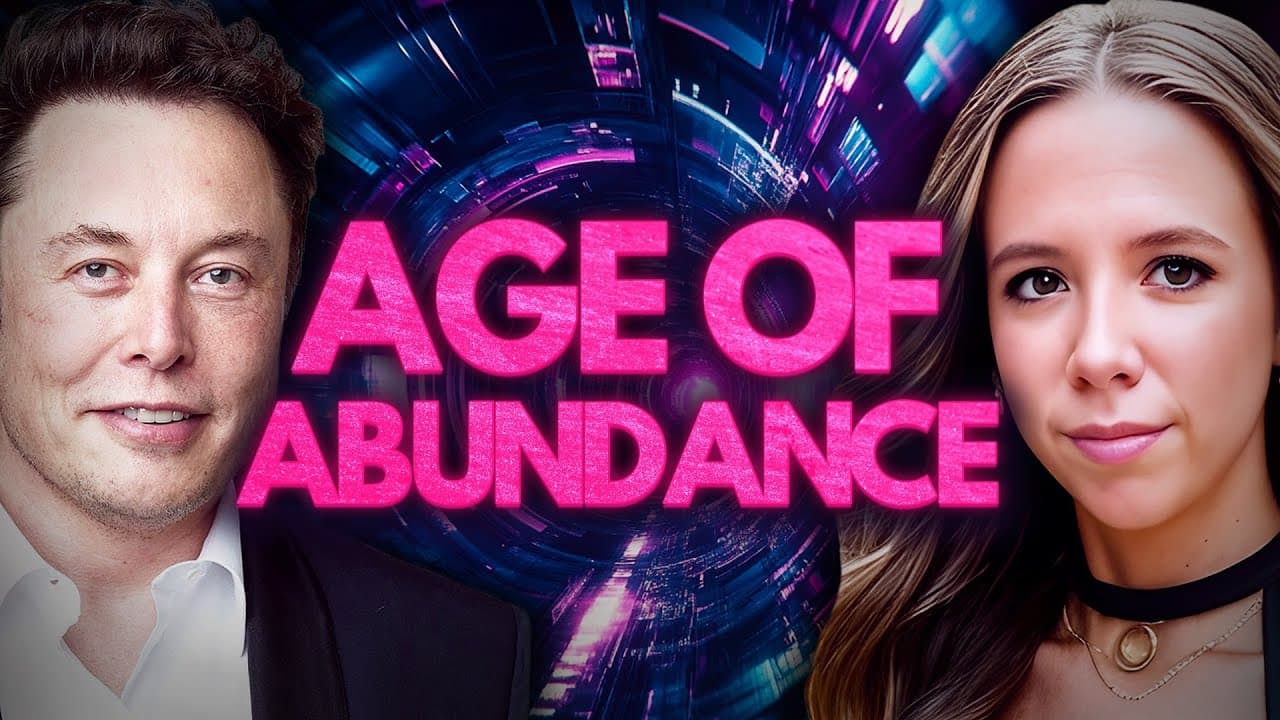
AI could create widespread material abundance by combining intelligence beyond human cognitive performance with billions of robots capable of producing goods and delivering services at very low cost. The optimistic forecast assigns an 80% chance to extreme prosperity, while acknowledging a 20% risk of catastrophic outcomes and emphasizing that wisdom, distribution, purpose, and human choices will shape the result.
Transcript
did you hear what Elon Musk just predicted about our future the genius behind Tesla SpaceX and neuralink believes there's an 80% chance we're heading toward unprecedented abundance through AI he says that by 2030 just a few years away artificial intelligence will surpass human intelligence and within a decade after that humanoid robots could make g... Read More
Key Insights
- AI is predicted to exceed the cognitive ability of the smartest humans within about 10 years, with the milestone also described as arriving by 2029 or 2030. This forecast assumes that the current rate of improvement continues and expands what machines can accomplish intellectually.
- Humanoid robots are expected to number in the billions and perform most physical tasks after AI surpasses human intelligence. Their ability to manufacture products and provide services for very little could make material necessities nearly free and produce a much higher standard of living.
- Autonomous driving is forecast to account for about 50% of miles driven within five years and 90% within 10 years. This projection illustrates how rapidly AI-controlled systems could move from emerging technology to widespread infrastructure across ordinary economic activity.
- Musk's outlook is presented as an 80% probability of extreme prosperity and a 20% probability of catastrophic AI outcomes. The optimistic scenario does not deny danger, but treats broad abundance as substantially more likely than killer robots or an apocalyptic result.
- Technological progress is portrayed as an existing trajectory toward abundance, supported in the presentation by rising global GDP and life expectancy, falling extreme poverty, wider electricity access, and a 99% decline in solar energy costs since 1977.
- Biblical abundance is described as a pattern beginning with the Garden of Eden and the command to be fruitful and multiply. Jesus feeding 5,000 people from five loaves and two fish is used as another example of abundance emerging from apparent scarcity.
- AI-enabled abundance is expected to affect energy, food, education, healthcare, and housing. The proposed mechanisms include optimized renewable systems, precision agriculture, personalized learning, assisted diagnosis and treatment, and structures designed by AI and constructed by robots.
- Meaning is expected to become a central challenge when material goods and services are readily available. The presentation argues that creativity, compassion, wisdom, spiritual insight, purposeful work, love, and connection will remain distinctly valuable even as AI handles more information processing and production.
Install to Summarize YouTube Videos and Get Transcripts
Explore YouTube Video Summarizer or Get YouTube Transcript Extractor
Questions & Answers
Q: How could AI make goods and services nearly free?
AI could make goods and services nearly free by directing tens of billions of robots that manufacture products and perform requested services for very little. If AI handles cognitive work better than humans and robots perform most physical tasks, production capacity could expand dramatically. The forecast expects this productivity to raise living standards rather than leave people without necessary goods or services.
Q: When could AI become smarter than the smartest human?
The forecast says AI could become smarter than the smartest human within about 10 years, while the presentation also identifies 2029 or 2030 as the expected milestone. The prediction is based on the current rate of improvement continuing. Within the following decade, humanoid robots could perform most physical tasks and help make goods and services nearly free.
Q: What does the 80% AI abundance prediction mean?
The 80% prediction means Musk sees extreme prosperity for everyone as the more likely result of advanced AI. The remaining 20% represents the possibility of catastrophic outcomes, including killer robots harming humanity. The presentation treats the forecast as a choice between risk and abundance, with human wisdom, intentions, distribution decisions, and technological governance influencing which future develops.
Q: How does AI abundance relate to biblical teaching?
The presentation interprets abundance as part of a biblical pattern that begins with the Garden of Eden and the command to be fruitful and multiply. It also cites Jesus feeding 5,000 people with five loaves and two fish. From this perspective, AI extends humanity's creative abilities and could help restore conditions where scarcity no longer organizes society.
Q: What evidence is offered for an existing abundance trend?
The presentation says global GDP increased 100-fold over 200 years, life expectancy more than doubled in most countries within a century, and extreme poverty fell from 42% to below 10% in four decades. It also says electricity access reached nearly 90% of the global population and solar energy costs declined 99% since 1977.
Q: Which sectors could benefit from AI-enabled abundance?
AI-enabled abundance could reach energy, food, education, healthcare, and housing. The presentation envisions renewable energy systems optimized by AI, precision agriculture managed by AI, personalized learning, assisted medical diagnosis and treatment, and housing designed by AI and built by robots. These applications are presented as emerging ways to remove artificial scarcity from essential goods and services.
Q: What risks could prevent AI from creating shared abundance?
Fear could produce restrictive systems that limit AI's potential, while greed could concentrate its benefits instead of distributing them. The presentation argues that free human choices can direct technology toward scarcity or abundance. It therefore treats wisdom and spiritual discernment as essential for managing the acknowledged 20% catastrophic risk and guiding AI toward broadly shared prosperity.
Q: How should people prepare for an age of AI abundance?
People should cultivate an abundance mindset, strengthen creativity, compassion, wisdom, and spiritual insight, and seek purposeful work aligned with divine intention. They should also approach AI as a collaborative tool that extends human creativity rather than merely as a competitor. The presentation emphasizes that material abundance cannot replace the deeper wealth found in love, meaning, purpose, and connection.
Summary & Key Takeaways
-
Elon Musk predicts that AI could surpass human intelligence by 2029 or 2030, followed by billions of humanoid robots performing physical tasks. Their productivity could make goods and services nearly free, raise living standards, and shift humanity's central challenge from meeting material needs to finding fulfillment and meaning.
-
The presentation connects AI-enabled prosperity with a biblical interpretation of abundance. Genesis, the multiplication of loaves and fish, and humanity's role as a creative partner are presented as evidence that productive expansion reflects divine design. AI is therefore framed as a tool for reducing artificial scarcity rather than replacing that design.
-
The forecast includes serious risk because human choices could direct AI toward fear, restriction, greed, or concentrated benefits. The recommended response combines an abundance mindset, spiritual discernment, purposeful work, human creativity, compassion, wisdom, and collaboration with technology. Material prosperity remains secondary to love, meaning, purpose, and connection.
Read in Other Languages (beta)
Share This Summary 📚
Summarize YouTube Videos and Get Video Transcripts with 1-Click
Try YouTube Summary with ChatGPT & Claude or YouTube Transcript Generator
Explore More Summaries from Julia McCoy 📚




Summarize YouTube Videos and Get Video Transcripts with 1-Click
Try YouTube Summary with ChatGPT & Claude or YouTube Transcript Generator