How to Turn $1,000 Into a Scalable Business
TL;DR
Two paths exist to make money fast with no capital: go work for the best entrepreneur you can find and learn their playbook, or start something yourself, which is higher risk but higher reward. Entrepreneurship at its base is a kid offering to mow lawns for money, a full cycle of advertising, selling, and delivery. Everything after that is added leverage.
Transcript
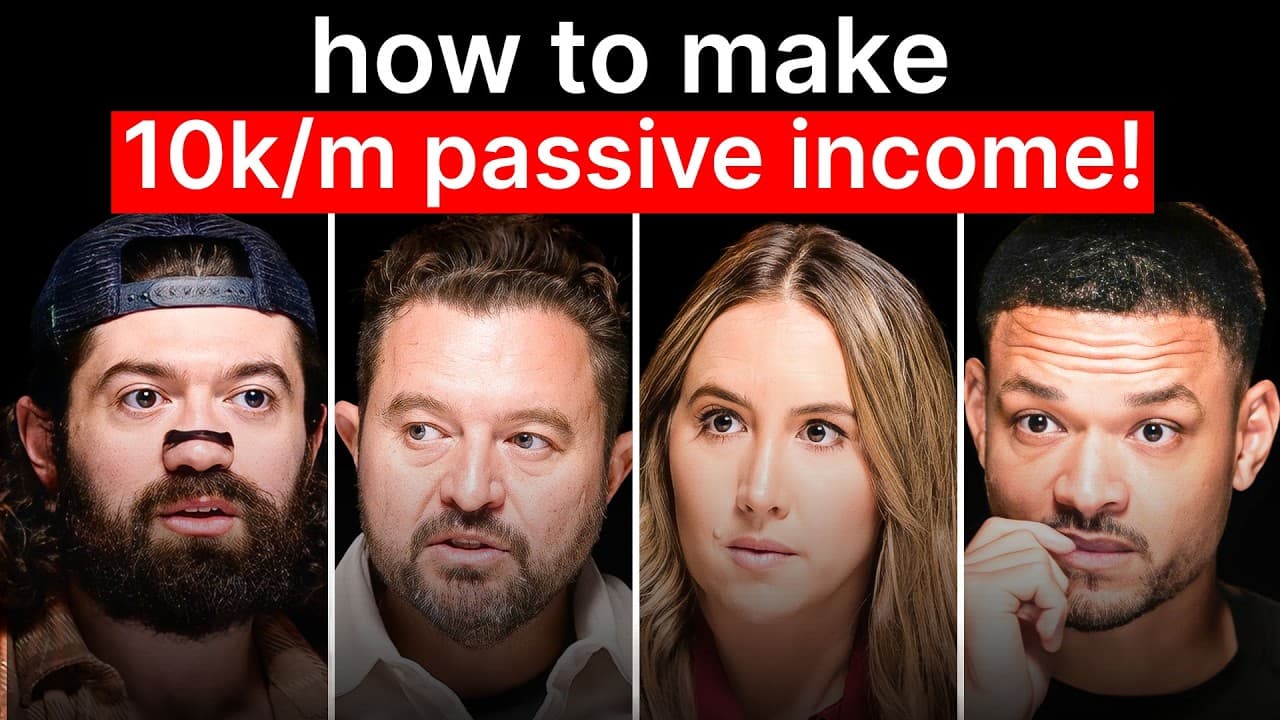
I've got three boxes here. One of them contains $1,000. One of them contains $10,000. And one of them contains $100,000. And you three are the avengers of entrepreneurship on the internet. So, you're going to tell me what you would do with that amount of money to build a scalable business. So, do I get to give the money? Is that how this works? Oka... Read More
Key Insights
- There are two paths to making money quickly when you have none: find the best entrepreneur you can and go work for them to learn as much as possible, or take the higher-risk, higher-reward route of doing it yourself from the start.
- Your first business teaches you the game of business more than it teaches you the specific business you are running, so the transferable lessons matter more than the venture's outcome.
- Entrepreneurship at its most basic level is a kid knocking on doors offering to mow lawns, rake leaves, or babysit in exchange for money. If you can get a job, you can be a self-employed entrepreneur.
- Every function of a business already exists in that door-knocking example: advertising by knocking, a presentation in exchange for money, delivery of the service, and eventually a review that starts creating leverage.
- Alex frames the rest of entrepreneurship as a lifelong question of how much leverage can be applied across all pieces of the business, since small operations do every function simultaneously at very low leverage.
- Cody argues entrepreneurship comes down to three things: how much pain you can tolerate, how consistently you tolerate it, and whether you can learn from that pain to decrease it over time.
- Waiting 8 seconds after asking someone to buy closes 30% more sales, one of several specific behavioral tactics the panel cites for improving conversion.
- Views do not equal influence. Creators with 50 plus million followers have had failed launches because they built audience without building the influence needed to convert it.
Install to Summarize YouTube Videos and Get Transcripts
Explore YouTube Video Summarizer or Get YouTube Transcript Extractor
Questions & Answers
Q: How do you make money quickly if you have none?
The panel describes two paths. The first is to find the best entrepreneur you can and go work for them, learning as much as possible from inside their operation. The example given is Kim Kardashian working as Paris Hilton's assistant, learning the playbook for being famous, then taking it to a new level. The second path is high risk but highest reward: go do it yourself. With the second, expect that your first business teaches you the game of business even more than it teaches you the particular business you are running.
Q: Can anyone become an entrepreneur?
Alex argues yes at the baseline level. If a kid can go around the neighborhood offering to mow lawns, rake leaves, or babysit in exchange for money, that is fundamentally entrepreneurship. His test is simple: if you can get a job, you can be a self-employed entrepreneur. Beyond that baseline it becomes a lifelong journey of learning the game and applying more leverage across every function of the business. Daniel adds that the wage-paying job is a recent innovation dating to around the 1850s, and that before then people were paid per task, so entrepreneurial behavior is built into us.
Q: What does entrepreneurship look like at its most basic level?
Alex breaks down the babysitting example into a complete cycle of exchange. There is advertising: you went up and knocked on a door. There is a presentation or pitch given in exchange for money, and they agree, which is the selling component. Then there is delivery: you show up with your human body, take care of another human body, make sure they do not die, and maybe clean the house as a value add. Finally they might leave a review, and once you have a website that review starts to create leverage. Every function of a real business is present, just done simultaneously and at very low leverage.
Q: Why is pain tolerance central to being an entrepreneur?
Cody says entrepreneurship is largely a byproduct of three things: how much pain you can tolerate, how consistently you can tolerate it, and whether you can take that consistent pain and find a way to decrease it, which means learning from what you have gone through. The path is hard because there is nobody else to blame and a scoreboard constantly behind you. With a job you can point to a boss or someone else's decisions. As the entrepreneur in charge, there is no one else. She compares it to the gym: nobody expects a workout to feel great, yet tearing muscle to rebuild is what getting fit requires.
Q: What is the difference between acute pain and low-grade pain in business?
Cody distinguishes two types. Acute pain is felt in the moment, deeply and intensely. In entrepreneurship that often looks like completely running out of money, with nobody else going to fix the problem because you are the last one on the line. Low-grade pain is consistent over time: having to work harder, and knowing that every single Friday there is a paycheck you have to hand to somebody else. Her view is that in entrepreneurship you should assume some version of low-grade pain is always present. She notes she had pain working in a call center and has pain now.
Q: How do you know which pain is worth tolerating?
The host raises this directly, noting that some pain is simply not worth it. Cody's answer is that it comes back to the third level, being on a journey to decrease the pain, which is what learning means. You touch the stove once, realize it burns, and do not touch it again. If you keep touching the stove over time, you have not learned. Daniel adds the alignment test: when you have an origin story, a mission and a vision, and you feel alignment between your past, present and future and are excited about the future the work builds toward, the pain becomes meaningful. What you are looking for is pain in alignment with origin, mission and vision.
Q: Why is a job considered a recent invention?
Daniel argues that taking a long view of history, the idea of a job is a very recent innovation. Jobs, specifically the idea of a wage, only came into existence around the 1850s. Before that, people got paid for tasks: you completed a task and you got paid, and this held across all sorts of levels of society. That arrangement gave rise to very entrepreneurial classes of people, and he says you had to be quite entrepreneurial prior to the 1800s. His conclusion is that entrepreneurial capability is definitely built into us rather than being a rare trait.
Q: What is the difference between having views and having influence?
The panel draws a sharp line between the two. Content is described as brand new to a lot of people, and many creators online do not think about how to monetize on top of what they have built. The specific example given is that there are TikTokers with 50 plus million followers who have had failed launches, because they have views but zero influence. Influence is presented as something separate that must be constructed, and the panel says there are four things required to create it. The practical implication is that audience size alone does not predict whether a launch will convert.
Summary & Key Takeaways
-
The premise is three boxes containing $1,000, $10,000 and $100,000, with three entrepreneurs asked how they would deploy each amount to build a scalable business. Alex Hormozi, Codie Sanchez and Daniel Priestley each bring different business models and perspectives, which is why the host frames the conversation as a master class in creating and scaling.
-
On whether anyone can be an entrepreneur, Alex starts from the simplest case: a kid offering to rake leaves or babysit for money is already doing entrepreneurship. Advertising, selling, delivery and reviews all exist there, just performed simultaneously at low leverage. If you are capable of holding a job, you are capable of being self-employed.
-
Cody's answer centers on pain tolerance, consistency, and learning to reduce pain over time. She distinguishes acute pain, such as completely running out of money with nobody else to fix it, from low-grade pain like working harder and making payroll every Friday. She compares it to the gym, where tearing muscle is the price of getting fit.
-
Daniel points out that the job, as a wage-paying arrangement, only arrived around the 1850s. Before that people were paid per task across all levels of society, which produced entrepreneurial classes. He argues entrepreneurship is built into humans and describes three levels of brain function: survival, status quo, and a higher visionary mind interested in exchange, empathy, strategy and adding value.
-
The episode also previews concrete frameworks: raising money, pitching, a method claimed to increase sales by 20 to 40%, and the moat strategy for judging whether a business will actually make money. Content is treated as its own lever, with the distinction drawn between having views and having influence, which the panel breaks into four components.
Read in Other Languages (beta)
Share This Summary 📚
Summarize YouTube Videos and Get Video Transcripts with 1-Click
Try YouTube Summary with ChatGPT & Claude or YouTube Transcript Generator
Explore More Summaries from The Diary Of A CEO 📚




Summarize YouTube Videos and Get Video Transcripts with 1-Click
Try YouTube Summary with ChatGPT & Claude or YouTube Transcript Generator