How Can Humanity Become a Kardashev Type 1 Civilization?
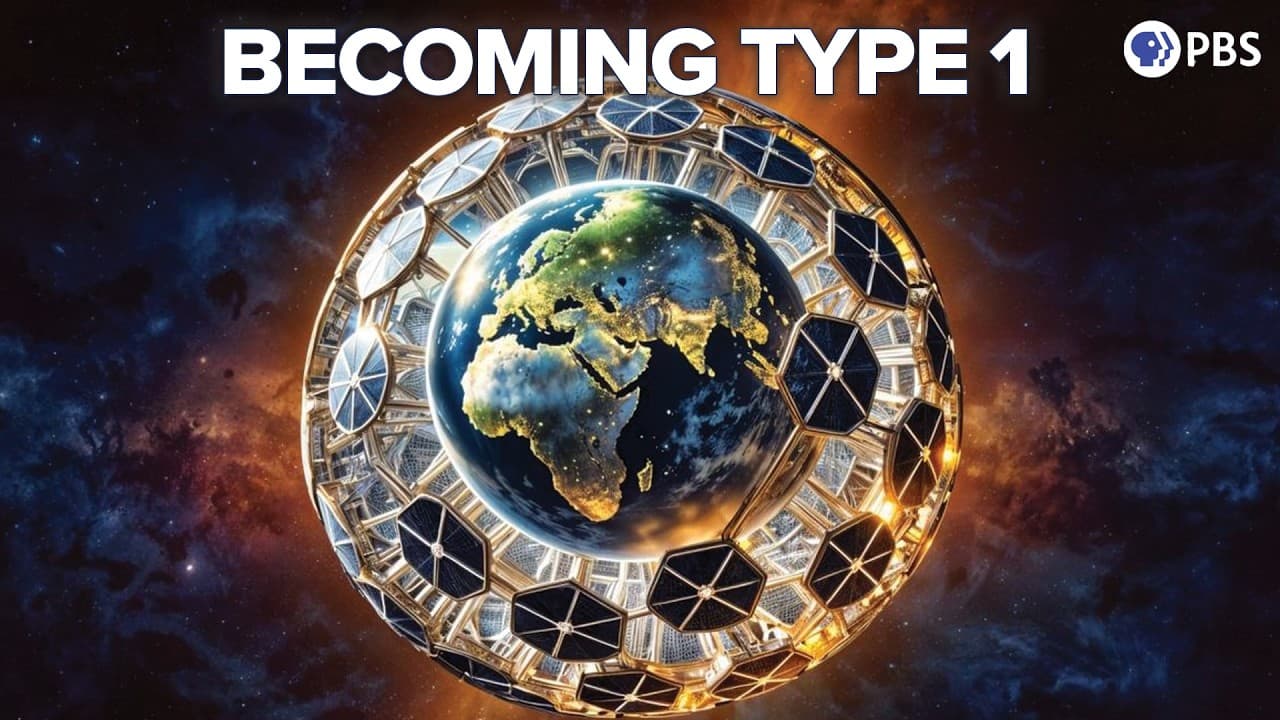
TL;DR
Exploring humanity's journey to a Type-1 civilization.
Transcript
Thank you to Anydesk for supporting PBS Imagine a world where humanity masters every planetary resource available to it—our first step on the famous Kardeshev scale of technological advancement. How distant is that step? Will we even become a true Type-1 civilization, and how can we get there? In 1964 Soviet physicist Nikolai Kardashev propose... Read More
Key Insights
- The Kardashev scale measures civilization's technological advancement based on energy consumption, with Type-1 harnessing planetary energy.
- Humanity currently operates at a Type 0 level, using only a fraction of the energy needed for Type 1 status.
- Achieving Type-1 status requires mastering solar energy, potentially through advanced solar cells and space-based solar arrays.
- Artificial fusion could provide a sustainable energy source, with deuterium and tritium as key fuels for fusion reactors.
- Commercial fusion remains a challenge, but projects like ITER aim to make it viable within decades.
- A global supergrid using high-temperature superconductors is essential for efficient energy distribution in a Type-1 civilization.
- Abundant energy could solve many global issues, enabling large-scale projects like climate control and resource manufacturing.
- The transition to a Type-1 civilization sets the stage for future advancements to Type 2, harnessing stellar energy.
Install to Summarize YouTube Videos and Get Transcripts
Explore YouTube Video Summarizer or Get YouTube Transcript Extractor
Questions & Answers
Q: What is the Kardashev scale and how does it categorize civilizations?
The Kardashev scale, proposed by Soviet physicist Nikolai Kardashev in 1964, categorizes civilizations based on their energy consumption capabilities. It consists of three types: Type 1, which harnesses planetary energy; Type 2, which accesses the energy of an entire star; and Type 3, which utilizes energy on a galactic scale. The scale helps measure technological advancement and potential capabilities of civilizations.
Q: Why is humanity currently considered a Type 0 civilization?
Humanity is considered a Type 0 civilization because we currently use only a fraction of the energy required for Type 1 status. A Type 1 civilization would have control over all available planetary energy resources, which is approximately 10,000 times more than what we currently utilize. Our current energy consumption and technological capabilities fall short of this threshold.
Q: How can solar energy contribute to achieving Type-1 status?
Solar energy is a key component in achieving Type-1 status due to its vast availability and renewability. By improving solar cell efficiency and deploying space-based solar arrays, we can significantly increase energy capture. Space-based solar power offers advantages like continuous energy collection without atmospheric losses, making it a promising path to meet the energy demands of a Type-1 civilization.
Q: What role does fusion energy play in the transition to a Type-1 civilization?
Fusion energy, particularly through the use of deuterium and tritium, offers a sustainable and powerful energy source for achieving Type-1 status. Fusion releases significantly more energy than current fission processes and could meet the high energy demands of a Type-1 civilization. However, commercial fusion remains challenging, with projects like ITER working to overcome technical hurdles and make it viable within the coming decades.
Q: What are the challenges in developing a global supergrid for energy distribution?
Developing a global supergrid involves overcoming challenges like efficient energy transmission and storage. High-temperature superconductors could enable lossless energy distribution, but they require cooling and durable infrastructure. Current efforts focus on improving superconducting materials and creating robust systems to handle the high current densities needed for a planetary-scale energy network, essential for a Type-1 civilization.
Q: How could abundant energy from a Type-1 civilization solve global problems?
Abundant energy from a Type-1 civilization could address numerous global issues by enabling large-scale solutions. It could power climate control initiatives, resource manufacturing, and advanced technologies. Energy abundance would reduce scarcity, potentially alleviating conflicts and fostering global cooperation. It would also support ambitious projects like terraforming other planets, paving the way for future advancements in civilization.
Q: What future advancements are possible after achieving Type-1 status?
After achieving Type-1 status, future advancements include transitioning to Type 2, which involves harnessing the energy of an entire star. This could lead to constructing Dyson spheres or similar structures. A Type-2 civilization would have the capability to undertake massive projects like interstellar travel, advanced AI development, and further exploration and colonization of the galaxy, expanding humanity's reach and influence.
Q: What is the significance of the Kardashev scale in understanding technological advancement?
The Kardashev scale provides a framework for understanding and measuring the technological advancement of civilizations based on their energy consumption capabilities. It highlights the potential growth paths and achievements of civilizations as they progress from planetary to stellar and galactic energy control. The scale inspires scientific and speculative exploration of future possibilities and the challenges humanity may face in its technological evolution.
Summary & Key Takeaways
-
The Kardashev scale, proposed by Nikolai Kardashev, categorizes civilizations based on their energy usage, with Type-1 having planetary-scale energy control. Humanity is currently at Type 0, using a fraction of the energy needed for Type 1. Transitioning to Type 1 involves mastering renewable energy sources, particularly solar and fusion energy.
-
Solar energy, especially through space-based arrays, offers a viable path to Type-1 status. Advanced solar cells could increase efficiency, while space-based solar power avoids atmospheric losses. Fusion energy, using deuterium and tritium, could also meet energy demands, though commercial viability is still decades away.
-
Achieving Type-1 status requires a global supergrid for energy distribution, potentially using high-temperature superconductors. Abundant energy would enable solutions to global challenges, such as climate change and resource scarcity, and lay the groundwork for future advancements to Type 2, harnessing stellar energy.
Read in Other Languages (beta)
Share This Summary 📚
Summarize YouTube Videos and Get Video Transcripts with 1-Click
Try YouTube Summary with ChatGPT & Claude or YouTube Transcript Generator
Explore More Summaries from PBS Space Time 📚



Summarize YouTube Videos and Get Video Transcripts with 1-Click
Try YouTube Summary with ChatGPT & Claude or YouTube Transcript Generator