Google’s New AI Learns Table Tennis! 🏓
TL;DR
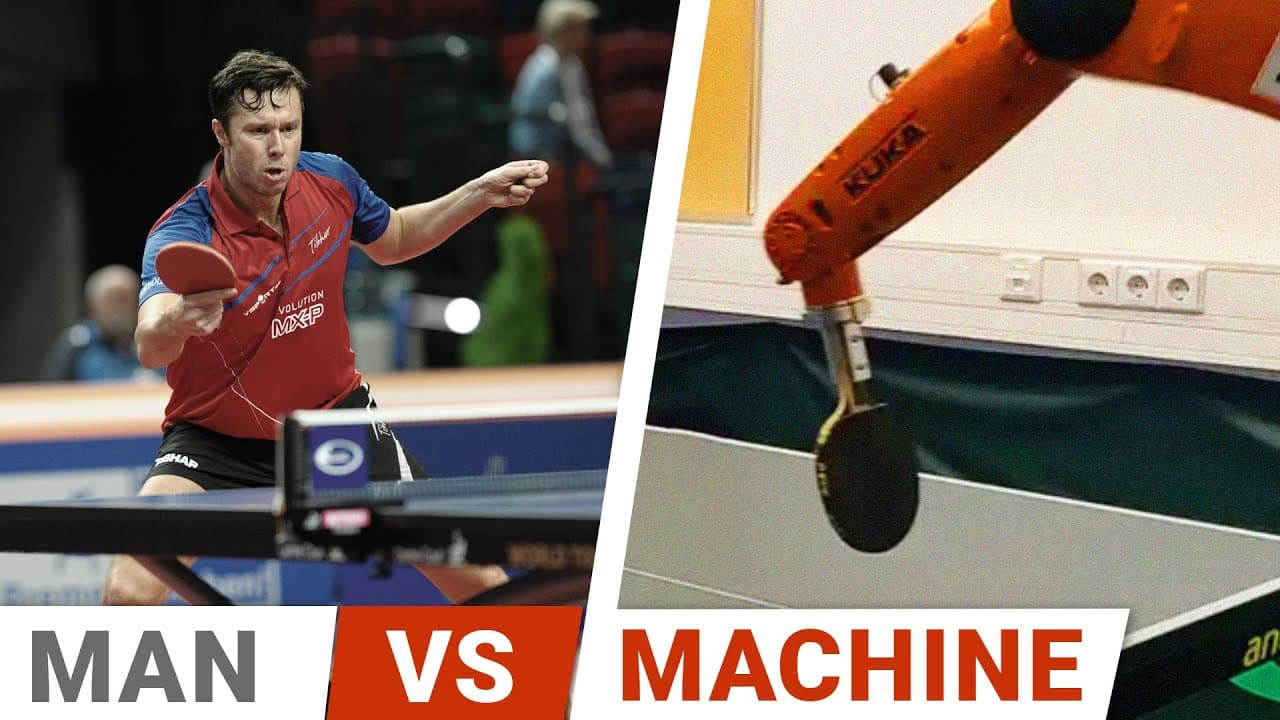
Table tennis robot learns to play by observing human data and training in a computer simulation, achieving impressive ball returns.
Transcript
dear fellow Scholars this is two minute papers with Dr Carol jonai fahir do you see this new table tennis robot it barely played any games in the real world yet it can return the ball more than a hundred times without failing wow so how is this even possible well this is a seem to real paper which means that first the robot starts learning in the s... Read More
Key Insights
- 🎠 OpenAI and Tesla also use simulations to train robots and self-driving cars.
- 🦺 Simulations provide a safe environment for training where anything is possible.
- 🤖 The seem to real concept has been successful in improving the performance of the table tennis robot.
- 🤖 The robot is able to learn from its mistakes and adjust its gameplay accordingly.
- ❓ General knowledge can be obtained from a limited amount of human data.
- 🏑 The seem to real concept has the potential for applications in various other fields.
- 👨🔬 Lambda Labs provides inexpensive GPU Cloud compute solutions for AI research.
Install to Summarize YouTube Videos and Get Transcripts
Explore YouTube Video Summarizer or Get YouTube Transcript Extractor
Questions & Answers
Q: How does the table tennis robot learn to play without real-world experience?
The robot starts by observing human data, building a model of how humans play. It then trains in a computer simulation, playing against the human data repeatedly to improve its skills.
Q: How does the robot transfer its knowledge from the computer simulation to the real world?
The robot takes the knowledge gained from the computer simulation and applies it to the real robot. This allows the robot to perform better in the real world and learn from its mistakes.
Q: Can the robot play against different players of varying skill levels?
Yes, the robot can play with different players. It learns general knowledge from a limited amount of human data, allowing it to adapt and play well with players of different skill levels.
Q: How does the robot continue to improve its skills?
The robot receives feedback from its performance in the real world and feeds that knowledge back into the computer simulation. This iterative process helps the simulation become more similar to the real world, leading to continuous improvement.
Summary & Key Takeaways
-
An AI table tennis robot is able to return the ball over a hundred times without failing, despite limited real-world experience.
-
The robot learns by observing human data and builds a model of how humans play.
-
It transfers its knowledge from the computer simulation to the real world and continues to improve through feedback loops.
Read in Other Languages (beta)
Share This Summary 📚
Summarize YouTube Videos and Get Video Transcripts with 1-Click
Try YouTube Summary with ChatGPT & Claude or YouTube Transcript Generator
Explore More Summaries from Two Minute Papers 📚



Summarize YouTube Videos and Get Video Transcripts with 1-Click
Try YouTube Summary with ChatGPT & Claude or YouTube Transcript Generator