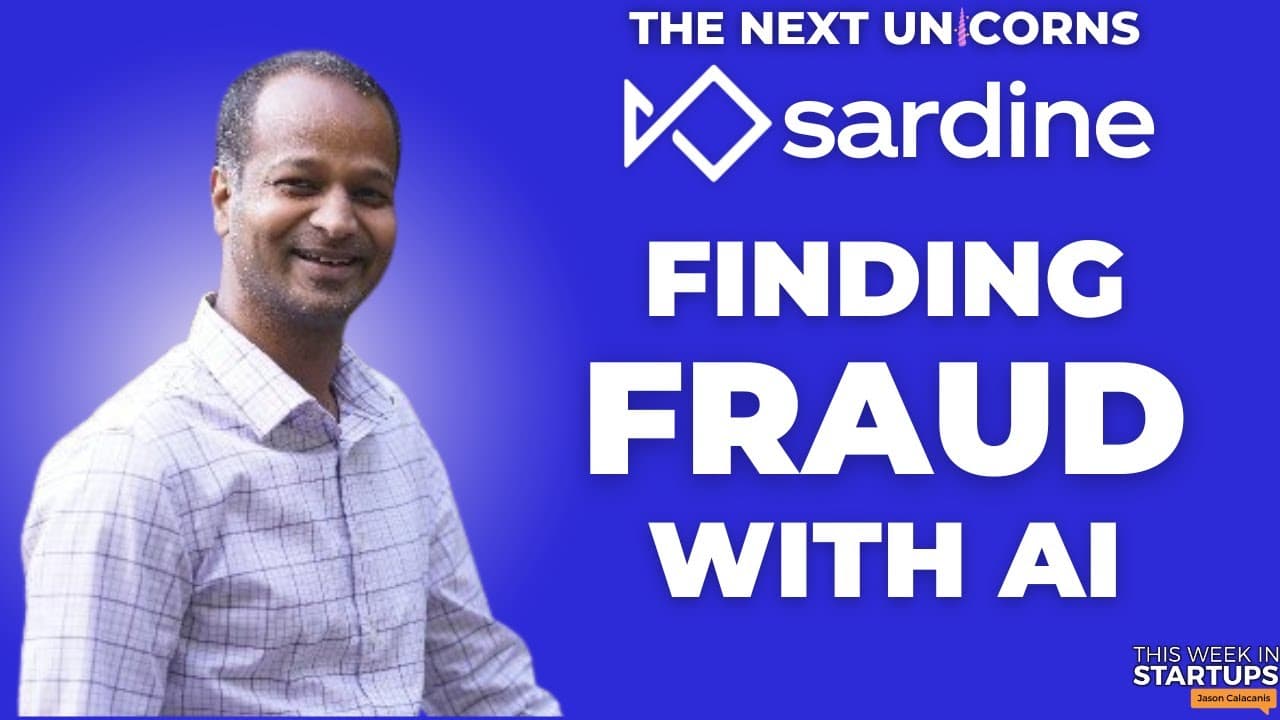
Next Unicorns: Preventing future fraud using AI with Sardine CEO Soups Ranjan | E1802
TL;DR
Sardine, a fraud detection company, uses intrinsic AI to battle against increasingly sophisticated fraudsters who are leveraging extrinsic AI. They offer behavior biometrics to identify fraudulent activities and protect customers from scams.
Transcript
so fraudsters you know uh as they use AI we are using AI as well so we think that the future of uh identity verification online is actually a battle of bots extrinsic AI versus intrinsic this week in startups is brought to you by link squares life for in-house legal just got a whole lot easier from contract creation to execution and more link squar... Read More
Key Insights
- 🌀 Generative AI poses a significant threat as fraudsters can clone voices and create realistic scams.
- 🐎 Behavior biometrics, such as typing speed and phone grip, can be valuable indicators to identify fraudulent activities.
- 🎓 Fraud prevention should extend beyond the financial sector, with industries like education and government also prioritizing effective fraud detection.
- ❓ The battle against fraud requires constant vigilance and the ability to anticipate the tactics used by fraudsters.
- 😪 Red-teaming and continuous testing are crucial to improving fraud prevention techniques.
- 💌 The lack of sender verification in telephony and email infrastructure is a weakness that fraudsters exploit.
- 🎯 Fraudsters often target vulnerable demographics, such as the elderly or non-technical individuals.
Install to Summarize YouTube Videos and Get Transcripts
Explore YouTube Video Summarizer or Get YouTube Transcript Extractor
Questions & Answers
Q: How does Sardine's algorithm work to detect fraud?
Sardine's algorithm utilizes behavior biometrics, analyzing factors like typing speed, phone grip, and other intrinsic features that help identify fraudulent activities. This allows them to detect unauthorized access and protect customers from scams.
Q: What are some common types of fraud that Sardine helps prevent?
Sardine helps prevent various types of fraud, including synthetic identity fraud, money mule scams, credit card theft, and social engineering scams targeting individuals through emails and text messages.
Q: What role does AI play in fighting fraud?
AI is used by both fraudsters and fraud detection companies like Sardine. Fraudsters use AI to clone voices, create realistic scams, and devise advanced phishing techniques. On the other hand, Sardine uses AI to develop behavior biometrics and train their algorithms to detect fraudulent activities.
Q: How does Sardine's solution help organizations beyond the financial sector?
Sardine's fraud detection solutions are applicable to various industries beyond finance, including education, local governments, and federal agencies. By integrating their software into the existing infrastructure, organizations can identify and prevent fraud attempts.
Summary
In this video, the host discusses the future of identity verification and the battle against fraud with the co-founder and CEO of Sardine. They explore various types of fraud, including synthetic identity fraud, money mules, credit card theft, and scams. The co-founder explains how Sardine's algorithm helps customers detect and prevent fraud before it happens. They also discuss the role of AI in fraud prevention, including the use of behavior biometrics and the battle between extrinsic and intrinsic AI. The co-founder highlights the need to stay ahead of fraudsters and the potential risks associated with generative AI.
Questions & Answers
Q: What is the big downside to AI?
The co-founder believes that the big downside to AI is the increase in financial fraud. With AI becoming more sophisticated, hackers and fraudsters can use AI to refine their tactics and target users more effectively. This can lead to an increase in phishing, scams, and misinformation.
Q: How does Sardine help customers detect fraud?
Sardine's algorithm detects and prevents fraud by analyzing various signals and behaviors. They offer a behavior biometrics product that can detect if someone else is controlling a user's screen or typing on their behalf. They also provide active phone call detection and the ability to detect suspicious activities during bank transactions.
Q: What are the different categories of fraud?
The co-founder categorizes fraud into synthetic identity fraud, money mules, credit card theft, and scams. Synthetic identity fraud involves creating fake identities using stolen social security numbers. Money mules are individuals who are recruited to open accounts and perform tasks for fraudsters. Credit card theft involves obtaining stolen card numbers and using them for fraudulent transactions. Scams encompass various types of social engineering tactics, such as impersonating banks, IRS, or well-known personalities like Elon Musk, to trick victims into sending money or providing sensitive information.
Q: Where are the actors behind financial fraud based?
The co-founder mentions that actors behind financial fraud come from various regions. The examples cited include scammers based in Southeast Asia, where they run scams like the "Pig butchering" scam that targets victims in other countries. Additionally, fraud can be perpetrated globally, as scammers can impersonate anyone using AI-generated content.
Q: What are the attack vectors for financial fraud?
The co-founder outlines several attack vectors for financial fraud. These include the use of synthetic identities, recruiting money mules, credit card theft, and various scams involving social engineering and impersonation. The scams can range from classic phishing scams to sophisticated schemes that involve remote access tools and manipulations of victims' screens.
Q: How does Sardine's AI system work?
Sardine provides an SDK that is embedded in the customer's platform, such as web or mobile applications. This SDK captures various behavior biometrics of users, such as typing speed, screen control, and phone call interaction. Sardine's AI system analyzes these behaviors in real-time to detect potential fraud or suspicious activities. The system can also be customized with additional rules and machine learning models to adapt to evolving fraud patterns.
Q: How does the intrinsic AI of Sardine complement extrinsic AI?
The co-founder explains that while fraudsters can use extrinsic AI (AI trained on publicly available information) to mimic identities and deceive users, intrinsic AI (AI trained on unique features about individuals) can counteract these attacks. Intrinsic AI analyzes behaviors and characteristics specific to a user, such as typing speed and phone holding style, to verify identity and detect fraud. The combination of extrinsic and intrinsic AI creates a battle of bots in the future of identity verification.
Q: What are the warning signs and future threats in AI hacking and fraud?
The co-founder mentions the threats posed by generative AI and voice cloning. Hackers can use generative AI to create realistic voice and video content to impersonate individuals. This can lead to sophisticated scams and fraudulent activities, such as giving false instructions, convincing victims to send money, or even ransom demands. The co-founder emphasizes the need to stay ahead of fraudsters and continually enhance fraud prevention strategies.
Q: Do you work with other industries outside of finance to prevent fraud?
Yes, the co-founder mentions that Sardine works with various industries beyond finance, including education, local governments, and three-letter federal agencies. As money movement becomes embedded in different sectors, fraud prevention becomes critical to protect against scams and unauthorized activities. Sardine's solutions can be customized to address the specific fraud risks in these industries.
Q: How does Sardine utilize machine learning in fraud detection?
Sardine leverages machine learning to detect and prevent fraud. They use machine learning models to analyze patterns and behaviors associated with fraud. Additionally, they provide a rule editor that allows fraud and compliance professionals to create new rules on the fly. By combining machine learning and rule-based approaches, Sardine can catch a wide range of fraud and scams in real-time.
Q: How does Sardine handle future threats and the rapidly evolving landscape of fraud?
Sardine understands the importance of staying ahead of fraudsters and proactively addressing new threats. They have an internal team that simulates attacks and constantly tests new technologies to identify vulnerabilities. By having a team of experts who have been fighting fraud for years, Sardine ensures that they are on top of the evolving landscape and can provide effective solutions to their customers.
Takeaways
The future of identity verification and fraud prevention is a battle between extrinsic AI and intrinsic AI. Fraudsters are using AI to refine their tactics, but companies like Sardine are utilizing AI to detect fraud in real-time. Synthetic identity fraud, money mules, credit card theft, and scams are common categories of financial fraud. Sardine's behavior biometrics and AI algorithms help customers detect fraud before it occurs. With the rise of generative AI, there are potential risks of voice and video cloning, leading to more sophisticated scams. It is crucial to continually enhance fraud prevention strategies and stay ahead of fraudsters in the rapidly evolving landscape of fraud.
Summary & Key Takeaways
-
Sardine is a company focused on identifying and stopping fraud before it happens, using their algorithm and behavior biometrics.
-
They offer fraud detection solutions for various industries, including banking, neo-banks, gift card exchanges, and more.
-
The rise of generative AI poses a significant threat, as fraudsters can clone voices, videos, and even create realistic scams targeting individuals.
Read in Other Languages (beta)
Share This Summary 📚
Summarize YouTube Videos and Get Video Transcripts with 1-Click
Try YouTube Summary with ChatGPT & Claude or YouTube Transcript Generator
Explore More Summaries from This Week in Startups 📚






Summarize YouTube Videos and Get Video Transcripts with 1-Click
Try YouTube Summary with ChatGPT & Claude or YouTube Transcript Generator