How to Make Decisions That Change Your Life
TL;DR
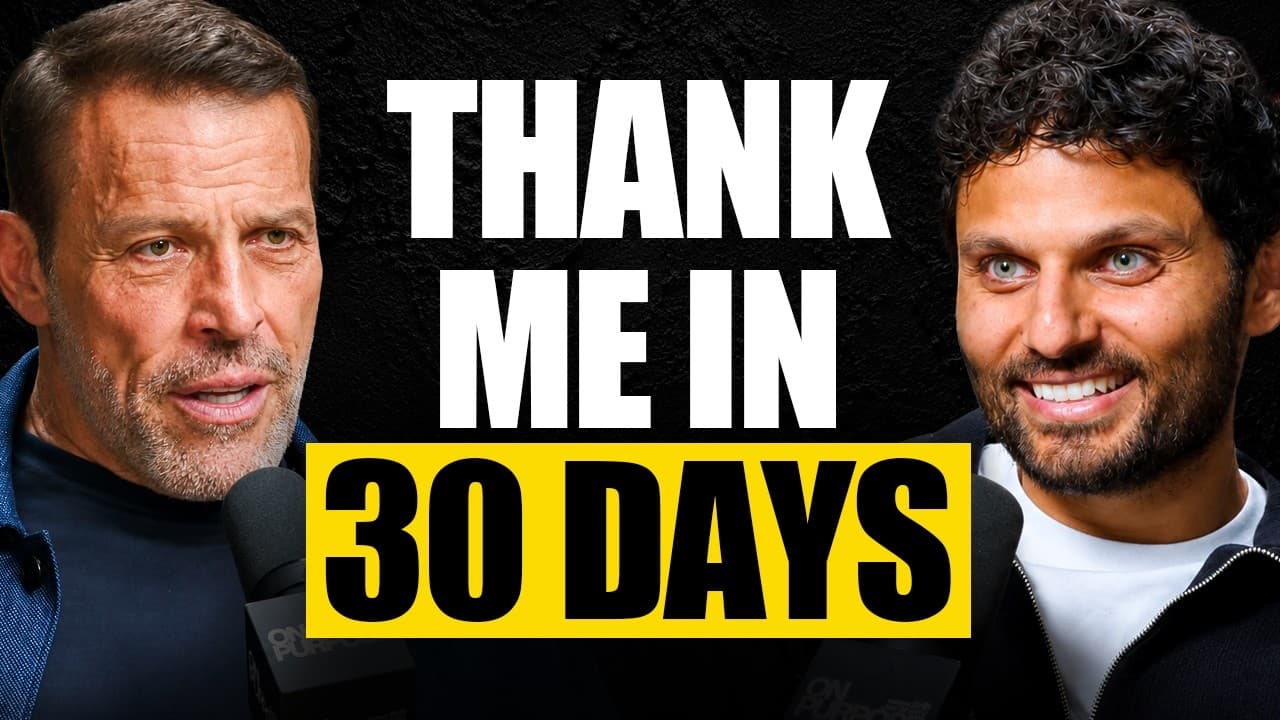
Decisions, not conditions, shape your life. Start small to build momentum and then tackle bigger choices. The key is acting quickly after deciding, because delaying action dilutes commitment. Embrace a mindset that you are a creator and use a simple, repeatable decision process to move from stress to progress.
Transcript
Tony, I want to start with, you know, with you. There's so many things we can talk about and you've been doing this work for decades. I feel like your ability to learn what's at the root of things is is second to none. It's so powerful for you to know. And I feel today since even when you started, people are still stuck. The thing I hear the most i... Read More
Key Insights
- Decisions determine life quality, not circumstances.
- Small, quick decisions build decision making muscle and momentum.
- Fear and information paralysis are common barriers to making decisions.
- The fastest way to change is to start with a real decision and act immediately.
- Decision making is improved by separating decision from execution and commitments.
- Great leaders value action over endless analysis and indecision.
- Rule 13 and Rule 14 emphasize taking charge and doing what is right.
- The three step view of decision making includes deciding, committing, and resolving.
Install to Summarize YouTube Videos and Get Transcripts
Explore YouTube Video Summarizer or Get YouTube Transcript Extractor
Questions & Answers
Q: How do you stop feeling stuck and start making progress with decisions
Feeling stuck often comes from fear of the wrong choice and a belief that more information will fix the situation. The solution is to make a real decision and then act immediately to commit to that path. Momentum builds as you repeatedly practice small decisions, which strengthens your ability to handle bigger ones over time.
Q: What is the difference between deciding, committing, and resolving
Deciding is choosing a direction when there is uncertainty. Committing is the act of taking immediate steps to follow through, moving you from possibility to action. Resolving is sticking with the chosen path, adjusting only if necessary, and continuing until the outcome is achieved. This three part flow keeps progress ongoing.
Q: Why do the smartest people often make poor investments according to the discussion
The discussion points out that the smartest people want to know everything before deciding, which leads to missed opportunities. In life, absolute certainty does not exist, so waiting for perfect information causes opportunities to slip away. Decisive action with imperfect information is presented as more effective.
Q: How does fear affect decision making and how can it be managed
Fear makes people avoid decisions due to uncertainty and potential consequences. It can be managed by using faith in a broader sense, focusing on the ability to act rather than awaiting perfect knowledge, and by building decision making muscle through repeated small, immediate actions.
Q: What is the six step decision process mentioned
The six step decision process is a structured method to approach big choices. While the exact steps are not enumerated in the transcript, it is described as a repeatable framework that enables systematic evaluation, action, and adjustment, helping to move from plan to execution effectively.
Q: What example did the speaker give to illustrate decisive leadership
The example involves a private who questioned how to decide without full information, and a general who asserted that a decision must be made even when both sides have strong arguments. He emphasized that if wrong, the team will learn quickly, and if right, progress continues.
Q: Why is decision making considered a critical leadership skill
Decision making is critical because it drives action, reduces paralysis by analysis, and accelerates progress. Leaders who can decide and act quickly create momentum, adapt faster, and guide teams through uncertainty, turning potential into measurable outcomes rather than remaining stalled by fear or indecision.
Q: How does the speaker describe the relationship between problems and fulfillment
The speaker suggests that understanding and solving problems is part of achieving fulfillment. Systems and spirit are linked to how decisions are made and carried out, implying that continual problem solving and meaningful decisions contribute to long term fulfillment rather than temporary relief.
Summary & Key Takeaways
-
Decision making is the primary lever for changing life conditions, not external circumstances. Building momentum through small wins helps cultivate confidence to handle bigger choices. Acting promptly after deciding locks in commitment and reduces fear driven stalling.
-
A practical framework is needed: make a decision, then commit to immediate action, then refine if needed. This three phase flow prevents paralysis by analysis and maintains forward motion toward goals.
-
The best leaders use decisive action over hesitation. Even in complex situations, a clear choice followed by rapid execution outperforms waiting for perfect certainty and delay, enabling continual growth and results.
Read in Other Languages (beta)
Share This Summary 📚
Summarize YouTube Videos and Get Video Transcripts with 1-Click
Try YouTube Summary with ChatGPT & Claude or YouTube Transcript Generator
Explore More Summaries from Jay Shetty Podcast 📚





Summarize YouTube Videos and Get Video Transcripts with 1-Click
Try YouTube Summary with ChatGPT & Claude or YouTube Transcript Generator