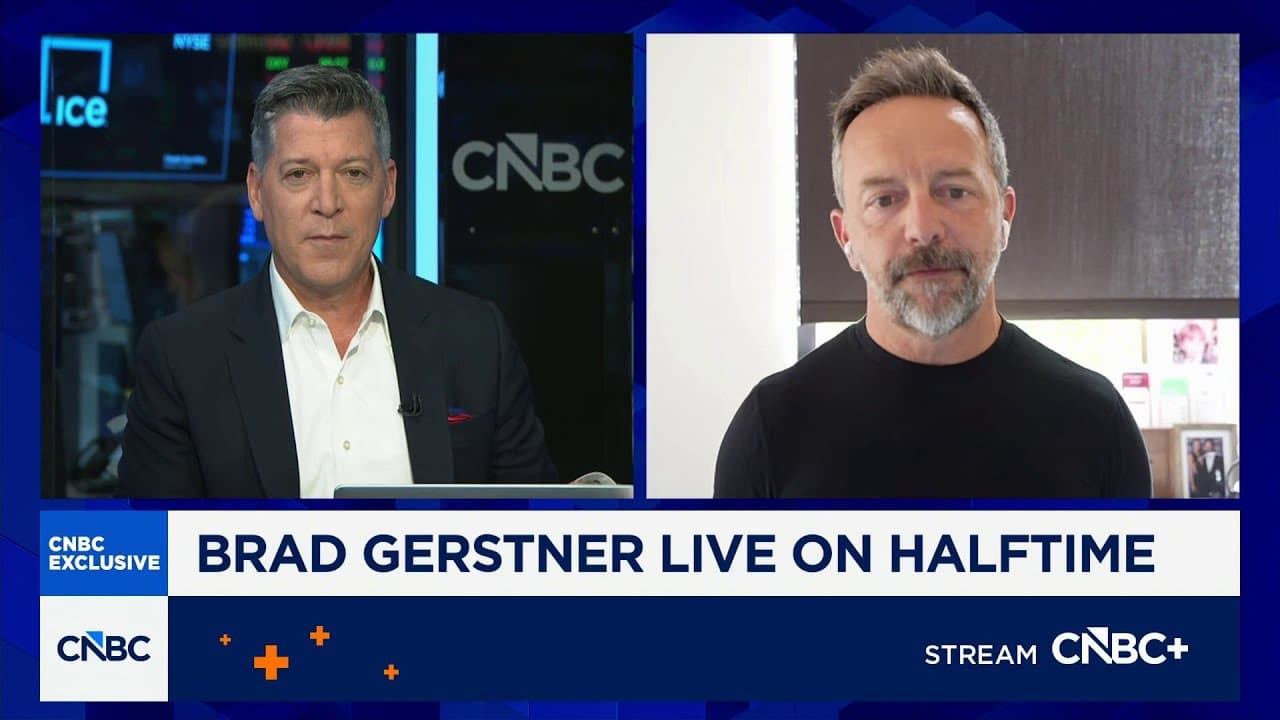
Why Does Brad Gerstner Reject AI Alarmism?
TL;DR
Brad Gerstner argues that AI development should continue alongside serious safety measures, rather than being stopped or heavily restricted because of catastrophic predictions. He says laboratories, government agencies, and industry leaders already scrutinize advanced models, while a balanced debate must also consider AI’s potential benefits, international competition, national security, and the risks of allowing adversaries to advance first.
Transcript
DEBATE OVER THE RISKS AND REWARDS OF AI REACHING A FEVERED PITCH THIS WEEK, WITH THE FORMER ANTHROPIC RESEARCHER GOING PUBLIC WITH HIS OWN CONCERNS. HIS WARNINGS DREW A SHARP REBUKE FROM OUR NEXT GUEST, BRAD GERSTNER. HE'S THE FOUNDER AND CEO OF ALTIMETER CAPITAL JOINS US NOW. HE'S AN INVESTOR IN BOTH ANTHROPIC AND OPENAI, AS WELL. AS ALL OF YOU KN... Read More
Key Insights
- AI safety is presented by Gerstner as a shared priority among laboratories, investors, industry leaders, and government officials. He disputes the idea that influential people in the sector support unrestricted development without safeguards, arguing that concern about children, national security, and the country’s future is widespread.
- Catastrophic AI predictions are characterized by Gerstner as hyperbolic scare tactics that may conceal political objectives. His objection is not to debating risk itself, but to presenting claims of imminent human extinction on national television without a counterbalancing discussion of current safeguards, benefits, and strategic consequences.
- AI laboratories are investing substantial money and computing capacity in sophisticated safety systems, according to Gerstner. He says these companies also coordinate closely with the federal national security apparatus and release transparency reports, which he offers as evidence that safety concerns are integrated into development and deployment decisions.
- Frontier model releases are subject to scrutiny before reaching the public, according to Gerstner. He points to a model that solved a Navier-Stokes problem but remained unavailable publicly because it was undergoing review by both its laboratory and the government, illustrating how capable systems may be withheld during evaluation.
- Industry coordination is another component of AI risk management in Gerstner’s account. He says dozens of chief executives, including Jamie Dimon and Michael Dell, are working together around critical industries to address safety, supplementing the measures taken independently by laboratories and federal agencies.
- Unilateral limits on American AI development could create national economic and security risks, Gerstner argues. His position is that international adversaries will not necessarily slow or stop, so policymakers must consider the danger of falling behind alongside the potential danger created by increasingly capable models.
- Public distrust of AI is connected to practical concerns about employment, data centers, electricity bills, water bills, and who profits from the technology. Gerstner agrees that the industry must communicate more effectively through reasoned, fact-based explanations rather than dismissing people who are worried about local and economic effects.
- Balanced AI policy must evaluate both risks and rewards, according to Gerstner. He warns that alarmist activism previously contributed to the closure of 67 nuclear reactors while China pursued additional fission capacity, using that comparison to argue against stopping or overregulating AI because of extreme forecasts.
Install to Summarize YouTube Videos and Get Transcripts
Explore YouTube Video Summarizer or Get YouTube Transcript Extractor
Questions & Answers
Q: Why does Brad Gerstner reject catastrophic AI warnings?
Brad Gerstner rejects the most catastrophic warnings because he considers them hyperbolic, politically motivated, and unsupported by a balanced account of existing safeguards. He objects particularly to claims that AI could kill all humanity within three years when those claims are presented nationally without opposing views. He nevertheless supports open debate about technological risks and says safety must remain central to development.
Q: What AI safety measures does Brad Gerstner describe?
Gerstner says AI companies are spending substantial money and computing resources on sophisticated safety systems. He also says laboratories coordinate deeply with the federal government’s national security apparatus and issue transparency reports. In addition, he describes government scrutiny before frontier models are released and industry coordination among dozens of chief executives focused on protecting critical industries and managing potential harms.
Q: Does Brad Gerstner support slowing AI development?
Gerstner does not advocate stopping AI development, but he repeatedly says progress must occur safely. He treats Sam Altman’s openness to slowing development and support for mandatory national safety requirements as reassuring evidence that industry leaders take the danger seriously. His objection concerns shutdowns and overregulation driven by extreme fears, not careful evaluation, delayed releases, safety investment, or government oversight.
Q: Why does Brad Gerstner consider AI a national security issue?
Gerstner argues that AI development affects both national security and national economic security because foreign adversaries may continue advancing even if the United States chooses to slow down or stop. He compares this strategic dilemma to the Manhattan Project, saying the United States may pursue a technology partly because its adversaries will do so regardless. Therefore, inaction also carries significant risks.
Q: How does government oversight affect frontier AI models?
According to Gerstner, government agencies already exercise meaningful scrutiny over advanced AI systems. He says the Treasury and Commerce departments shut down a system called Mythos over possible cybersecurity concerns, required the systems to be hardened, and kept it shelved until rerelease. He also cites an executive order establishing a model-release framework that reviews frontier systems before they become publicly available.
Q: Why are Americans distrustful of AI and data centers?
The interview connects public distrust to fears about data centers entering local communities, potentially raising water and electricity bills, and AI eliminating jobs. People also see rapid industry expansion, public offerings, and individuals becoming wealthy, which can deepen suspicion about whose interests are being served. Gerstner agrees that the industry needs clearer, reasoned, and fact-based explanations of what is actually happening.
Q: What does Brad Gerstner say about AI and employment?
Gerstner disputes predictions that AI would already have eliminated 10 percent of jobs. He cites an Economist story from the same week claiming that AI had instead created one million new jobs in America. He uses this contrast to argue that public discussion often emphasizes catastrophic forecasts without adequately examining contrary evidence, realized benefits, or the accuracy of earlier employment predictions.
Q: What does Brad Gerstner mean by a balanced AI debate?
A balanced debate, in Gerstner’s view, would openly examine AI’s dangers while also acknowledging current safety investments, government oversight, delayed model releases, economic benefits, and international competition. It would ask critics which additional safeguards they specifically want and evaluate the risks of stopping alongside the risks of continuing. He opposes portraying the industry as indifferent to safety when its leaders publicly support precautions.
Summary & Key Takeaways
-
Brad Gerstner rejects predictions that AI could soon destroy humanity as hyperbolic and politically motivated. Although he supports open discussion of technological risks, he argues that public debate has distorted the industry’s position by suggesting AI companies are racing forward without concern for safety, children, national security, or broader social consequences.
-
Gerstner says AI laboratories invest substantial money and computing resources in safety systems, coordinate with federal national security agencies, and publish transparency reports. He also cites government scrutiny of frontier models and delayed public releases as evidence that advanced systems are being evaluated rather than automatically made available as soon as development is completed.
-
The interview also addresses public distrust involving jobs, data centers, electricity, water, and personal enrichment within the AI industry. Gerstner calls for clearer, fact-based communication while warning that stopping American development could create economic and security risks because international adversaries may continue advancing regardless of decisions made in the United States.
Read in Other Languages (beta)
Share This Summary 📚
Summarize YouTube Videos and Get Video Transcripts with 1-Click
Try YouTube Summary with ChatGPT & Claude or YouTube Transcript Generator
Explore More Summaries from CNBC Television 📚



Summarize YouTube Videos and Get Video Transcripts with 1-Click
Try YouTube Summary with ChatGPT & Claude or YouTube Transcript Generator