What Can Stanford's OceanOneK Robot Do Underwater?
TL;DR
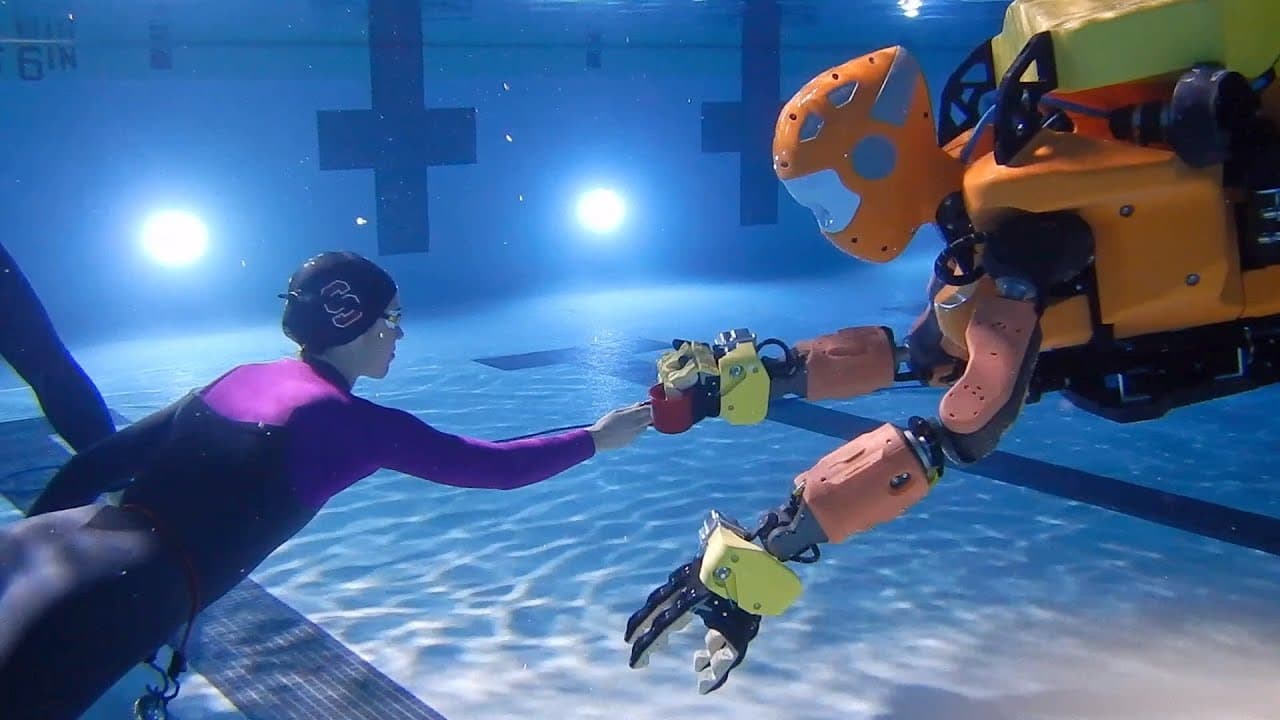
The OceanOneK robot can dive up to one kilometer underwater, enabling it to perform complex underwater tasks. Its haptic interface allows users to see and interact with the environment, enhancing deep-sea exploration and marine biology research while keeping humans safe and dry.
Transcript
there are a lot of ropes that are capable of going very deep in the water the problem is with the ropes you can see that you cannot do ocean one actually started around 2014 that early prototype of the robot was designed to go to 200 meters and the idea was how to connect this robot to a human we designed a haptic interaction haptic interface that ... Read More
Key Insights
- 🤢 The Ocean 1K robot represents a significant advancement in underwater robotics, allowing for deep-sea exploration and complex tasks.
- ♻️ The haptic interface enables operators to experience a realistic sense of touch and immersion in the underwater environment.
- 🤖 The robot's dexterous arms and 3D vision system provide it with human-like capabilities for manipulation and perception.
- 🔨 The development of specialized tools, such as the camera tool, enhances the robot's capabilities and expands its potential applications.
- 👌 Ocean 1K has the potential to contribute to environmental conservation by helping in tasks that aid the recovery of marine ecosystems.
- 🤖 The robot's ability to perform tasks underwater without the need for humans to physically enter the water improves safety and efficiency.
- 🤖 The expedition near Marseille and Corsica showcased the adaptability and versatility of the Ocean 1K robot in various underwater challenges and missions.
Install to Summarize YouTube Videos and Get Transcripts
Explore YouTube Video Summarizer or Get YouTube Transcript Extractor
Questions & Answers
Q: How deep can the Ocean 1K robot dive?
The Ocean 1K robot can dive up to one kilometer underwater, allowing for exploration and tasks at significant depths.
Q: What capabilities does the robot have to interact with the environment?
The robot has seven-degree-of-freedom arms that can manipulate the environment similar to a human arm, enabling it to perform tasks such as collecting corals, handling shipwrecks, and exploring submarines.
Q: How does the haptic interface work?
The haptic interface connects the operator to the robot by providing real-time feedback from sensors on the robot's arms and hands. This information is reconstructed and transmitted to a haptic device, allowing the operator to feel immersed in the underwater environment.
Q: What are the potential applications for the Ocean 1K robot?
The robot has immense potential for tasks such as aiding marine biology research, recovering artifacts for archaeology, and performing repair work on underwater structures.
Summary & Key Takeaways
-
The Ocean 1K robot was initially designed to reach a depth of 200 meters but was later upgraded to dive up to one kilometer underwater.
-
It features a haptic interface that enables operators to see and touch the underwater environment through the robot.
-
The robot is equipped with dexterous arms, thrusters, and a 3D vision system, making it ideal for tasks such as marine biology research, artifact recovery, and underwater structure repair.
Read in Other Languages (beta)
Share This Summary 📚
Summarize YouTube Videos and Get Video Transcripts with 1-Click
Try YouTube Summary with ChatGPT & Claude or YouTube Transcript Generator
Explore More Summaries from Stanford 📚





Summarize YouTube Videos and Get Video Transcripts with 1-Click
Try YouTube Summary with ChatGPT & Claude or YouTube Transcript Generator