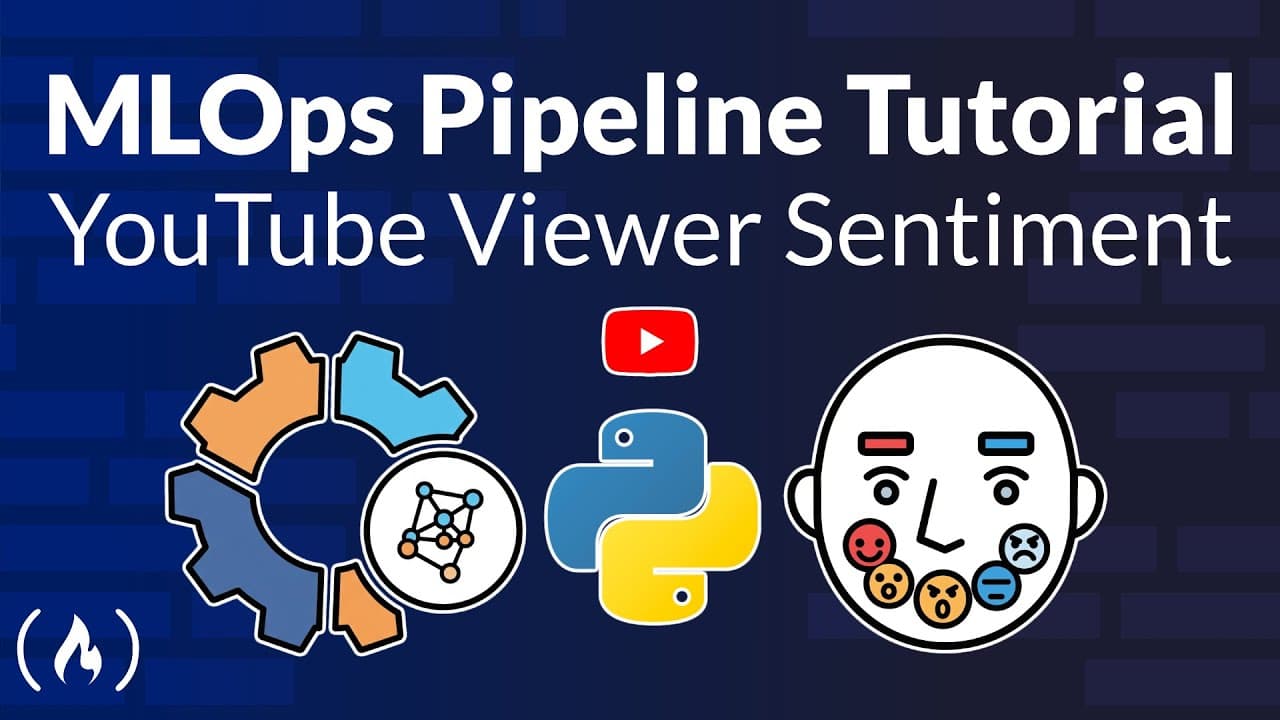
How to Build MLOps Pipeline for YouTube Sentiment
TL;DR
This course guides you through building an end-to-end MLOps pipeline to analyze YouTube sentiment in real-time using a Chrome extension. You'll learn to use tools like MLflow, DVC, Docker, and AWS, covering data collection to deployment. Gain hands-on experience with machine learning engineering and MLOps practices.
Transcript
This comprehensive course teaches you to build an end toend MLOps pipeline that analyzes YouTube sentiment in real time through a Chrome extension. You'll master modern ML tools like MLFlow, DVC, Docker, and AWS while developing a complete solution from data collection to deployment. You'll gain hands-on experience with real world ML engineering an... Read More
Key Insights
- MLOps pipeline involves tools like MLflow, DVC, Docker, and AWS.
- The project analyzes YouTube sentiment in real-time through a Chrome extension.
- Data collection, preprocessing, and model building are key components of the pipeline.
- MLflow is used for experiment tracking and model registry.
- DVC helps in building and managing the ML pipeline.
- Handling imbalanced data is crucial for improving model performance.
- Hyperparameter tuning and stacking models can enhance model accuracy.
- Deployment involves Dockerization and CI/CD on AWS.
Install to Summarize YouTube Videos and Get Transcripts
Explore YouTube Video Summarizer or Get YouTube Transcript Extractor
Questions & Answers
Q: How to set up an MLflow server on AWS?
To set up an MLflow server on AWS, create an EC2 instance and install Python, pip, and MLflow. Configure AWS CLI with your access and secret keys for S3 access. Start the MLflow server on a specified port and ensure security group settings allow access. Use the public IP with the port to access MLflow.
Q: What is the role of DVC in the MLOps pipeline?
DVC (Data Version Control) is used to manage and track the ML pipeline components. It helps in versioning datasets, models, and code, ensuring reproducibility and collaboration. DVC integrates with Git, allowing seamless tracking of changes and pipeline execution, making it a vital tool in the MLOps workflow.
Q: How does the Chrome extension analyze YouTube sentiment?
The Chrome extension extracts comments from YouTube videos and uses a machine learning model to classify sentiments as positive, negative, or neutral. It summarizes the sentiment distribution and displays it on a dashboard. The extension automates sentiment analysis, providing insights without manually reading comments.
Q: What are the best practices for handling imbalanced data?
Handling imbalanced data involves techniques like oversampling, undersampling, and using algorithms like SMOTE. These methods balance the class distribution, improving model performance. It's crucial to evaluate models using metrics like precision, recall, and F1-score to ensure balanced accuracy across classes.
Q: How to perform hyperparameter tuning in the pipeline?
Hyperparameter tuning can be performed using libraries like Optuna or GridSearchCV. These tools automate the search for optimal model parameters by evaluating different combinations. In the pipeline, integrate these tools to systematically test and log results, improving model performance through efficient parameter selection.
Q: What is the significance of model registry in MLflow?
Model registry in MLflow acts as a centralized hub for managing model versions, metadata, and lifecycle stages. It enables tracking of model performance, ensuring consistency and reproducibility. The registry facilitates collaboration and deployment by providing a structured approach to model management in production environments.
Q: How does Dockerization aid in deployment?
Dockerization packages the application and its dependencies into a container, ensuring consistent execution across environments. It simplifies deployment by creating a portable and isolated runtime environment. Docker containers enhance scalability, reliability, and ease of maintenance, making them ideal for deploying ML models in production.
Q: What are the steps for CI/CD deployment on AWS?
CI/CD deployment on AWS involves setting up a pipeline using AWS CodePipeline, CodeBuild, and CodeDeploy. Automate code integration, testing, and deployment processes. Configure triggers for code changes, ensuring continuous delivery. This streamlines updates, enhances collaboration, and ensures reliable deployment of ML models.
Summary & Key Takeaways
-
The course covers building an MLOps pipeline for real-time YouTube sentiment analysis using a Chrome extension. It incorporates tools like MLflow, DVC, Docker, and AWS. Participants gain practical experience in ML engineering and MLOps practices, from data collection to deployment.
-
Key components of the pipeline include data ingestion, preprocessing, model building, and evaluation. The course emphasizes handling imbalanced data, hyperparameter tuning, and model stacking to improve accuracy.
-
The deployment process involves Dockerization and CI/CD on AWS, ensuring an efficient and scalable solution. This comprehensive guide equips learners with the skills to implement modern MLOps practices in real-world projects.
Read in Other Languages (beta)
Share This Summary 📚
Summarize YouTube Videos and Get Video Transcripts with 1-Click
Try YouTube Summary with ChatGPT & Claude or YouTube Transcript Generator
Explore More Summaries from freeCodeCamp.org 📚





Summarize YouTube Videos and Get Video Transcripts with 1-Click
Try YouTube Summary with ChatGPT & Claude or YouTube Transcript Generator