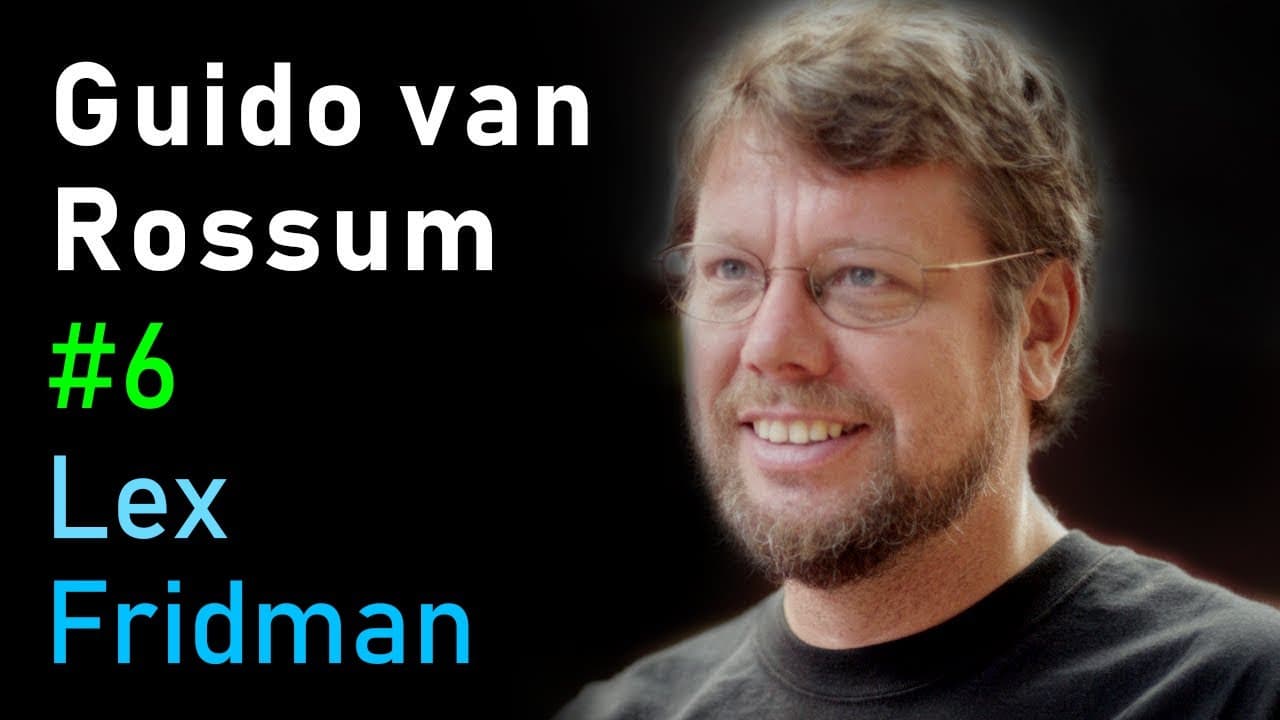
Guido van Rossum: Python | Lex Fridman Podcast #6
TL;DR
Guido van Rossum believes that human nature contains both good and evil, shaped by circumstances and context. His passion for programming was inspired by Dutch literature and early electronics tinkering, leading to the creation of Python as a tool for enhancing programmer productivity through simplicity and readability.
Transcript
the following is a conversation with guido van rossum creator of Python one of the most popular programming languages in the world used in almost any application that involves computers from web back-end development to psychology neuroscience computer vision and robotics deep learning natural language processing in almost any subfield of AI this co... Read More
Key Insights
- 😈 Humans have both good and evil potential within them, influenced by circumstances and context.
- 🉐 Dutch literature during World War II significantly impacted van Rossum's teenage years.
- 🏛️ Building electronic circuits served as a foundation for van Rossum's passion for programming languages and their design.
- 🔨 Python was created to be a tool that improves programmer productivity, focusing on simplicity and readability.
Install to Summarize YouTube Videos and Get Transcripts
Explore YouTube Video Summarizer or Get YouTube Transcript Extractor
Questions & Answers
Q: How did Dutch literature influence Guido van Rossum during his teenage years?
Dutch author Willem Frederik Hermans, particularly his novels set during World War II, influenced van Rossum. These novels explored ambiguity, resistance, and the nature of good and evil, leaving a lasting impact on van Rossum.
Q: How did Guido van Rossum's early experiences with building electronic circuits shape his understanding of programming languages?
Initially, van Rossum's focus was on tinkering and puzzle solving. He followed instructions to build circuits without fully understanding their underlying principles. As he ventured into more complex digital circuits, he realized the importance of understanding the analog part of how they work, which influenced his approach to programming.
Q: What led Guido van Rossum to create Python?
Van Rossum wanted to develop a programming language that was more productive and easier to use than C, while bridging the gap between scripting languages and low-level languages. This led to the creation of Python, which has a focus on simplicity and readability.
Q: How does Guido van Rossum view the future of programming languages, specifically in terms of high concurrency, parallelism, and async IO?
Van Rossum believes that Python is unlikely to become a high concurrency or parallelism language. The design of the language, the preferences of most users, and the implementation of Python make it challenging to develop it into a language suited for high levels of concurrent programming. However, he acknowledges the importance of async IO and its role in improving the performance of certain types of applications.
Key Insights:
- Humans have both good and evil potential within them, influenced by circumstances and context.
- Dutch literature during World War II significantly impacted van Rossum's teenage years.
- Building electronic circuits served as a foundation for van Rossum's passion for programming languages and their design.
- Python was created to be a tool that improves programmer productivity, focusing on simplicity and readability.
- Van Rossum sees limitations in Python's ability to become a high concurrency or parallelism language.
Summary
In this conversation, Guido van Rossum, the creator of Python, discusses his views on human nature, his love for Dutch literature, his early hobbies, and his thoughts on artificial intelligence and consciousness. He also reflects on the evolution of programming languages and the potential future of programming.
Questions & Answers
Q: What is Guido van Rossum's view on human nature?
Guido believes that humans have both good and evil potential within them, and that it is influenced by circumstances and context.
Q: Can Guido van Rossum share his favorite books from his childhood?
As a teenager, Guido was influenced by the writings of Dutch author Willem Frederik Hermans, particularly his novels set during World War II. These novels explored ambiguous situations in the resistance against the Germans.
Q: Does Guido van Rossum believe that literature and art impact his work in programming?
While Guido still reads novels, he does not believe that literature directly impacts his work. He sees his work as highly technical and separate from the world of art and literature.
Q: What were Guido van Rossum's hobbies as a teenager?
Guido's hobbies included building electronic circuits and mechanical models. He enjoyed the joy of tinkering and puzzle solving.
Q: Did Guido van Rossum anticipate the rise of personal computing in the 1970s?
No, Guido did not anticipate the rise of personal computing. He was not aware of computers as a teenager and only learned about them in college.
Q: Did Guido van Rossum see personal computers as a tool or as a potential for artificial beings?
Guido saw personal computers more as a tool rather than a medium for creating artificial beings. He was primarily interested in tinkering and programming itself.
Q: Did Guido van Rossum sense the possibility of artificial intelligence and the rise of computers with more complex abilities during his early years?
No, Guido did not see the potential for artificial intelligence or the impact of computers with complex abilities during his early years. He was focused on tinkering and programming at a more basic level.
Q: How does Guido van Rossum view the concept of consciousness and intelligence?
Guido sees consciousness and intelligence as a spectrum rather than an all-or-nothing concept. He believes that animals like cats, dogs, and mice have some form of intelligence and consciousness, albeit different from human intelligence and consciousness.
Q: Does Guido van Rossum believe that consciousness and intelligence can emerge from a fixed set of rules?
Yes, Guido believes that consciousness and intelligence can emerge from a fixed set of rules, particularly in biological systems like the brain. He sees the evolution of more intelligence being linked to the evolution of senses, particularly the visual sense.
Q: How does Guido van Rossum view programming in the context of higher levels of abstraction?
Guido believes that as levels of abstraction increase, programming will not be called programming anymore, as it will be a different concept that does not resemble what we currently call programming. He expects different concepts to emerge based on different models and education.
Q: How does Guido van Rossum view the concept of "programming 2.0" or machine learning?
Guido sees "programming 2.0" or machine learning as a different activity than traditional programming. He considers it more like training and data manipulation rather than traditional coding and source code.
Takeaways
Guido van Rossum believes that humans have both good and evil within them, and that consciousness and intelligence can emerge from a fixed set of rules. He sees programming as an activity that may evolve into different concepts as levels of abstraction increase. He also believes that machine learning or "programming 2.0" is a different activity that involves training and data manipulation rather than traditional coding.
Summary & Key Takeaways
-
Guido van Rossum believes that humans have both good and evil potential within them, which depends on circumstances and context.
-
Dutch literature, particularly novels set during World War II, had a significant influence on van Rossum during his teenage years.
-
Building electronic circuits started as a hobby for van Rossum, but he gradually developed a passion for programming languages and their design.
-
Python was created to be a tool that improves productivity for programmers, with a focus on simplicity and readability.
Read in Other Languages (beta)
Share This Summary 📚
Summarize YouTube Videos and Get Video Transcripts with 1-Click
Try YouTube Summary with ChatGPT & Claude or YouTube Transcript Generator
Explore More Summaries from Lex Fridman Podcast 📚
Summarize YouTube Videos and Get Video Transcripts with 1-Click
Try YouTube Summary with ChatGPT & Claude or YouTube Transcript Generator