What Is Glycolysis and How Does It Work?
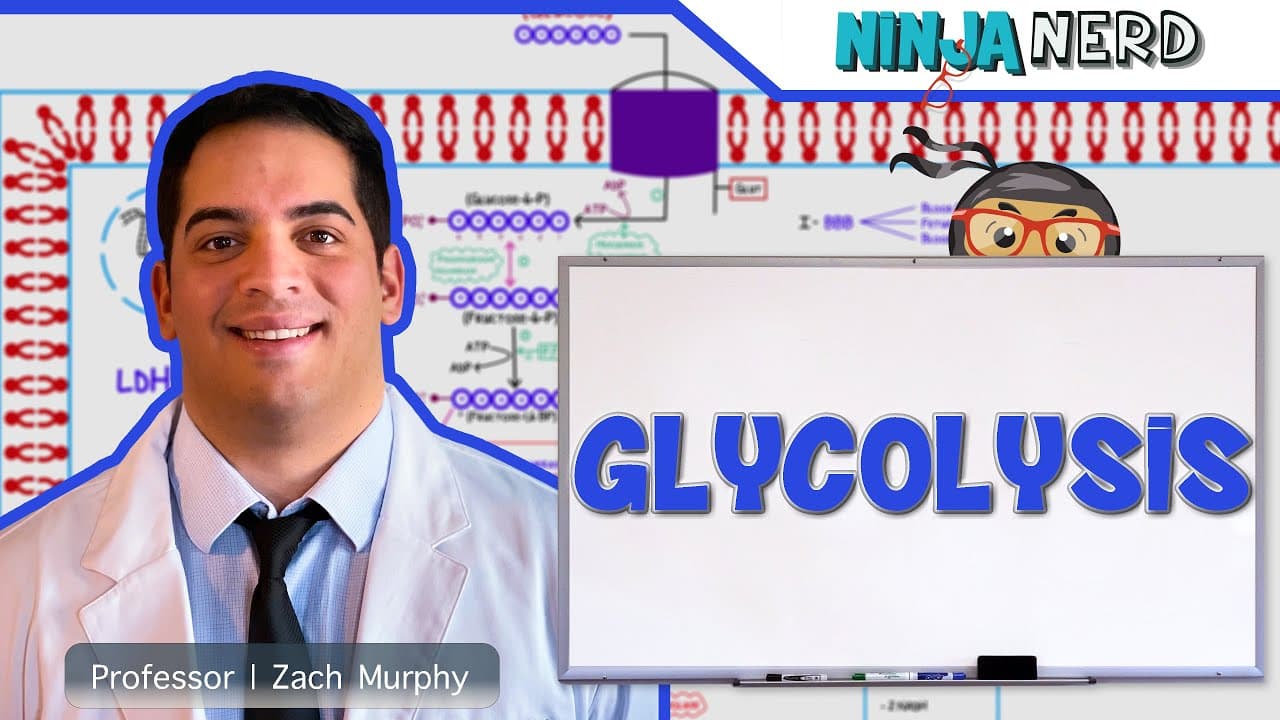
TL;DR
Glycolysis is the metabolic pathway that converts glucose into two pyruvate molecules while producing a net gain of 2 ATP and 2 NADH. This process occurs in the cytoplasm and can function under both anaerobic and aerobic conditions, with pyruvate being converted into lactic acid in low oxygen environments.
Transcript
our ninja nerds in this video we're going to talk about glycolysis so in short just a little definition about glycolysis if they're going to oxidize a molecule called glucose so you know glucose is a six carbon molecule it's basically a monosaccharide which is just a fancy word for sugar so glucose is a six carbon molecule and we're getting that fr... Read More
Key Insights
- ✖️ Glycolysis is a multi-step process that converts glucose into pyruvate.
- 🤙 Specialized transporters called GLUT transporters are responsible for glucose entry into the cell during glycolysis.
- 🥺 Glycolysis can occur in both anaerobic and aerobic conditions, leading to different end products.
- 🏍️ In anaerobic conditions, pyruvate is converted into lactic acid, while in aerobic conditions, it undergoes further transformations in the citric acid cycle.
- 🪐 Glycolysis produces a net gain of 2 ATP molecules and 2 NADH molecules.
- ❓ Lactate dehydrogenase is the enzyme responsible for converting pyruvate into lactic acid in anaerobic conditions.
- 🖐️ Glycolysis plays a crucial role in energy production and is a fundamental pathway in the metabolism of glucose.
Install to Summarize YouTube Videos and Get Transcripts
Explore YouTube Video Summarizer or Get YouTube Transcript Extractor
Questions & Answers
Q: How does glucose enter the cell during glycolysis?
Glucose enters the cell through specialized transporters called GLUT transporters, which require ATP and are bidirectional, allowing glucose to move in and out of the cell.
Q: What is the function of GLUT transporters?
GLUT transporters facilitate the movement of glucose across the cell membrane, ensuring its uptake into the cell for glycolysis to occur.
Q: What is the difference between HEXOKINASE and GLUCOKINASE?
HEXOKINASE is present in various tissues, including muscle, while GLUCOKINASE is primarily found in the liver. Both enzymes convert glucose to glucose-6-phosphate during glycolysis.
Q: What happens to pyruvate in anaerobic conditions?
In anaerobic conditions, pyruvate is converted into lactic acid by the enzyme lactate dehydrogenase, as the absence of oxygen prevents the pyruvate from entering the citric acid cycle.
Key Insights:
- Glycolysis is a multi-step process that converts glucose into pyruvate.
- Specialized transporters called GLUT transporters are responsible for glucose entry into the cell during glycolysis.
- Glycolysis can occur in both anaerobic and aerobic conditions, leading to different end products.
- In anaerobic conditions, pyruvate is converted into lactic acid, while in aerobic conditions, it undergoes further transformations in the citric acid cycle.
- Glycolysis produces a net gain of 2 ATP molecules and 2 NADH molecules.
- Lactate dehydrogenase is the enzyme responsible for converting pyruvate into lactic acid in anaerobic conditions.
- Glycolysis plays a crucial role in energy production and is a fundamental pathway in the metabolism of glucose.
- Further reactions, such as the citric acid cycle, occur after glycolysis in aerobic conditions.
Summary & Key Takeaways
-
Glycolysis is the process of oxidizing glucose to produce pyruvate, a three-carbon molecule.
-
Glucose enters the cell through specialized transporters called GLUT transporters, which are bidirectional and require ATP for movement.
-
Glycolysis involves several enzymatic reactions that convert glucose into pyruvate, producing ATP and NADH in the process.
-
In anaerobic conditions, pyruvate is converted into lactic acid, while in aerobic conditions, pyruvate enters the transition step to form acetyl CoA.
Read in Other Languages (beta)
Share This Summary 📚
Summarize YouTube Videos and Get Video Transcripts with 1-Click
Try YouTube Summary with ChatGPT & Claude or YouTube Transcript Generator
Explore More Summaries from Ninja Nerd 📚
Summarize YouTube Videos and Get Video Transcripts with 1-Click
Try YouTube Summary with ChatGPT & Claude or YouTube Transcript Generator