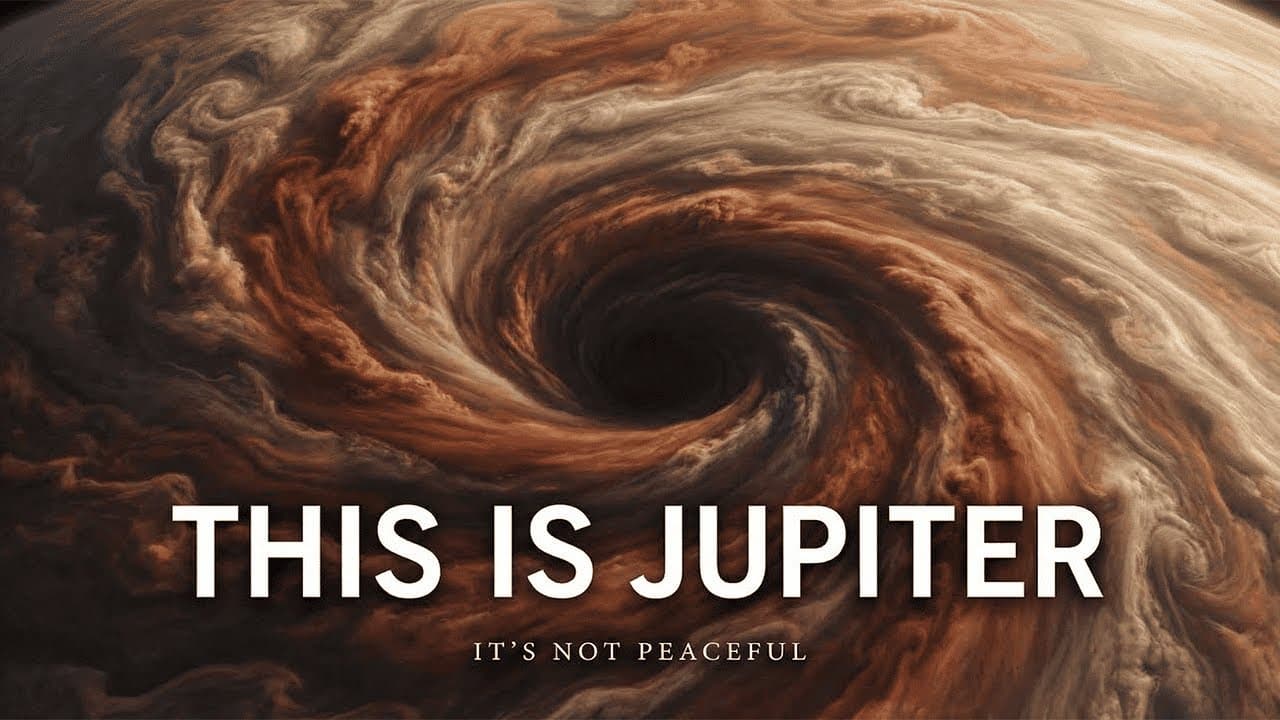
Why Jupiter is the Scariest Planet Explained
TL;DR
Jupiter is not a peaceful giant but a massive, radiation fierce planet with a deep atmosphere and no solid surface. Its magnetic field is thousands of times stronger than Earth's, creating deadly radiation belts and extreme pressures that would fry equipment and kill unprotected humans in minutes. Its gravity reshaped the solar system and continues to influence everything nearby.
Transcript
Imagine you're aboard a spacecraft approaching Jupiter. From a distance, it looks almost serene. Swirling bands of cream and orange. That famous red spot. A storm larger than Earth. It's beautiful. But as you get closer, something feels wrong. The radiation alarms start screaming. [music] Your instruments begin to malfunction. And then you realize ... Read More
Key Insights
- Jupiter is not merely large; it is incomprehensibly massive, dwarfing every other body in the solar system.
- Jupiter has no solid surface and a thickening atmosphere that becomes liquid metallic hydrogen deep inside.
- Jupiter’s magnetic field is about 20,000 times stronger than Earths, extending to Saturns orbit.
- Radiation belts around Jupiter are so intense they would kill an unprotected human in minutes.
- The Great Red Spot is a storm raging for centuries and wider than Earth.
- Jupiter has a significant gravitational influence that shaped the inner solar system by migrating during its history.
- Moons like Io and Europa are within deadly radiation belts and shaped by strong tidal forces.
- Exploration near Jupiter is valuable but limited by radiation, requiring careful mission design and shielding.
Install to Summarize YouTube Videos and Get Transcripts
Explore YouTube Video Summarizer or Get YouTube Transcript Extractor
Questions & Answers
Q: What makes Jupiter uniquely dangerous compared to other planets
Jupiter combines extreme mass with a completely different atmospheric structure, resulting in crushing pressures and a transition to liquid metallic hydrogen deep inside. Its magnetic field is enormous, and radiation belts surrounding the planet are powerful enough to kill unprotected humans and destroy spacecraft within minutes. This combination makes Jupiter uniquely dangerous among the planets.
Q: How does Jupiter influence the solar system
Jupiter has a gravitational influence so strong that it reshaped the early solar system. Its migration may have scattered debris, absorbed potential planets, and prevented Mars from growing larger. It acts as a gravitational vacuum cleaner, absorbing or deflecting comets and asteroids, while also enabling some to reach the inner solar system, creating a complex balance of risk and protection.
Q: Why is there no solid surface on Jupiter
The planet is a gas giant whose atmosphere thickens with depth. As you descend, pressure increases until hydrogen becomes liquid metallic, signaling a transition from a gaseous envelope to an exotic interior. This structure means there is no rocky ground to land on, and any mission would be crushed by the crushing pressures before reaching a solid surface.
Q: What have missions like Juno revealed about Jupiter
Juno has shown that Jupiter’s core may be diffuse rather than solid, possibly still absorbing material from billions of years ago. It has revealed that atmospheric dynamics extend far deeper than expected and that auroras are powered by interactions with its moons. These findings deepen our understanding of gas giant formation and magnetospheric physics.
Q: Why are Jupiter and its moons considered hazardous for exploration
Jupiter’s radiation belts are intense enough to threaten electronics and crew safety. Even shielded probes and orbiters require careful trajectory planning to minimize exposure, and moons like Europa and Io lie within these belts, making landing or long-term operations extremely challenging. Any exploration must balance scientific value with radiation risks.
Q: Could Jupiter protect Earth from impacts
Some scientists argue Jupiter acts as a shield by capturing or deflecting comets and asteroids, reducing impact risk for the inner solar system. Others note that its gravity can redirect objects toward the inner system, increasing risk in other scenarios. The overall effect likely sits somewhere in between, with both protection and risk present.
Q: What justifies continued exploration of Jupiter
Exploration of Jupiter yields insights into gas giant formation, magnetosphere physics, and planetary evolution. The radiation environment provides a natural laboratory for charged particle interactions, while the moons offer potential habitats in extreme conditions. Even with limits, missions like Juno advance our knowledge of the solar system and fundamental physics.
Q: What would constitute a safe mission profile for Jupiter
A safe mission would require shielding and robust radiation-hardened systems, careful orbit design to minimize exposure time, and possibly remote sensing rather than long-term surface operations. Missions might focus on atmospheric study, magnetospheric dynamics, and satellite interactions from safeguarded orbits, balancing scientific gain against radiation risk and engineering constraints.
Summary & Key Takeaways
-
Jupiter is incomprehensibly massive and outweighs all other solar system bodies combined. It could contain over a thousand Earths and is more massive than the rest of the planets, moons, and asteroids put together. Its size and mass drive all of its dangerous characteristics.
-
The planet has no solid surface, and its atmosphere thickens with depth, creating crushing pressures and a transition to liquid metallic hydrogen. This interior structure drives both extreme gravity and the powerful magnetic field that defines Jupiter.
-
Jupiter’s radiation belts are lethal to unprotected life and electronics. Spacecraft like Juno required titanium radiation Vaults and limited close passes. The same radiation environment impacts its moons and shapes potential habitability and exploration strategy.
Read in Other Languages (beta)
Share This Summary 📚
Summarize YouTube Videos and Get Video Transcripts with 1-Click
Try YouTube Summary with ChatGPT & Claude or YouTube Transcript Generator
Explore More Summaries from Cosmicus 📚
Summarize YouTube Videos and Get Video Transcripts with 1-Click
Try YouTube Summary with ChatGPT & Claude or YouTube Transcript Generator