How to Find the Domain and Range of Reciprocal Functions
TL;DR
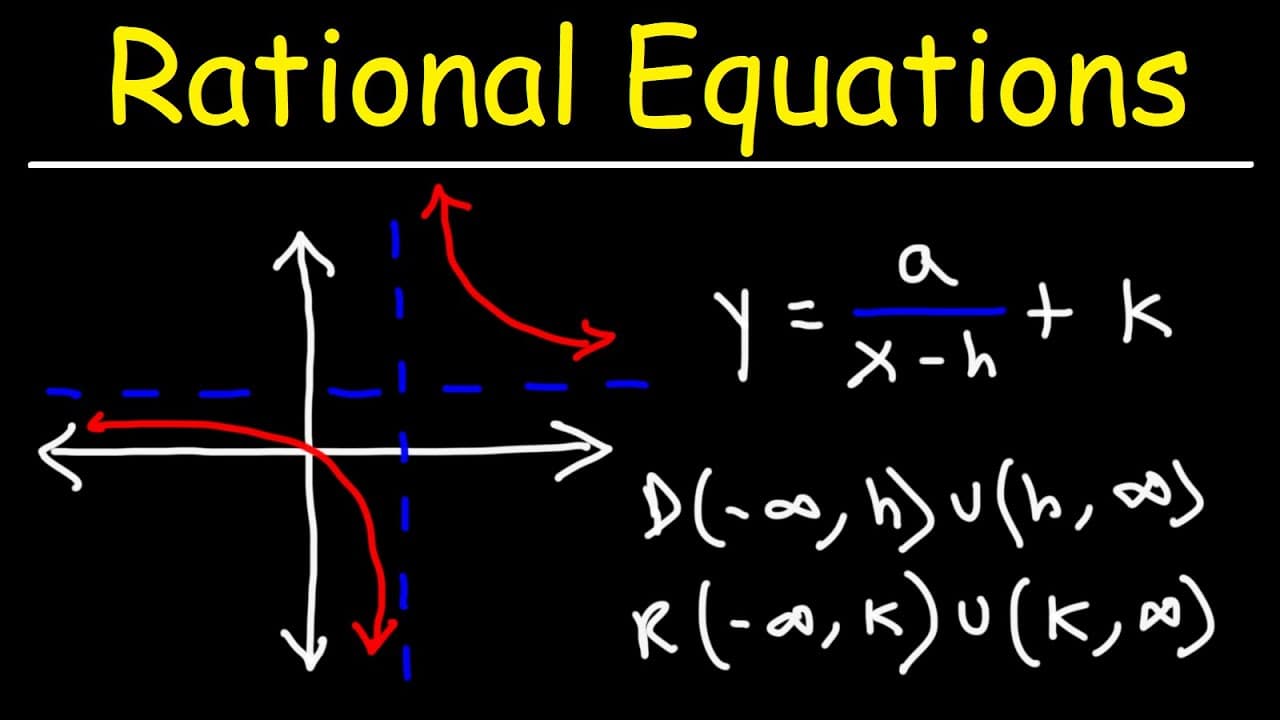
To find the domain of a reciprocal function, exclude the vertical asymptote from all x-values, resulting in an interval notation of (-∞, h) ∪ (h, ∞). For the range, exclude the horizontal asymptote from all y-values, giving a range of (-∞, k) ∪ (k, ∞). Understanding these exclusions is crucial for accurately determining the function's domain and range.
Transcript
in this video we're going to talk about how to find the domain and range of a reciprocal function so here is the standard form of a reciprocal function y is equal to a / x - h plus K now what I'm going to do is I'm going to draw a rough sketch of this function and to do that I need to determine the horizontal ASM toote and the vertical ASM toote th... Read More
Key Insights
- ❣️ The standard form of a reciprocal function is y = a / (x - h) + k.
- 🔃 The horizontal asymptote is determined by the value of k, while the vertical asymptote is determined by the value of h.
- ☺️ The domain of a reciprocal function includes all x values except for the vertical asymptote.
- 😀 The range of a reciprocal function includes all y values except for the horizontal asymptote.
- ❎ Reciprocal functions with positive values of a exist in quadrants 1 and 3, while those with negative values of a exist in quadrants 2 and 4.
- 🧡 It is important to remove the vertical asymptote from the domain and the horizontal asymptote from the range when writing them in interval notation.
Install to Summarize YouTube Videos and Get Transcripts
Explore YouTube Video Summarizer or Get YouTube Transcript Extractor
Questions & Answers
Q: How do you find the horizontal asymptote of a reciprocal function?
The horizontal asymptote of a reciprocal function is determined by the value of k in the equation y = a / (x - h) + k. If k is positive, the horizontal asymptote is at y = k, and if k is negative, the asymptote is at y = k.
Q: What is the significance of the vertical asymptote in a reciprocal function?
The vertical asymptote in a reciprocal function is determined by the value of h in the equation y = a / (x - h) + k. It represents the value of x for which the function is undefined, as it results in division by zero.
Q: How do you write the domain of a reciprocal function?
To write the domain, you need to include all x values except for the vertical asymptote. In interval notation, the domain would be (-∞, 2) ∪ (2, ∞).
Q: How do you write the range of a reciprocal function?
To write the range, you need to consider the y values of the function. The range includes all y values except for the horizontal asymptote. In interval notation, the range would be (-∞, 4) ∪ (4, ∞).
Summary & Key Takeaways
-
Reciprocal functions can be represented by the equation y = a / (x - h) + k.
-
The horizontal asymptote is determined by the value of k, while the vertical asymptote is determined by the value of h.
-
The domain of a reciprocal function includes all x values except for the vertical asymptote, while the range includes all y values except for the horizontal asymptote.
Read in Other Languages (beta)
Share This Summary 📚
Summarize YouTube Videos and Get Video Transcripts with 1-Click
Try YouTube Summary with ChatGPT & Claude or YouTube Transcript Generator
Explore More Summaries from The Organic Chemistry Tutor 📚


Summarize YouTube Videos and Get Video Transcripts with 1-Click
Try YouTube Summary with ChatGPT & Claude or YouTube Transcript Generator