How to Start an AI-Powered Services Business
TL;DR
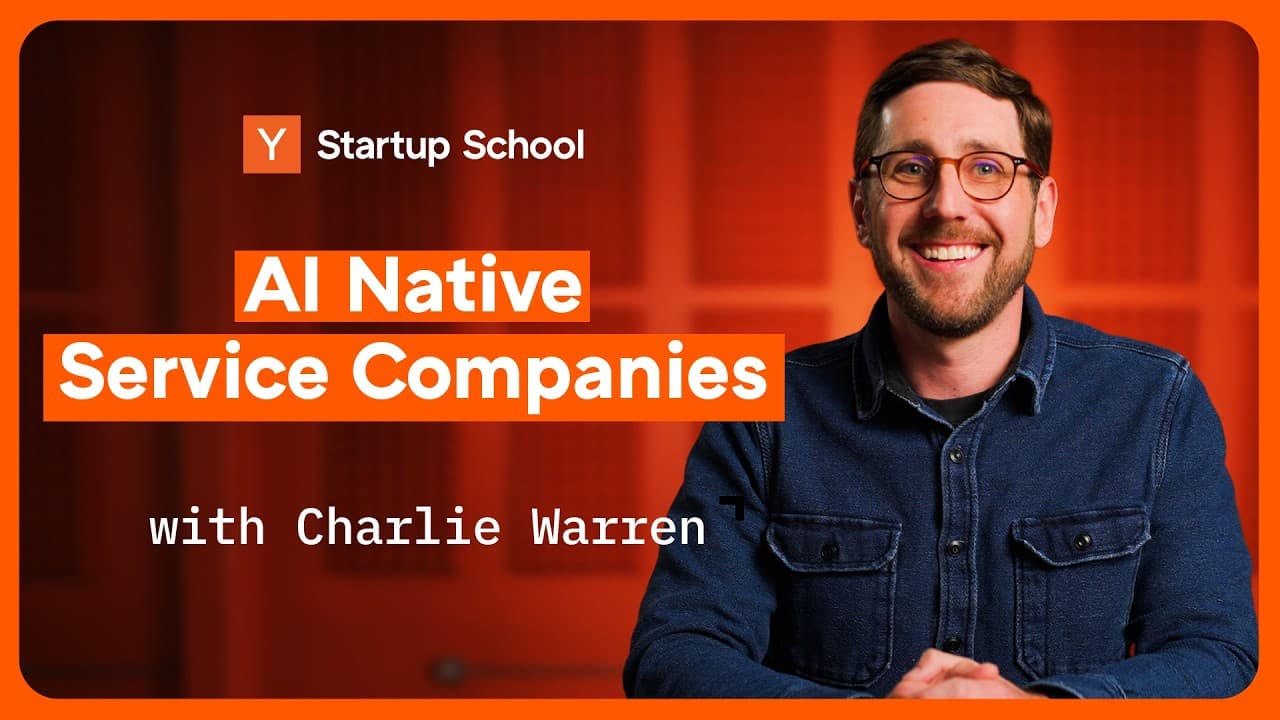
AI-native service companies are poised to dominate future markets by leveraging AI to replace traditional service models in industries like insurance and law. These companies focus on delivering outcomes rather than tools, requiring founders to carefully select markets, assemble skilled teams, and manage operations efficiently. Success hinges on understanding AI capabilities, maintaining operational rigor, and navigating market-specific challenges.
Transcript
Some of the biggest companies of the next decade won't be software businesses at all. They'll be services companies like insurance carriers and law firms rebuilt from scratch with AI doing most of the work. These are what we call AI native service companies. And the markets are trillions of dollars in size. tax, audit, insurance, law, parts of heal... Read More
Key Insights
- AI-native service companies are reshaping industries by automating tasks traditionally done by humans, reducing costs and increasing efficiency.
- Successful AI service companies focus on markets with low trust, low judgment tasks, high intelligence thresholds, and beneficial regulation.
- Founders must choose markets they are passionate about, as building these companies can take a decade or more.
- The right founding team combines domain expertise, model fluency, and operational rigor to navigate complex, regulated industries.
- AI services require an operations mindset, focusing on throughput, cycle time, and minimizing variance to maintain customer trust.
- Sales strategies should focus on selling outcomes rather than products, and pricing should reflect the value delivered, not just cost savings.
- AI services aim for higher margins than traditional service firms by leveraging AI for operational efficiency, targeting software-like profit margins.
- Acquiring existing service businesses to add AI is often a trap; building from scratch is usually more effective for achieving product-market fit.
Install to Summarize YouTube Videos and Get Transcripts
Explore YouTube Video Summarizer or Get YouTube Transcript Extractor
Questions & Answers
Q: How do AI-native service companies differ from traditional service firms?
AI-native service companies leverage artificial intelligence to automate tasks traditionally performed by humans, focusing on delivering outcomes rather than providing tools or services. These companies operate in markets with low trust and judgment tasks, high intelligence thresholds, and beneficial regulation. They aim for higher profit margins by increasing operational efficiency and reducing costs through AI.
Q: What are the key market characteristics for AI service companies?
The best markets for AI service companies have four key traits: low trust, where work is already outsourced; low judgment tasks, allowing for automation; high intelligence thresholds, requiring AI and human collaboration; and beneficial regulation, which can raise expectations and create barriers to entry. These characteristics enable AI services to replace traditional service models effectively.
Q: Why is an operations mindset crucial for AI service companies?
An operations mindset is crucial for AI service companies because it focuses on optimizing throughput, cycle time, and minimizing variance to maintain customer trust. Unlike traditional software, where the product is the interface, AI services require human interfaces, making operational efficiency key to scaling. By identifying and addressing bottlenecks, companies can ensure consistent, reliable service delivery.
Q: How should AI service companies approach pricing?
AI service companies should approach pricing by focusing on the value delivered rather than simply undercutting labor costs. Options include per-unit pricing, which is straightforward, and outcome-based pricing, which aligns incentives but can be challenging to forecast. Avoid cost-plus pricing, which limits upside, and straight-line undercutting, which may devalue the service. Pricing should reflect the unique leverage AI provides.
Q: What role does team composition play in AI service company success?
Team composition is critical for AI service company success, requiring domain expertise, model fluency, and operational rigor. Founders should build teams with people they know and trust, leveraging their combined skills to navigate complex, regulated industries. Domain fluency ensures credibility, model fluency enables effective product design, and operational rigor ensures efficient service delivery, all essential for building a successful AI service company.
Q: Why is it important to avoid acquiring existing businesses for AI integration?
Acquiring existing businesses to integrate AI is often a trap because it doesn't guarantee product-market fit. Legacy service businesses have different expectations and operational metrics, which may not align with AI capabilities. Building from scratch allows founders to design processes and products tailored to AI's strengths, ensuring better integration and potential for achieving desired outcomes and market success.
Q: What is the significance of AI operating leverage in service companies?
AI operating leverage is significant because it allows service companies to achieve higher profit margins by reducing the cost of goods sold (COGS) through automation. As AI capabilities improve, companies can scale operations more efficiently, lowering costs and increasing gross margins. This leverage enables AI service companies to approach software-like profit margins while addressing larger markets than traditional software companies.
Q: What are the early challenges AI service companies face in sales?
AI service companies face the early challenge of the 'early demand trap,' where signing up too many pilot customers can overwhelm their ability to deliver and scale. Founders should limit initial pilot customers, focusing on learning and refining their product. Selling outcomes rather than products and using pilots to identify unique AI leverage points are crucial for overcoming these challenges and building a scalable business model.
Summary & Key Takeaways
-
AI-native service companies are emerging as key players in industries like insurance and law by automating tasks and delivering outcomes rather than tools. Founders should focus on markets with low trust and judgment tasks, high intelligence thresholds, and beneficial regulation. Building a passionate team with domain expertise and operational rigor is crucial for success.
-
The operational mindset is essential for AI services, focusing on throughput, cycle time, and minimizing variance to maintain customer trust. Sales strategies should emphasize selling outcomes, with pricing reflecting the value delivered. Founders should avoid acquiring existing businesses to add AI, as building from scratch is often more effective.
-
AI services aim for higher margins than traditional service firms by leveraging AI for operational efficiency. Successful companies focus on markets they are passionate about, assemble skilled teams, and manage operations efficiently. The opportunity for AI-native service companies is vast, with the potential to achieve software-like profit margins in large markets.
Read in Other Languages (beta)
Share This Summary 📚
Summarize YouTube Videos and Get Video Transcripts with 1-Click
Try YouTube Summary with ChatGPT & Claude or YouTube Transcript Generator
Explore More Summaries from Y Combinator 📚






Summarize YouTube Videos and Get Video Transcripts with 1-Click
Try YouTube Summary with ChatGPT & Claude or YouTube Transcript Generator