Did the Federal Reserve Cancel Rate Cuts, and How Is the Presenter Investing?
TL;DR
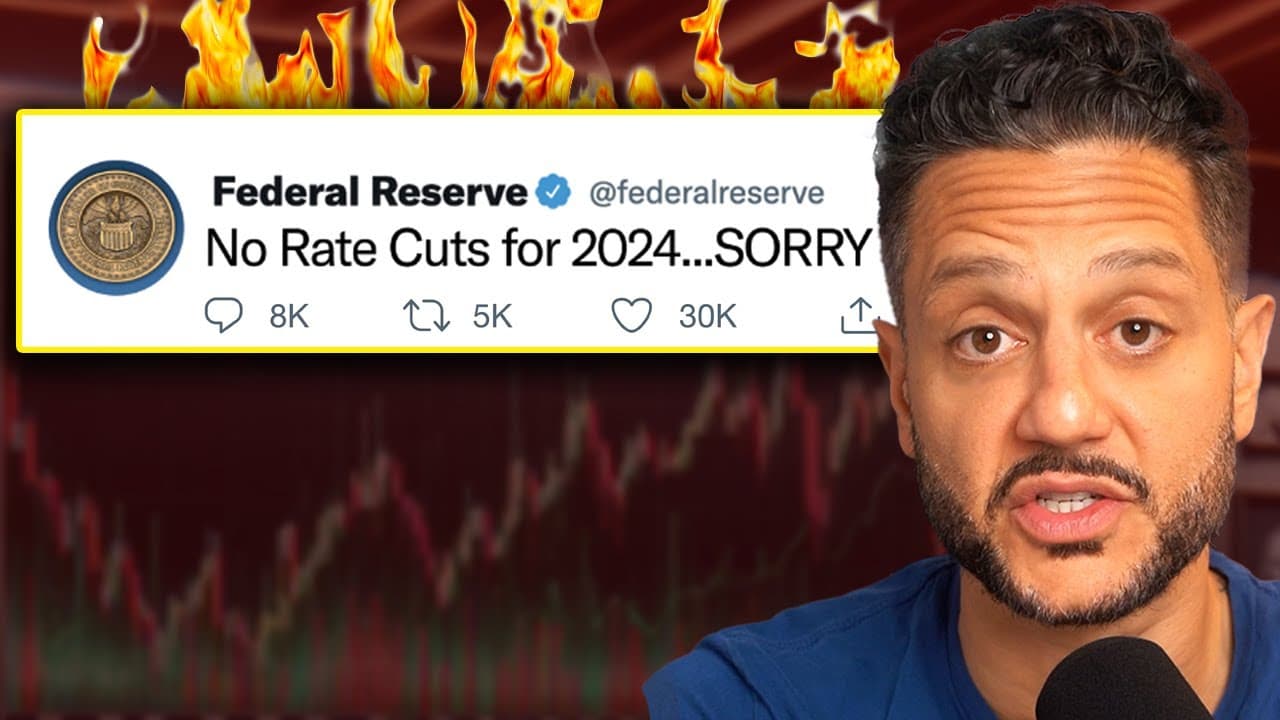
Delayed Federal Reserve rate cuts could allow stocks to keep rising until recession signals or economic failures change the outlook. Powell cited strong growth, including a 3.4% latest GDP reading, while five of the previous seven CPI reports exceeded expectations. The presenter therefore avoids broad indexes at record highs and searches for asymmetrical opportunities, making the specific watchlist and historical rate-cut comparison worth examining.
Transcript
I'm sure you guys noticed by now the S&P 500 is on a historic rally only three negative months in the last 13 months and aside from September 2023 the other two negative months were negligible at negative - 1% and -2% for the month other than that the stock market has been a straight rocket up now why is that well aside from the record number of ca... Read More
Key Insights
- Powell emphasizes economic resilience: Powell said the economy was strong enough for policymakers to wait before cutting rates. The latest cited GDP report showed 3.4% growth, supporting the view that current rates had not broadly broken economic activity, although interest-sensitive spending was feeling their effects.
- Inflation prevents an early pivot: The CPI sequence was unfavorable to rapid easing. Five of seven reports exceeded expectations, one matched them, and one fell below them. The presenter interprets that pattern as evidence that inflation remains too stubborn for the Federal Reserve to cut merely because markets expect it.
- Core PCE offers partial relief: Core PCE appeared more favorable than CPI because most months were described as meeting expectations. Even so, the presenter focuses on whether inflation is sustainably returning to 2% and treats the stronger CPI readings as a significant obstacle to near-term policy easing.
- The dot plot tracks expectations: The dot plot collects individual FOMC participants’ projections for the federal funds rate. That rate governs the cost at which banks borrow from and lend to one another, indirectly affecting broader borrowing costs because banks respond when their own funding becomes more expensive.
- Projected cuts were reduced: During the summer of 2023, most FOMC participants expected at least five cuts in 2024. By the March 2024 dot plot, the projection had declined to three. Despite that reduction, the market continued rising as Powell’s earlier messaging indicated that July was probably the final hike.
- Cuts depend on economic context: A Federal Reserve cut is not presented as an automatic sell signal. Historical examples since the early 1980s showed markets tending to rally when cuts occurred without a recession threat. The crucial issue is why policymakers are cutting, not the cut considered in isolation.
- Failures made past cuts dangerous: The negative market reactions highlighted in 2001 and 2007 occurred while economic conditions were deteriorating. For 2007, the presenter cites falling home sales, increasing mortgage defaults, collapsing GDP, and unemployment reaching 5% or more as evidence that serious problems were already developing.
- A crisis could change policy: With growth strong and inflation stubborn, the presenter sees no basis for an immediate cut under normal conditions. A Black Swan event, emerging recession indicators, or failures within the economy could instead force the Federal Reserve to act before inflation data alone supports easing.
- Premature easing carries inflation risk: The presenter believes policymakers will avoid cutting while inflation remains elevated. The early 1980s are used as the warning, when returning inflation ultimately led Paul Volcker to raise rates to 20%. That history supports waiting for convincing, sustainable progress rather than reacting early.
- The rally can continue: The outlook remains bullish until recession indicators appear or parts of the economy begin to fail. Corrections and pullbacks can still occur within that trend. The presenter therefore separates ordinary market weakness from the deeper deterioration that might force policy action and damage stocks.
- Small caps offer relative upside: The Russell 2000 had risen 23% since the presenter mentioned it in November, yet remained roughly 15% to 16% below its all-time high. That gap is viewed as more attractive than purchasing large-cap indexes already trading at record levels.
- Dislocations shape the watchlist: Tesla becomes interesting after a possible weak first-quarter report and further price decline, while Bitcoin miners attract attention because they have become unusually decorrelated from Bitcoin. Google represents another category, a large company that may offer opportunity when temporarily damaged.
Install to Summarize YouTube Videos and Get Transcripts
Explore YouTube Video Summarizer or Get YouTube Transcript Extractor
Questions & Answers
Q: Did the Federal Reserve cancel rate cuts, and how is the presenter investing?
The presenter does not report an official cancellation, but argues that the Federal Reserve may avoid cutting throughout 2024. Powell said strong growth lets policymakers wait for greater confidence that inflation is sustainably returning to 2%, while five of the previous seven CPI reports exceeded expectations. Instead of buying QQQ or SPY at all-time highs, the presenter seeks asymmetrical opportunities in the Russell 2000, Tesla after a possible pullback, Bitcoin miners, and temporarily damaged large companies such as Google. The strategy reflects a belief that the rally can continue, while favoring assets with greater perceived upside relative to risk.
Q: Why might the Federal Reserve delay interest-rate cuts?
The Federal Reserve can wait because the economy was described as strong, with the latest cited GDP report showing 3.4% growth. Inflation also remained stubborn, as five of the previous seven CPI releases exceeded expectations and only one came in below expectations. Powell said policymakers could use that economic strength to become more confident that inflation was returning sustainably to 2%. The presenter therefore sees little justification for an immediate cut unless recession signals, economic failures, or an unexpected crisis change the conditions.
Q: What did Jerome Powell say about future interest rates?
Powell said strong economic growth meant the Federal Reserve did not need to hurry to cut rates. Waiting would allow policymakers to gain greater confidence that inflation was moving sustainably toward 2%. He also said he did not expect rates to return to the very low levels that existed before the pandemic. However, he acknowledged that the eventual level at which rates settle was difficult to determine.
Q: What does the Federal Reserve dot plot show?
The dot plot presents individual FOMC participants’ expectations for the federal funds rate. The presenter explains that this rate governs what banks pay when borrowing from and lending to each other, so changes affect broader financing costs. In the summer of 2023, most participants expected at least five cuts during 2024. By March 2024, that expectation had fallen to three cuts, reflecting a substantial shift even as the stock market continued rising.
Q: Do stocks always fall after Federal Reserve rate cuts?
No, the presenter says stocks do not automatically decline when the Federal Reserve cuts rates. Historical data since the early 1980s is described as showing healthy rallies when cuts occurred without a recession threat. Losses after cuts in 2001 and 2007 coincided with broader economic deterioration rather than the rate decision alone. In 2007, the warning signs included falling home sales, rising mortgage defaults, weakening GDP, and unemployment reaching 5% or above.
Q: What could force the Federal Reserve to cut rates?
The presenter argues that strong growth and stubborn inflation give policymakers little reason to cut soon. A Black Swan event could force action, as could recession indicators or failures emerging in important parts of the economy. Under this view, cuts become more likely when economic damage outweighs the concern about easing too early. That distinction also matters for stocks because crisis-driven cuts have historically produced different outcomes from cuts made without a recession threat.
Q: Why does the presenter favor the Russell 2000?
The Russell 2000 represents a potential asymmetrical opportunity because small companies remained below the highs already reached by large-cap indexes. Although the index had gained 23% since the presenter mentioned it in November, it was still approximately 15% to 16% below its all-time high. The presenter also points to similar small-cap disparities before extended outperformance in the early 2000s. This relative gap appears more attractive than buying QQQ or SPY at record highs.
Q: Why are Tesla and Bitcoin miners on the watchlist?
Tesla becomes a possible purchase if weak first-quarter results cause another decline, particularly below recently observed prices. The presenter notes that the first quarter is generally Tesla’s weakest delivery quarter and that the company had released a new beta version of FSD. Bitcoin miners are interesting for a different reason, their performance had become unusually decorrelated from Bitcoin. The presenter views that separation as potentially exploitable while expecting Bitcoin to rise around the halving and cross six figures within the following year.
Summary & Key Takeaways
-
Explaining the historic rally: The S&P 500 recorded only three negative months across the previous 13 months, and two of those declines were just 1% and 2%. The presenter attributes the advance to record cash on the sidelines in 2023, short squeezes, money managers putting capital to work, and the recovery from a bear market and 10% correction. Above all, expectations about Federal Reserve policy are presented as the rally’s most important macroeconomic driver.
-
Interpreting Powell’s remarks: Speaking on Good Friday at a San Francisco macroeconomics and monetary policy conference, Jerome Powell said the economy’s strength meant the Federal Reserve did not need to rush into cuts. Growth exceeded 3% during the previous year, and the latest cited GDP report showed 3.4%. Powell wanted greater confidence that inflation was moving sustainably toward 2%, and he did not expect rates to return to their very low pre-pandemic levels.
-
Reviewing stubborn inflation data: Five of the previous seven CPI reports came in above expectations, one met expectations, and only one was below expectations. Core PCE, described as the Federal Reserve’s preferred gauge, appeared better because most monthly readings were in line with expectations. The presenter nevertheless treats CPI as the relevant measure when discussing the 2% inflation objective and argues that persistent readings make an imminent cut difficult to justify without an unexpected crisis.
-
Comparing cuts with market outcomes: The Federal Reserve’s dot plot showed how expectations changed as economic data remained strong. Most FOMC participants anticipated at least five cuts in 2024 during the summer of 2023, but the March 2024 projection fell to three. The presenter then rejects the idea that cuts automatically crash stocks. Markets generally rallied after cuts without a recession threat, whereas the negative outcomes in 2001 and 2007 accompanied serious economic deterioration.
-
Building an asymmetric watchlist: The presenter expects the rally to continue until recession indicators emerge, economic components begin failing, or weakness forces the Federal Reserve to respond. Rather than buying QQQ or SPY at all-time highs, the strategy targets situations where possible gains substantially exceed perceived risks. Candidates include the Russell 2000, Tesla after a possible earnings-related decline, Bitcoin miners that have diverged from Bitcoin, and temporarily damaged large companies such as Google.
Read in Other Languages (beta)
Share This Summary 📚
Summarize YouTube Videos and Get Video Transcripts with 1-Click
Try YouTube Summary with ChatGPT & Claude or YouTube Transcript Generator
Explore More Summaries from The Traveling Trader 📚





Summarize YouTube Videos and Get Video Transcripts with 1-Click
Try YouTube Summary with ChatGPT & Claude or YouTube Transcript Generator