How to Fine-Tune Llama 2 on a Single GPU Effectively?
TL;DR
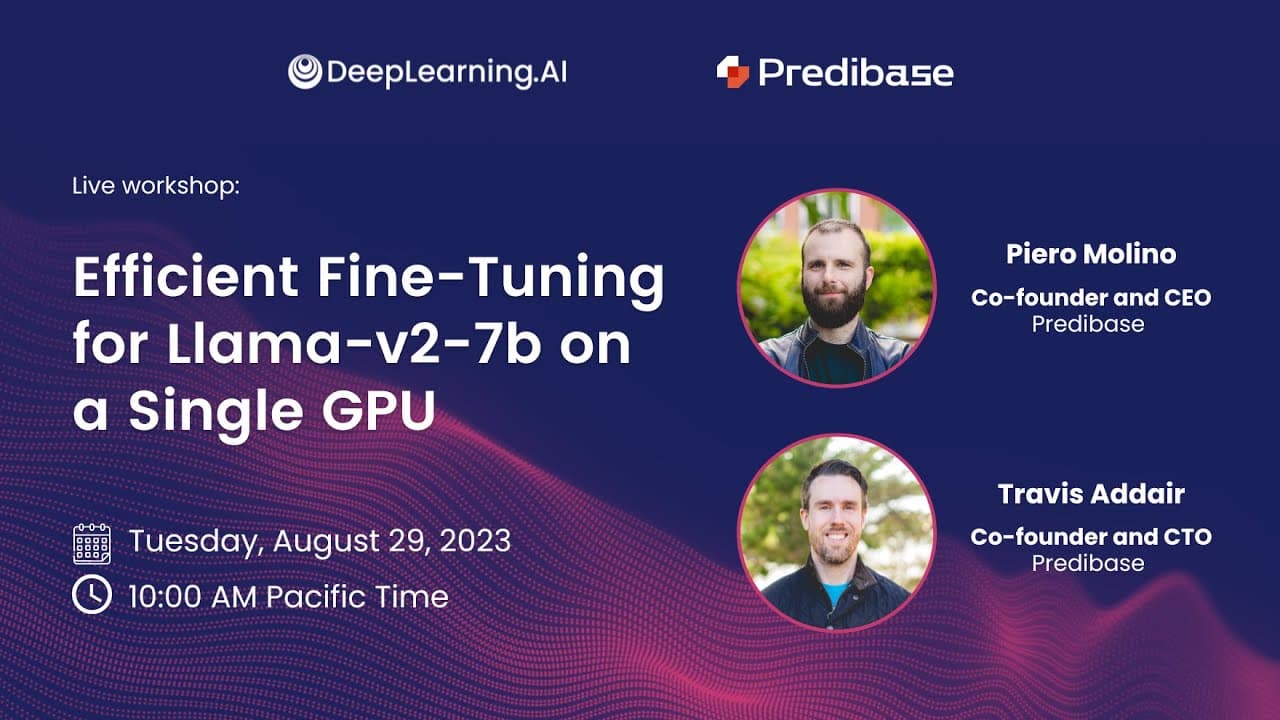
To effectively fine-tune Llama 2 on a single GPU, utilize techniques like half-precision quantization, low-rank adaptation, and gradient accumulation to manage memory limitations. The Ludwig framework simplifies this process with a declarative configuration, allowing for efficient model training while leveraging pre-trained models. This approach maximizes performance without requiring high-end hardware.
Transcript
foreign hi everyone my name is Diana Chen Morgan and I'm part of the deep learning.ai team bringing you all together for all things AI community and events today we are very lucky to have a workshop with some special speakers From Prada base in this Hands-On Workshop we'll discuss the unique challenges in fine-tuning llms and show how you can tackl... Read More
Key Insights
- 🚂 Fine-tuning LLMs is a valuable technique that allows you to train smaller models with excellent performance by leveraging pre-trained models.
- 😄 Ludwig simplifies the process of building custom AI models with its declarative configuration file approach, providing both control and ease of use.
- 😘 Memory limitations of GPUs can be overcome through techniques like quantization, low-rank adaptation, and gradient accumulation.
- 🥠 Fine-tuned LLMs offer more control, accuracy, and performance compared to retrieval augmented generation (RAG).
Install to Summarize YouTube Videos and Get Transcripts
Explore YouTube Video Summarizer or Get YouTube Transcript Extractor
Questions & Answers
Q: What is Ludwig and how does it simplify the process of building custom AI models?
Ludwig is a declarative deep learning framework that allows you to build AI models using a simple YAML configuration file. You can define the schema of your data, specify inputs and outputs, and easily iterate and experiment with different models without writing extensive code.
Q: How can we overcome the memory limitations of GPUs when fine-tuning LLMs?
Techniques like half-precision quantized training, low-rank adaptation, and gradient accumulation help reduce the memory footprint of LLMs. By compressing model parameters, gradients, and optimizer states, it becomes possible to fit LLMs into limited GPU memory.
Q: What is the advantage of fine-tuning LLMs over other strategies like retrieval augmented generation (RAG)?
Fine-tuning LLMs allows you to train a smaller model to perform a specific task by leveraging existing pre-trained models. It offers more control and flexibility in model behavior, accuracy, and performance. RAG is useful when you need to retrieve information from specific documents, but fine-tuning is better for task-specific performance.
Q: Can we generate embeddings from LLMs using Ludwig?
Yes, Ludwig provides a predict function that allows you to generate embeddings from LLMs. You can specify the layer from which you want to collect the activations, which can be used for downstream tasks or for building vector databases.
Summary & Key Takeaways
-
Fine-tuning LLMS: Discover the unique challenges of fine-tuning LLMs and understand why it is a valuable technique in machine learning applications.
-
Introducing Ludwig: Learn about Ludwig, a declarative deep learning framework, and how it simplifies the process of building and fine-tuning custom AI models.
-
Overcoming Memory Bottlenecks: Explore techniques such as half-precision quantized training, low-rank adaptation, and gradient accumulation to fit LLMs into limited GPU memory.
-
Demo and Resources: Get a step-by-step demonstration of fine-tuning LLMs using Ludwig and discover additional resources and platforms, like Prada Base, for hosting and deploying LLMs.
Read in Other Languages (beta)
Share This Summary 📚
Summarize YouTube Videos and Get Video Transcripts with 1-Click
Try YouTube Summary with ChatGPT & Claude or YouTube Transcript Generator
Explore More Summaries from DeepLearningAI 📚

Summarize YouTube Videos and Get Video Transcripts with 1-Click
Try YouTube Summary with ChatGPT & Claude or YouTube Transcript Generator