How Do Nuclear Submarines Produce Oxygen for Crews?
TL;DR
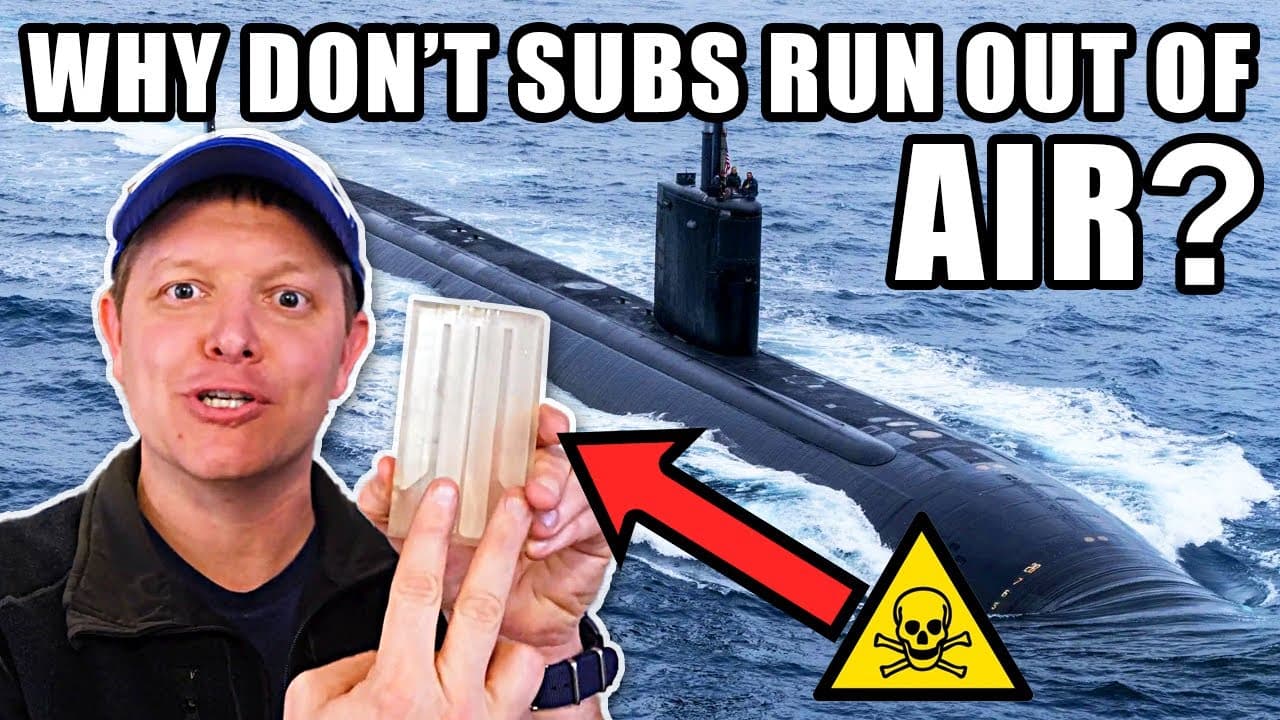
Nuclear submarines make oxygen two ways: electrolysis, which uses the nuclear reactor's electricity to split water into hydrogen and oxygen, and oxygen candles, which release oxygen when a chemical charge (containing compounds like iron and sodium chlorate) is burned with no external power needed. A central atmospheric monitoring system called CAMS constantly measures oxygen, carbon dioxide, and other gases at every station on the boat, and carbon dioxide is scrubbed out using monoethanolamine (MEA) and lithium hydroxide. Read on to see how each system keeps the crew breathing under the ice.
Transcript
hey it's me destin welcome back to smarter every day this is a lunar lander that's a different series we're starting on smarter every day this is a nuclear submarine we are now really far into the nuclear submarine deep dive here on smarter every day and today we're going to answer a question that i've always wanted to know submarines are designed ... Read More
Key Insights
- 🚣 Submarines heavily rely on the central atmospheric monitoring system (CAMS) to monitor and maintain a livable atmosphere throughout the boat.
- ✊ Electrolysis and oxygen candles are both used to generate oxygen on submarines, providing a backup method in case of power loss.
- 💠 Monoethanol amine (MEA) and lithium hydroxide are used for scrubbing carbon dioxide from the atmosphere inside submarines.
- 🎟️ The ability to continuously generate oxygen and remove carbon dioxide is vital for prolonged underwater missions.
- 🍵 Submariners are trained extensively to handle and maintain the systems responsible for oxygen generation and carbon dioxide removal.
- ✊ Oxygen candles are a passive means of generating oxygen that requires no external power source.
- 🦺 Submarines employ various safety measures and protocols, such as monitoring alarms and leak detection systems, to ensure the crew's safety during oxygen generation processes.
Install to Summarize YouTube Videos and Get Transcripts
Explore YouTube Video Summarizer or Get YouTube Transcript Extractor
Questions & Answers
Q: How do nuclear submarines make oxygen?
Submarines produce oxygen with two methods: electrolysis and oxygen candles. Electrolysis uses electricity from the nuclear reactor to power electrodes that break water into hydrogen and oxygen, with the hydrogen removed and the oxygen kept for breathing. Oxygen candles serve as a backup, releasing oxygen when burned.
Q: What are the two methods used to create oxygen on submarines?
The two methods are electrolysis and oxygen candles. Electrolysis splits water into hydrogen and oxygen using reactor power, while oxygen candles release oxygen as a byproduct when their chemical charge is burned. Having both means the crew still has air even if power is lost.
Q: How does electrolysis work on a submarine to generate oxygen?
Electrolysis uses the nuclear reactor to power electrodes that break down water into hydrogen and oxygen. The hydrogen is removed from the boat and the oxygen is added to the atmosphere for the crew to breathe. This lets the submarine keep making oxygen continuously while submerged.
Q: What is an oxygen candle and why is it used on submarines?
An oxygen candle is a chemical charge, containing compounds like iron and sodium chlorate, that releases oxygen when it is burned. It works as a passive backup because it needs no external power source. This makes it a reliable way to keep generating breathable air if the boat loses power.
Q: How do submarines remove carbon dioxide from the air?
As the crew breathes, carbon dioxide builds up and the atmosphere would eventually become soured. Submarines scrub the carbon dioxide out of the air using monoethanolamine (MEA) and lithium hydroxide. Continuously removing carbon dioxide is as important as making oxygen for long underwater missions.
Q: How do submarines monitor the atmosphere on board?
They use a system called CAMS, the central atmospheric monitoring system, located in the middle of the boat. Operators turn a dial to sample and measure gases such as oxygen, carbon dioxide, hydrogen, nitrogen, water, carbon monoxide, and refrigerant at different stations. If a level gets too high or too low, an alarm beeps to warn the crew.
Q: Why do submarines need to make their own oxygen?
Submarines are designed to stay underwater as long as possible, and sometimes cannot surface at all, such as when a boat like the USS Toledo is operating under the ice. Since the crew constantly consumes oxygen and exhales carbon dioxide, the air would eventually become unbreathable. Onboard oxygen generation and carbon dioxide removal keep the atmosphere livable throughout the boat.
Q: How do submariners find a gas leak on board?
CAMS first isolates which section of the boat has an abnormal reading. Crew then use a handheld universal refrigerant leak detector, called a sniffer, which they drag slowly along the piping to pinpoint the leak, and it can be set for small, medium, or large leaks. It alerts the operator as it gets closer to the source, similar to a Geiger counter.
Summary & Key Takeaways
-
Submarines rely on a central atmospheric monitoring system (CAMS) to monitor the atmosphere at different locations in the boat and ensure it remains livable throughout.
-
Electrolysis is one method used to create oxygen on submarines by using a nuclear reactor to power electrodes that break down water into hydrogen and oxygen.
-
Oxygen candles, containing chemicals like iron and sodium chlorate, are another method employed to produce oxygen by burning these candles and releasing oxygen as a byproduct.
Read in Other Languages (beta)
Share This Summary 📚
Summarize YouTube Videos and Get Video Transcripts with 1-Click
Try YouTube Summary with ChatGPT & Claude or YouTube Transcript Generator
Explore More Summaries from SmarterEveryDay 📚



Summarize YouTube Videos and Get Video Transcripts with 1-Click
Try YouTube Summary with ChatGPT & Claude or YouTube Transcript Generator