Why Learn Programming When AI Can Already Code?
TL;DR
You should still learn programming because AI can magnify strong human abilities, but it cannot replace the foundational understanding, motivation, and curiosity required for meaningful growth. Use AI experimentally and self-consciously, making sure you continue doing enough thinking and practice to retain architectural judgment, writing ability, probabilistic reasoning, and independent problem-solving skills.
Transcript
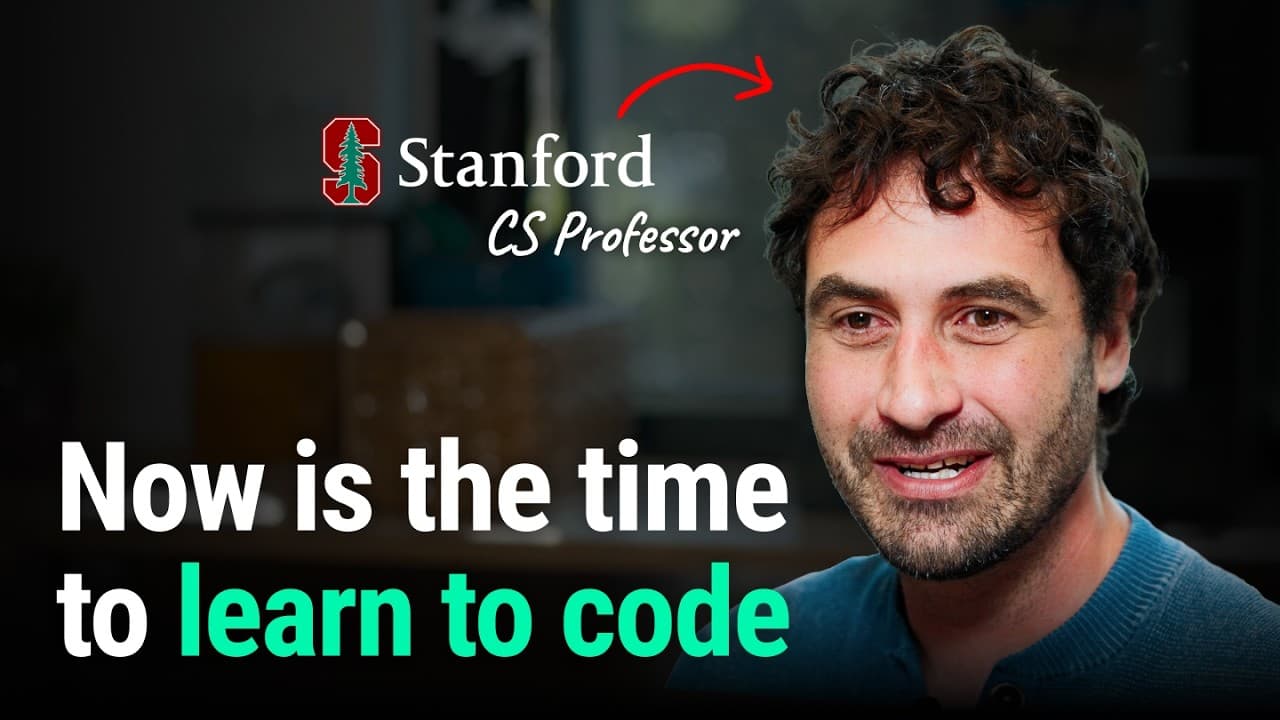
Hi, you know, I'm Chris Peach. I'm a professor here at Stanford University. I teach some large intro to computer science classes, some intro to math for AI. Code in Place, if people don't know it, it's an online class where you can learn to program. And the special thing about Code in Place is that it's the class in the world with the most teachers... Read More
Key Insights
- Programming remains worth learning because AI can amplify a person's existing abilities, but effective use still depends on understanding code, reasoning about architecture, and recognizing when generated work is appropriate. Giving up foundational knowledge would also mean surrendering the judgment needed to guide AI well.
- The argument for learning code also applies to probability, writing, and formal reasoning. AI can perform tasks in all of these areas, yet students still need deep knowledge because intellectual competence remains valuable even when tools can produce plausible answers or complete portions of the work.
- Excessive AI outsourcing can interrupt personal growth. If students let AI write too many essays or too much code, they risk losing the ability to perform the critical thinking and architectural work themselves. Productive use therefore requires continual self-awareness about whether the learner is developing alongside the tool.
- Student motivation is being strained by uncertainty about future employment. Learners beginning a four-year program must imagine jobs in 2030 while anticipating several more years of AI development, even though predictions about which jobs will matter five to ten years ahead have historically been unreliable.
- Code in Place serves about 17,000 students with more than 1,000 teachers, producing roughly one teacher for every ten students. Its defining feature is not merely online instructional content, but access to people who are slightly further along and willing to support each learner's development.
- Generic chatbot access can demotivate beginners rather than improve their learning. Across six years of Code in Place experiments with different amounts of AI support, simply giving students a chatbot was associated with predictable dropout, showing that correct answers alone do not solve educational challenges.
- Human interaction can measurably improve persistence. When Code in Place students received an invitation to speak with an available teacher for ten minutes and accepted it, their probability of completing the course increased by 10 percentage points, even though the human teachers were not always correct.
- Curiosity and inspiration are central educational outcomes that current chatbots often fail to produce. A teacher who understands a student's level and direction can select an unexpected example or challenge that ignites sustained interest, whereas a chatbot commonly limits itself to answering the question presented.
Install to Summarize YouTube Videos and Get Transcripts
Explore YouTube Video Summarizer or Get YouTube Transcript Extractor
Questions & Answers
Q: Why should students learn programming when AI can code?
Students should learn programming because AI can magnify their abilities, but they still need enough knowledge to reason independently, evaluate generated code, and handle valuable architectural decisions. Programming also develops formal thinking and problem-solving. If learners outsource too much work before establishing foundations, they may lose the ability to identify what the AI should do or whether its output is appropriate.
Q: How should students use AI without weakening their coding skills?
Students should experiment with AI while remaining conscious of their own growth. They should ask whether the tool is helping them understand a problem or merely doing the important thinking for them. Building foundations first, practicing independently, and retaining responsibility for architectural choices can help ensure that AI extends their abilities instead of replacing the learning experiences that create those abilities.
Q: What is Code in Place and how does it support learners?
Code in Place is an online programming class created by Chris Piech and offered for six years. It has about 17,000 students and more than 1,000 teachers, with approximately one teacher for every ten students. Its distinctive support model gives learners access to people who are slightly further along and willing to spend time helping them develop, rather than relying only on recorded instructional content.
Q: Why can an AI tutor reduce student motivation?
An AI tutor can reduce motivation when it is introduced as a generic chatbot at the wrong stage of learning. Code in Place experiments found that learners predictably dropped out when they were simply given AI and told to use it. The problem was not necessarily incorrect answers. The AI was accurate in introductory programming, but accuracy alone did not provide the care, encouragement, or inspiration students needed.
Q: How much can a short conversation with a human teacher improve course completion?
A ten-minute conversation with an available human teacher can raise a Code in Place student's probability of completing the course by 10 percentage points. Students may receive a pop-up offering the conversation while they are programming. The benefit does not appear to come solely from technical correctness, because teachers were not always correct. The motivating effect of personal attention is presented as the crucial difference.
Q: What is the most important role of a teacher in the age of AI?
A teacher's most important role is to motivate students, communicate genuine care for their intellectual growth, and ignite curiosity. Teachers can use their understanding of a student's current level and goals to choose an unexpectedly compelling example or challenge. That personalized inspiration can make a learner keep thinking about a problem long after class, while current chatbots generally focus on answering the question they receive.
Q: Why are students experiencing a motivational crisis about AI?
Students face uncertainty not only about what they can contribute with current AI, but also about what employment will exist after they finish a multi-year education. Someone entering a four-year program must consider jobs in 2030, when AI may be four years more advanced. That uncertainty can undermine motivation, especially because long-term predictions about which jobs will be right have often been wrong.
Q: Should students build foundations before learning to code with AI?
Students should work on foundational programming skills before making AI central to their coding process. Chris Piech describes this sequence as more effective: first establish the ability to think, reason, and program, then learn how to code with AI. Foundations help learners preserve independent judgment and recognize the valuable architectural work that might otherwise be outsourced before they understand it.
Summary & Key Takeaways
-
Chris Piech argues that AI's ability to code does not make programming education obsolete. The same reasoning applies to writing, probability, and formal argument. Students should build deep foundations because AI can magnify their abilities, while excessive outsourcing may weaken the judgment and independent thinking needed to direct complex work.
-
Code in Place grew from an online response to the pandemic into a course serving about 17,000 students with more than 1,000 teachers. Its model emphasizes accessible human guidance, including section leaders who are slightly further along and personally invested in helping learners develop confidence, persistence, and practical programming skills.
-
Experiments with different levels of AI assistance found that simply giving learners a chatbot could reduce motivation and increase dropout. A short conversation with an available human teacher raised a student's probability of completing the course by 10 percentage points, suggesting that education depends on care, inspiration, and curiosity as well as correct explanations.
Read in Other Languages (beta)
Share This Summary 📚
Summarize YouTube Videos and Get Video Transcripts with 1-Click
Try YouTube Summary with ChatGPT & Claude or YouTube Transcript Generator
Explore More Summaries from EO 📚

Summarize YouTube Videos and Get Video Transcripts with 1-Click
Try YouTube Summary with ChatGPT & Claude or YouTube Transcript Generator