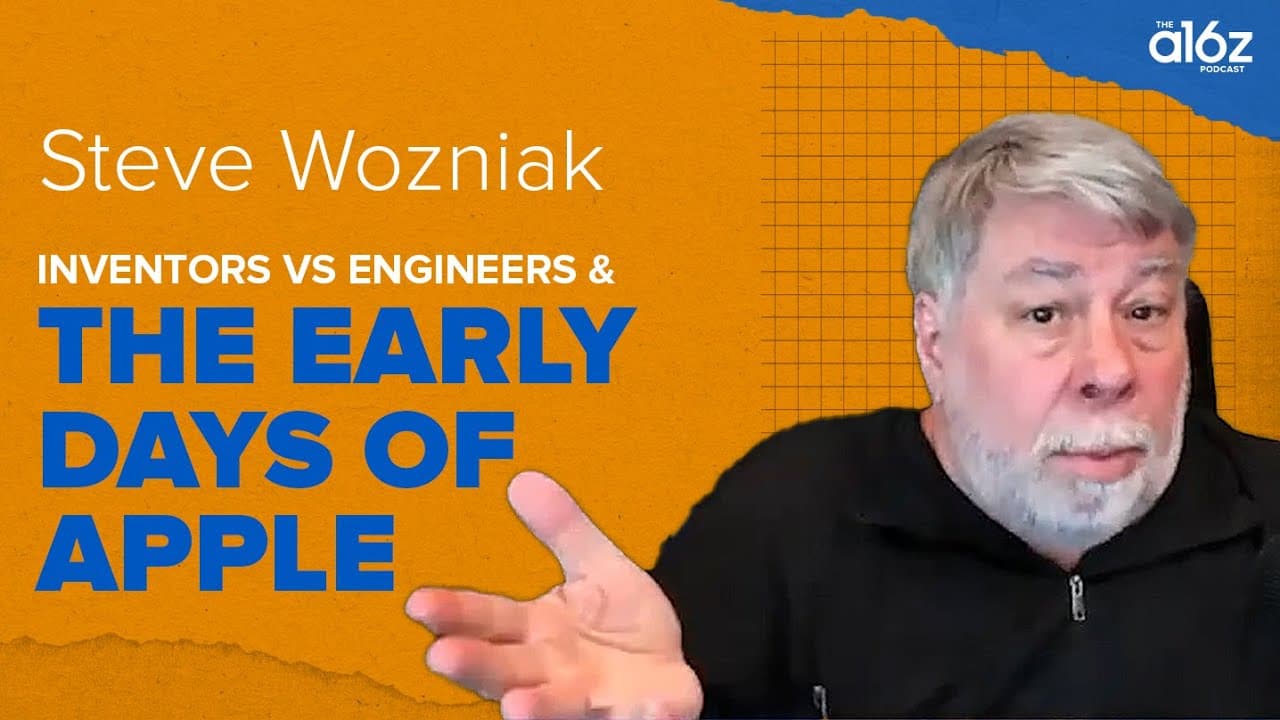
Steve Wozniak on Inventors vs Engineers and the Early Days of Apple
TL;DR
Steve Wozniak believes that inventors are motivated by passion and creativity, while engineers focus on practical solutions. His journey from wanting a computer to co-founding Apple was fueled by a personal need and a bit of luck. He emphasizes that successful innovation often stems from the desire to make a difference and shows that making learning engaging is key to effective education.
Transcript
well something you spoke to there is the ability for these Technologies to be exponential right what we see today from private tier might not be what it is in five years or 50 years and I had the privilege of talking to Alex yesterday and he told me this story about you from the very very early days where when you were younger you basically told yo... Read More
Key Insights
- 🥺 The journey that starts with personal passion can lead to significant business success.
- 🎓 Making education enjoyable and fostering motivation are crucial in effective learning.
- 🖐️ Luck can play a substantial role in achieving business success.
- 🤔 Private industry and inventors have the advantage of thinking differently, being more creative, and taking risks.
Install to Summarize YouTube Videos and Get Transcripts
Explore YouTube Video Summarizer or Get YouTube Transcript Extractor
Questions & Answers
Q: What motivated Steve Wozniak to start Apple?
Initially, Wozniak simply wanted a computer for himself and others. He believed in the personal need for devices like computers and wanted to make them accessible to everyone.
Q: What did Steve Wozniak learn during his time as a teacher?
Wozniak learned that the motivation of students to learn is more important than simply delivering knowledge. He found ways to make education fun, understandable, and engaging through storytelling and stimulating students' curiosity.
Q: What role did luck play in Steve Wozniak's success?
Wozniak acknowledges that luck played a significant role in the success of Apple. The timing of building the computer he wanted coincided with a point where it became incredibly valuable. Luck, combined with hard work and dedication, contributed to his achievements.
Q: How does Steve Wozniak view the difference between government and private industry approaches?
Wozniak believes that private industry works differently from governments due to their ability to think differently, be creative, and take risks. He sees inventors as essential in private industry, driven by their desire to create something new and make a difference.
Summary
In this video, Steve Wozniak discusses his early days in technology, the importance of motivation and passion in learning, the advantages of private industry over government, and the role of inventors in driving innovation. He also talks about the evolution of computer technology and the challenges of predicting the future.
Questions & Answers
Q: What motivated Steve Wozniak to build a computer in the early days?
Steve Wozniak was motivated by a personal need for a computer. He had a strong desire to own and use a computer, even though at that time they were very expensive. He wanted not just a computer for himself, but also for others to have access to this technology.
Q: What was going on in Steve Wozniak's mind during the early days of computer development?
Steve Wozniak saw the potential of computers and believed that they could be a powerful tool for individuals. He had a deep passion for technology and wanted to create a computer for himself. He also had the belief that designing computers could be a job for engineers, even though they were still in the analog days of technology.
Q: How does private industry differ from government in terms of innovation?
Private industry allows for more creativity and freedom in thinking. The inventor mindset is valued in private industry, where individuals are encouraged to come up with new ideas and make a difference in the world. In contrast, government tends to be more conservative and relies on established approaches. Private industry can take risks and think differently, which often leads to groundbreaking innovations.
Q: What advantages does private industry have over government?
Private industry has the advantage of being more agile and adaptable. It can take advantage of new technologies and resources that may be cheaper or more readily available. Private industry also attracts visionary inventors who are driven by their passion and curiosity, rather than simply following predefined career paths. This entrepreneurial spirit and willingness to take risks often leads to more innovation and success.
Q: Could Steve Wozniak envision the path from the early days of computers to today's advanced technology?
While Steve Wozniak couldn't predict every advancement that would take place, he had the foresight to see the potential for growth and progress in technology. He didn't envision the exact details of the future, as that would be akin to science fiction, but he believed in the power of innovation and the continuous improvement of computer technology. He focused on what could be achieved in the present while keeping an eye on future possibilities.
Q: How did Steve Wozniak approach the development of Apple products in terms of vision and practicality?
Steve Wozniak believed in combining practicality and vision in the development of Apple products. While he agreed that having a vision for the future is important, he also emphasized the importance of focusing on what can be accomplished in the present. The approach was to build on what they could do today, always pushing for incremental improvements tomorrow. This allowed them to have a strong product pipeline and a clear path towards the future.
Q: Can Steve Wozniak predict the future of technology beyond a year?
Steve Wozniak believes that predicting the future beyond a year is difficult, even for someone deeply involved in technology. The pace of advancements and the influence of external factors make it challenging to accurately foresee what will happen. He acknowledges that technology development is influenced by various factors, including people's desires and technological breakthroughs from unexpected sources. While it's important to have long-term goals, the focus should primarily be on immediate projects and making progress step by step.
Q: How does Steve Wozniak differentiate between inventors and engineers?
Steve Wozniak sees inventors as individuals who have the drive to create something that doesn't yet exist. They are driven by curiosity and the desire to make a difference in the world. Engineers, on the other hand, are skilled professionals who can design and build what they are assigned. While both inventors and engineers are important, inventors tend to take risks and push boundaries, while engineers focus on practicality and delivering results.
Q: What was the turning point for Apple's success?
The turning point for Apple's success was the introduction of the iPod, which revolutionized the music industry. The iPod was based on the Apple II, but its mass appeal and wide adoption propelled Apple's sales and profits to new heights. This success was further amplified with the launch of the iPhone, which built upon the iPod's foundation. Steve Jobs played a crucial role in driving these innovations and steering Apple towards tremendous success.
Q: How do big companies differ from inventors in terms of success?
Big companies, with their vast resources and established market presence, have a different level of certainty in their projects. Their focus is on creating successful products and meeting market demand. In contrast, inventors are more inclined to take risks and challenge the status quo. They strive to prove to themselves and the world that they can go beyond what is currently imaginable. While both approaches can lead to success, inventors are often more motivated by the desire to achieve the extraordinary.
Takeaways
Steve Wozniak emphasizes the importance of passion, motivation, and creativity in driving innovation. He highlights the advantages of private industry, where inventive thinkers can push boundaries and take risks. He also acknowledges the challenges of predicting the future and encourages focusing on the present while continually striving for progress. Ultimately, the ability to envision and create something that didn't exist before is what distinguishes inventors from engineers and contributes to significant advancements in technology.
Summary & Key Takeaways
-
Steve Wozniak initially wanted a computer, which led to his co-founding of Apple, driven by the desire to make computers accessible to everyone.
-
Wozniak emphasizes the importance of motivation and making learning fun for students to encourage effective education.
-
He highlights the role of luck in business success and contrasts the approaches of government and private industry, emphasizing the creativity and inventiveness in the latter.
Read in Other Languages (beta)
Share This Summary 📚
Summarize YouTube Videos and Get Video Transcripts with 1-Click
Try YouTube Summary with ChatGPT & Claude or YouTube Transcript Generator
Explore More Summaries from The a16z Podcast 📚






Summarize YouTube Videos and Get Video Transcripts with 1-Click
Try YouTube Summary with ChatGPT & Claude or YouTube Transcript Generator