How to 10x AI outputs with simple prompts for ChatGPT
TL;DR
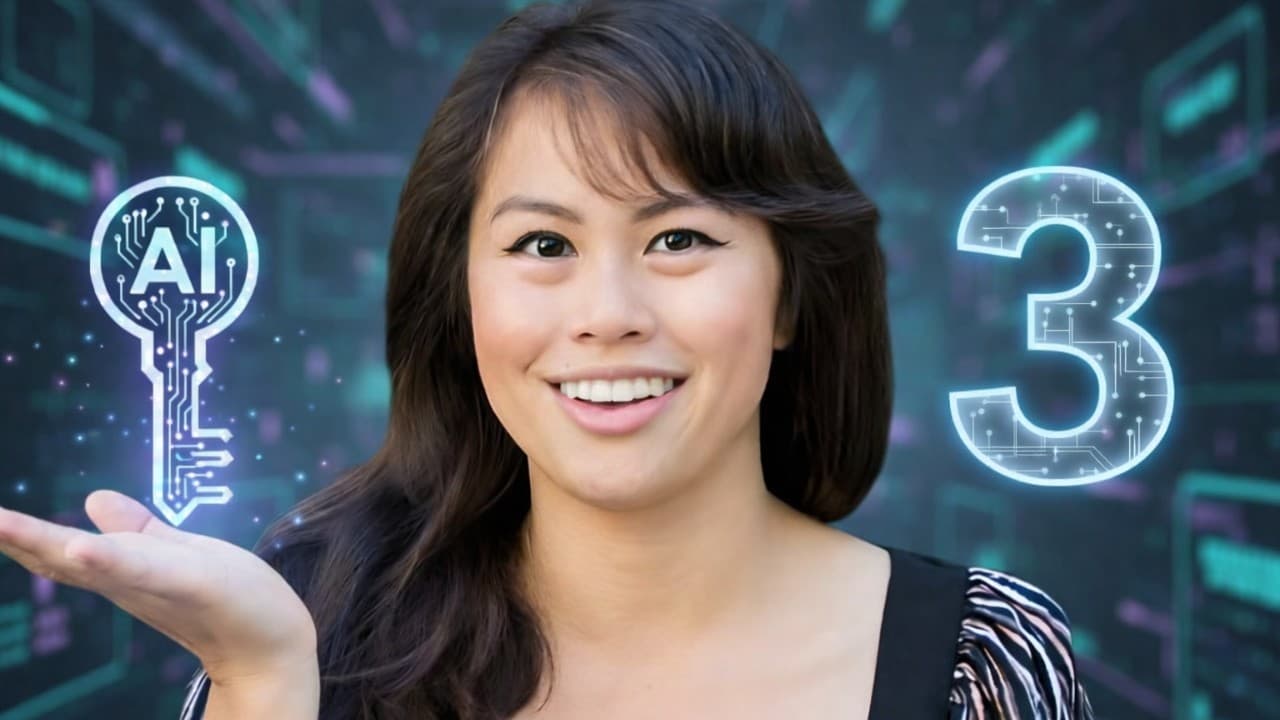
Appending each of three oneliners to your prompts makes GPT ask clarifying questions, tailor responses, and produce a more tailored business plan. The video demonstrates exactly how to test prompts step by step and shows examples of questions to ask before answering. This method improves alignment and output quality across models.
Transcript
here are three simple tips to unlock chat GPT genius mode And all you have to do is append each of these items to the end of your prompt and it's going to be 10x better By the way you can use this in chat GPT Deep Seek Claw Gemini your favorite AI model It works really well with any of them If you don't know me my name is Sabrina Romanov I'm an AI ... Read More
Key Insights
- Oneliners appended to prompts alter AI behavior by adding explicit constraints or steps. This simple tactic can dramatically change the quality of the AI's response.
- The key to better results is asking clarifying questions until 95 percent confidence is reached, prompting the model to refine requirements before proceeding.
- Tailored prompts produce more relevant outputs by centering the task around user-specific details and intended outcomes rather than generic responses.
- The method is versatile across AI models like ChatGPT, Deep Seek, Claude, and Gemini, enabling consistent improvements regardless of the platform.
- Testing prompts one tip at a time helps isolate what works and allows for incremental learning and optimization in real use cases.
- Using top thinker prompts, such as asking how a top investor would view a plan, can shift output toward more rigorous, investment-grade analyses.
- Reframing the problem with prompts can shift focus from features to fundamental user pains, improving product-market fit understanding.
- The overall strategy encourages interactive prompt design, where the AI’s output guides further questioning and refinement for a tightly scoped result.
Install to Summarize YouTube Videos and Get Transcripts
Explore YouTube Video Summarizer or Get YouTube Transcript Extractor
Questions & Answers
Q: How can one use oneliners to improve AI outputs in practice
Using oneliners involves appending short, directive phrases to the end of your prompts before submission. These phrases steer the model to ask clarifying questions, tailor the output to your specifications, or reframe the problem. Practically, you would test a base prompt, then add a one liner and compare results to choose the best approach.
Q: Why are clarifying questions important before proceeding
Clarifying questions uncover ambiguities and assumptions that could otherwise lead to misaligned results. By prompting the AI to ask questions until near certainty, you ensure the task scope is correct, required details are collected, and the final output matches your actual needs rather than an approximate solution.
Q: What is the benefit of getting 95 percent confidence before proceeding
Reaching 95 percent confidence helps ensure the AI has gathered enough critical information to complete the task accurately. It reduces back-and-forth iterations, speeds up delivery, and yields outputs that reflect a well-defined plan or analysis, which is particularly valuable for complex tasks like business planning.
Q: Can you use this method with different AI models
Yes, the approach is model-agnostic. The same principle works when using different AI systems such as ChatGPT, Deep Seek, Claude, or Gemini. The one-liner prompts help tailor outputs to the user’s needs regardless of the underlying model, enabling consistent improvements across platforms.
Q: How does testing prompts one tip at a time help
Testing prompts one tip at a time isolates the impact of each modification. This incremental approach makes it easier to identify which prompts drive the most significant improvements, creates a learning loop, and allows building a customized prompt toolkit that reliably yields better results over time.
Q: What is the value of thinking like a top investor in prompts
Asking the model to think like a top investor sharpens the analysis by focusing on market opportunity, defensibility, unit economics, and credible metrics. It steers outputs toward rigorous, decision-grade content rather than generic prose, making the results more persuasive for stakeholders.
Q: How does reframing the problem improve results
Reframing the problem shifts attention to underlying pains, user needs, and broader contexts rather than surface features. This helps generate outputs that address real problems, opens new design possibilities, and leads to solutions that are more likely to resonate with the intended audience.
Q: What practical steps can viewers take after watching this video
Viewers can start by selecting a challenging task, writing a base prompt, and then creating several one liner variations. Test each variation, compare results, and adopt the best performing prompts into a personal toolkit. Regular experimentation builds familiarity and improves future AI outputs.
Summary & Key Takeaways
-
Prompts can be extended with concise oneliners to steer AI behavior and produce deeper, more relevant outputs across models and tasks.
-
Clarifying questions are used to raise confidence and surface missing assumptions, guiding the user to provide better input and yielding more precise results.
-
The approach is demonstrated with a business plan example, illustrating how tailored prompts create outputs that align with user goals and constraints.
Read in Other Languages (beta)
Share This Summary 📚
Summarize YouTube Videos and Get Video Transcripts with 1-Click
Try YouTube Summary with ChatGPT & Claude or YouTube Transcript Generator
Explore More Summaries from Sabrina Ramonov 🍄 📚



Summarize YouTube Videos and Get Video Transcripts with 1-Click
Try YouTube Summary with ChatGPT & Claude or YouTube Transcript Generator