How Does Mist Cooling Improve Heatsink Performance?

TL;DR
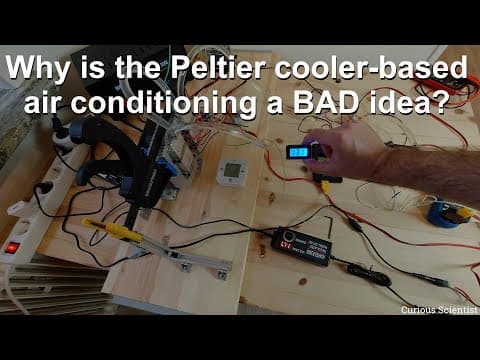
Mist cooling can enhance heatsink performance by over 4 degrees Celsius. By introducing water vapor in conjunction with proper airflow, the temperature difference between the hot and cold sides of a cooling system is significantly reduced. This method leverages the heat absorption properties of evaporation, leading to more effective heat management.
Transcript
welcome everyone in this video i'm going to continue the previous videos experiments so what i did in the previous video i was using uh this heatsink and i was trying out different methods to cool it down and what i did basically is i attached a thermometer here now it is attached here so there was a k-type thermocouple clamped on this surface and ... Read More
Key Insights
- 🥺 The experiment effectively illustrates how the combination of mist and airflow can lead to significant reductions in temperature for heatsinks.
- 🥵 Vapor cooling benefits from the principle of heat absorption during the evaporation process, making it a valuable addition to traditional cooling methods.
- 😎 The recorded temperature differences underscore the critical relationship between the efficiency of cooling components and the resulting thermal outcomes of cooling systems.
- 🥶 Properly insulating the cold side of the cooler allows for enhanced temperature differentials, benefiting performance.
- 🔡 Achieving low temperatures is not solely dependent on the power input; cooling strategies can dramatically affect outcomes.
- 😎 Experimentation with different setups revealed that even minor adjustments in fan placement and cooling mechanisms can yield noticeable improvements.
- 😎 The findings highlight the need for careful design considerations in order to prevent moisture-related issues in cooling systems.
Install to Summarize YouTube Videos and Get Transcripts
Explore YouTube Video Summarizer or Get YouTube Transcript Extractor
Questions & Answers
Q: What was the initial temperature when starting the cooling experiment?
The initial temperature recorded at the start of the experiment was approximately 26.7 degrees Celsius. This measurement was taken to establish a baseline for the cooling performance of different methods employed in the video. By ensuring consistency in temperature measurements, comparisons could be accurately made as the cooling methods were tested.
Q: How does the introduction of mist affect the cooling efficiency?
The introduction of mist significantly enhances cooling efficiency by leveraging the evaporation of water droplets. As mist passes through the heatsink's lamellas, the fine droplets absorb heat from the surface upon evaporation, resulting in lower temperatures at the cold side. This process effectively transfers heat away from the heatsink, leading to improved thermal performance in comparison to dry air alone.
Q: What were the achieved temperature results without and with mist?
Without the introduction of mist, the experiments achieved a minimum temperature of around -20.5 degrees Celsius at approximately 40 watts of power. In comparison, when mist was utilized as a cooling method, the temperature was lowered to approximately -24.5 degrees Celsius, showcasing a substantial enhancement in cooling performance, demonstrating the effectiveness of evaporative cooling strategies.
Q: What role does airflow play in the cooling process during the experiment?
Airflow plays a crucial role in the cooling process by facilitating the transfer of heat away from the cooler's hot side to the environment. Proper airflow ensures that the hot side is effectively cooled, allowing for lower temperatures to be reached at the cold side. The video illustrates that an optimal arrangement of fans can directly impact cooling efficiency and highlights the importance of maintaining airflow for achieving the desired thermal performance.
Q: What factors were noted to influence the temperature difference between the cold and hot sides?
The temperature difference observed between the cold and hot sides was influenced by several factors, including the efficiency of airflow, the presence of mist for evaporative cooling, the power applied to the cooling unit, and thermal insulation of the cold side. The experiment demonstrated that effectively cooling the hot side directly correlated to achieving lower temperatures on the cold side, emphasizing the significance of each element in the overall cooling process.
Q: Can the setup discussed in the video be improved further?
Yes, the setup discussed in the video can definitely be improved further. Potential enhancements include optimizing the airflow dynamics and exploring the use of specialized fans designed for wet environments to prevent moisture damage. The author also indicated plans to fine-tune the configuration to achieve even lower temperatures, highlighting the possibilities for ongoing experimentation and improvement in cooling systems.
Summary & Key Takeaways
-
The video demonstrates the use of mist and airflow to enhance the cooling performance of heatsinks, specifically a patio cooler and a CPU cooler.
-
By applying water vapor through mist and maintaining proper airflow, the experiment highlights how these elements can lower the temperature difference between the cold and hot sides of a cooling system.
-
Results indicated a notable temperature drop of over 4 degrees Celsius when water vapor was introduced, showcasing effective cooling strategies for heat management.
Read in Other Languages (beta)
Share This Summary 📚
Summarize YouTube Videos and Get Video Transcripts with 1-Click
Try YouTube Summary with ChatGPT & Claude or YouTube Transcript Generator
Explore More Summaries from Curious Scientist 📚
![Building a coil winder [Part 6] - A few improvements thumbnail](/_next/image?url=https%3A%2F%2Fi.ytimg.com%2Fvi%2F3eyxG_g2iUA%2Fhqdefault.jpg&w=750&q=75)



Summarize YouTube Videos and Get Video Transcripts with 1-Click
Try YouTube Summary with ChatGPT & Claude or YouTube Transcript Generator