How to Calculate the Inverse of a 2x2 Matrix
TL;DR
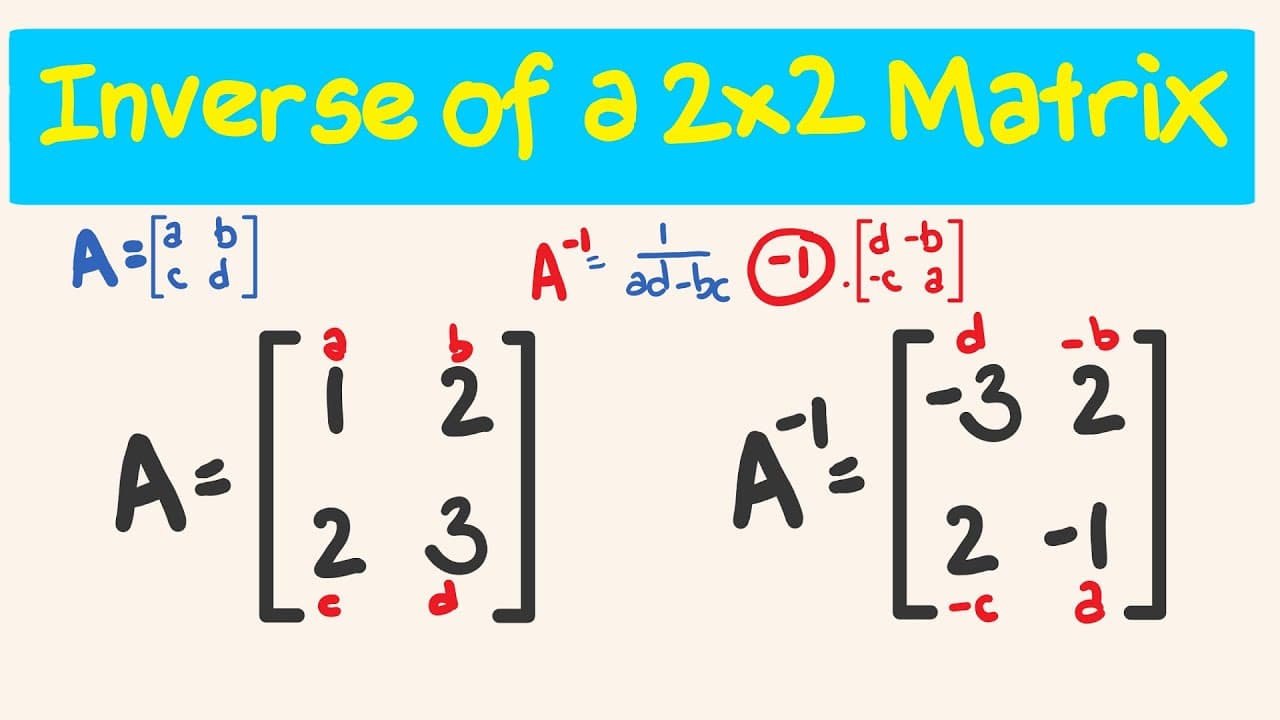
To find the inverse of a 2x2 matrix, calculate its determinant by multiplying elements diagonally and subtracting the products. If the determinant is non-zero, swap the positions of the elements and change the signs of the off-diagonal elements, then multiply by the reciprocal of the determinant to get the inverse matrix.
Transcript
good day welcome to Tech maath Channel I'm Josh in this video we're going to continue looking at matrices particularly what we're going to be having a look at is this the identity Matrix what that is and then also we're going to have a look at inverse matrices and this thing called to determine it how we can use that to work out the inverse Matrix ... Read More
Key Insights
- 🧑🏭 The identity matrix acts similarly to multiplying a number by one in regular mathematics.
- ❎ Only square matrices can have an identity matrix.
- ❓ The size of the identity matrix follows a specific pattern.
- ❓ The inverse matrix is calculated using the determinant and a swapping process.
- 0️⃣ Not all matrices have an inverse matrix if the determinant is zero.
- ❓ Calculating the inverse matrix involves specific steps and formulas.
- ✖️ The inverse matrix, when multiplied with the original matrix, yields the identity matrix.
Install to Summarize YouTube Videos and Get Transcripts
Explore YouTube Video Summarizer or Get YouTube Transcript Extractor
Questions & Answers
Q: What is the identity matrix and how does it relate to regular multiplication in mathematics?
The identity matrix is a matrix that, when multiplied with another matrix, results in the same matrix. It is similar to multiplying a number by one in regular multiplication, where the number remains unchanged.
Q: Can any matrix have an identity matrix?
No, only square matrices can have an identity matrix. The dimensions of the identity matrix will match the dimensions of the square matrix.
Q: How can the identity matrix be represented for different sizes of square matrices?
The identity matrix follows a specific pattern. For a 1x1 matrix, it consists of a single row and column with a value of 1. For a 2x2 matrix, it has a diagonal of ones and zeros for the rest. For a 3x3 matrix, the leading diagonal is ones, and for a 4x4 matrix, it follows a similar pattern.
Q: What is the inverse matrix and how is it calculated?
The inverse matrix, when multiplied with the original matrix, yields the identity matrix. To calculate the inverse matrix, you need to find the determinant of the original matrix and use a specific swapping process to modify the elements.
Summary & Key Takeaways
-
The identity matrix is a matrix that, when multiplied with another matrix, leaves the matrix unchanged.
-
Only square matrices can have an identity matrix.
-
The identity matrix follows a specific pattern based on the size of the square matrix.
-
The inverse matrix is the matrix that, when multiplied with the original matrix, yields the identity matrix.
-
The process of finding the inverse matrix involves calculating the determinant and swapping elements.
Read in Other Languages (beta)
Share This Summary 📚
Summarize YouTube Videos and Get Video Transcripts with 1-Click
Try YouTube Summary with ChatGPT & Claude or YouTube Transcript Generator
Explore More Summaries from tecmath 📚

Summarize YouTube Videos and Get Video Transcripts with 1-Click
Try YouTube Summary with ChatGPT & Claude or YouTube Transcript Generator