Making my own reflow hot plate - Part 1 - Prototype
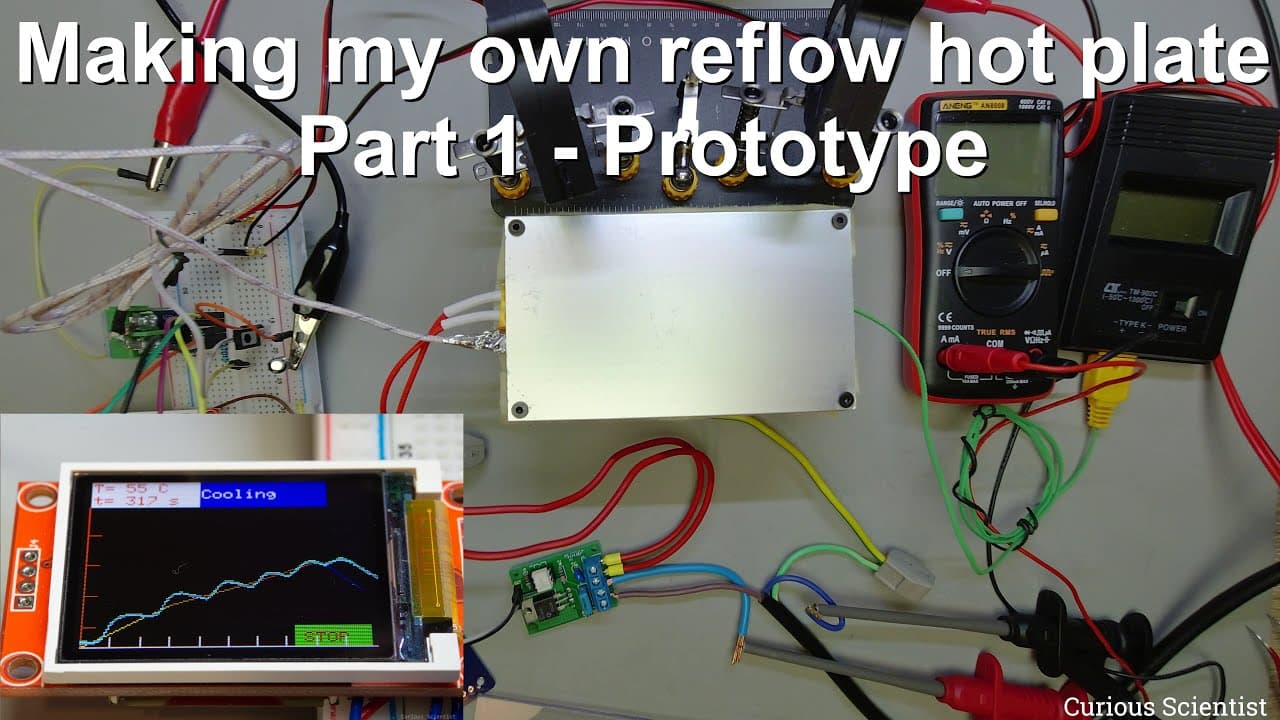
TL;DR
The video demonstrates a hazardous yet innovative prototype reflow station for soldering SMD boards.
Transcript
welcome everyone in this video i'm going to show you the prototype of my reflow plate or reflow station however we want to call it and i will show you how it works i will introduce you all the different parts and what they do in this let's say experimental setup and then i will try to make a test so before starting the video i have to emphasize tha... Read More
Key Insights
- ⚡ The prototype emphasizes the importance of safety when working with high voltage electronics, urging users to communicate any observed risks for community learning.
- 🎮 Temperature control is crucial for effective soldering; the reflow process involves distinct phases that require precise regulation for proper component adhesion.
- 🚉 The creator identifies a popular trend in DIY electronics, highlighting that several creators independently developed similar reflow station prototypes.
- 📽️ Using a combination of Arduino and thermal feedback, the project demonstrates a viable approach to automating SMD soldering processes for hobbyists.
- 👻 The reflow station's design allows for experimentation with different heating elements to achieve better performance in future iterations, broadening its applicability.
- 🫵 The creator provides resources for viewers, including a link to the source code on Patreon for those interested in developing and customizing their own devices.
- 📽️ The importance of community engagement is evident, as the creator invites input and collaboration to refine the project continuously.
Install to Summarize YouTube Videos and Get Transcripts
Explore YouTube Video Summarizer or Get YouTube Transcript Extractor
Questions & Answers
Q: What is the primary purpose of the reflow station demonstrated in the video?
The primary purpose of the reflow station is to solder surface-mounted devices (SMDs) onto printed circuit boards (PCBs) using a controlled heating process. This involves preheating the board, allowing the solder to flow, and then cooling it to form solid connections. The reflow station is particularly useful for handling delicate components that require precise temperature management.
Q: What safety precautions are mentioned in the video for using the reflow station?
The creator emphasizes the dangers of working with mains voltage, particularly in Europe (230 volts). Viewers are advised to handle operations carefully and to be aware of the potential for electric shock. Specific precautions include using rubber gloves, properly insulating wiring, and ensuring the device is unplugged when making adjustments. There is also a grounding mechanism to protect users in case the device malfunctions.
Q: How does the temperature regulation system in the reflow station work?
The reflow station uses a self-regulating PTC heater, which adjusts its resistance based on temperature to control heating. An Arduino microcontroller monitors and regulates this system, following a pre-programmed reflow temperature curve. The use of a thermocouple provides real-time temperature feedback, ensuring the heating plate maintains the desired temperatures throughout the soldering process.
Q: What feedback does the creator seek from the viewers during the demonstration?
The creator encourages viewers to provide feedback by pointing out any mistakes or safety oversights observed during the assembly and operation of the prototype. This interactive component fosters a sense of community learning, allowing others to contribute to future improvements and corrections of the design.
Summary & Key Takeaways
-
The video presents a comprehensive introduction to the prototype of a reflow station designed for soldering SMD components, emphasizing safety due to high mains voltage operation.
-
It details the components and functionality of the device, including the implementation of a thermal regulation system to achieve precise temperature control during the soldering process.
-
The creator discusses previous successful projects and encourages viewers to share their insights or critiques, fostering an interactive community around DIY electronics.
Read in Other Languages (beta)
Share This Summary 📚
Summarize YouTube Videos and Get Video Transcripts with 1-Click
Try YouTube Summary with ChatGPT & Claude or YouTube Transcript Generator
Explore More Summaries from Curious Scientist 📚
Summarize YouTube Videos and Get Video Transcripts with 1-Click
Try YouTube Summary with ChatGPT & Claude or YouTube Transcript Generator