What Shapes Molecules and Why Does It Matter?
TL;DR
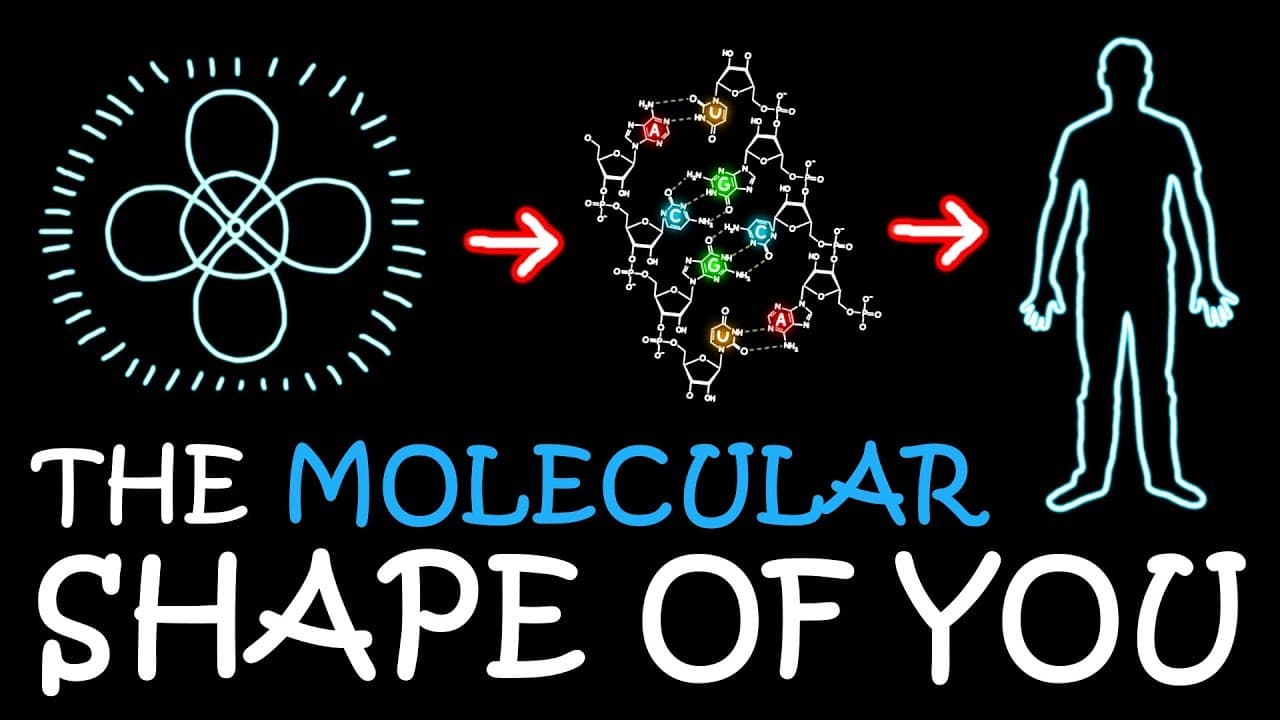
Molecules take the shape they do because electrons settle into stable states set by quantum rules, and "The Molecular Shape of You" is A Capella Science's parody of Ed Sheeran's "Shape of You" that sets that chemistry to music. It walks through hydrogen bonding as H2, carbon hybridizing to sp3 and spreading out 109.47 degrees to make methane, sigma-pi bonding in benzene, and peptides folding into beta pleat sheets. Read on for the science behind each lyric.
Transcript
A dot isn't the best way to try to sum up how electrons come and go They are the states of a matter field that follows and equation that Dirac wrote The Schrödinger part of the whole equation will just lead
In sub-c when it expands Now get that Coulomb and add it in with a proton And watch them start to dance As hydrogen it's like "Oh pro... Read More
Key Insights
- 🦾 Electrons in atoms do not orbit the nucleus but follow the laws of quantum mechanics.
- 🥺 Hydrogen atoms bond by sharing electrons, leading to stable diatomic and molecular compounds.
- 🦮 The shape of molecules is determined by the arrangement of electrons, guided by quantum rules.
- ❓ Aromatic compounds, like benzene, exhibit a unique bonding pattern known as aromatic bonding.
- 🙏 Peptides, composed of amino acids, form chains and fold into specific shapes through hydrogen bonding and secondary linkages.
- 💁 Polymers, such as RNA, form through hydrogen bonding between base-level residues.
- 🖐️ The shape and arrangement of molecules play a crucial role in the functioning of the human body.
Install to Summarize YouTube Videos and Get Transcripts
Explore YouTube Video Summarizer or Get YouTube Transcript Extractor
Questions & Answers
Q: What is "The Molecular Shape of You" by A Capella Science?
It is a parody of Ed Sheeran's "Shape of You" that turns the chemistry of molecular bonding into a song. The lyrics explain how electrons, quantum rules, and bonding give molecules their shapes, ending on the line that "molecules take the shape of you."
Q: How do electrons behave in atoms, and why don't they fall into the nucleus?
The song describes electrons not as dots or simple orbits but as the states of a matter field that follows an equation Dirac wrote, with the Schrödinger part guiding their behavior. An electron feels the proton's pull but does not fall in because, as the lyric puts it, "that would break uncertainty."
Q: Why is hydrogen found in nature as H2?
When one hydrogen orbital approaches another they combine into a stable bonding state, so hydrogen is found in nature as H2. The song calls this "diatomically bonding," an energy configuration that forms the molecule.
Q: How does carbon form methane?
Carbon has 6 electrons, and to bond with hydrogen it hybridizes to sp3. Those bonds spread out at 109.47 degrees, letting carbon combine with hydrogen to make methane.
Q: What bond angle does the song give for carbon in methane?
It states the sp3 hybridized bonds "spread out 109.47 degrees." This is the angle at which carbon's four bonds arrange themselves when forming methane.
Q: What determines the shape of a molecule?
Molecules take their shape from the quantum rules governing how electron orbitals combine into stable states. The song points to examples like sp2 hybridization for sigma and pi double bonding, and benzene holding a ring through aromatic bonding.
Q: How do peptides fold into specific shapes?
Peptides make a chain of amino acids that folds using secondary linkages. The lyrics name beta pleat sheets and corkscrews as the folded structures, held together with these secondary links so the peptides are "all over your body."
Q: How do polymers like RNA hold together?
Polymers form by combining base-level residues, and RNA is given as the example with its bases A, C, G, and U. The song says these residues are held together by hydrogen bonding.
Summary & Key Takeaways
-
Electrons in atoms follow a matter field equation and do not simply orbit around the nucleus.
-
Hydrogen atoms bond by sharing electrons, forming stable molecules like H2 and methane.
-
Molecules can have different shapes based on the quantum rules governing electron configurations, such as sigma and pi bonding.
-
Peptides, composed of amino acids, form chains and fold into specific shapes through hydrogen bonding and secondary linkages.
Read in Other Languages (beta)
Share This Summary 📚
Summarize YouTube Videos and Get Video Transcripts with 1-Click
Try YouTube Summary with ChatGPT & Claude or YouTube Transcript Generator
Explore More Summaries from acapellascience 📚




Summarize YouTube Videos and Get Video Transcripts with 1-Click
Try YouTube Summary with ChatGPT & Claude or YouTube Transcript Generator