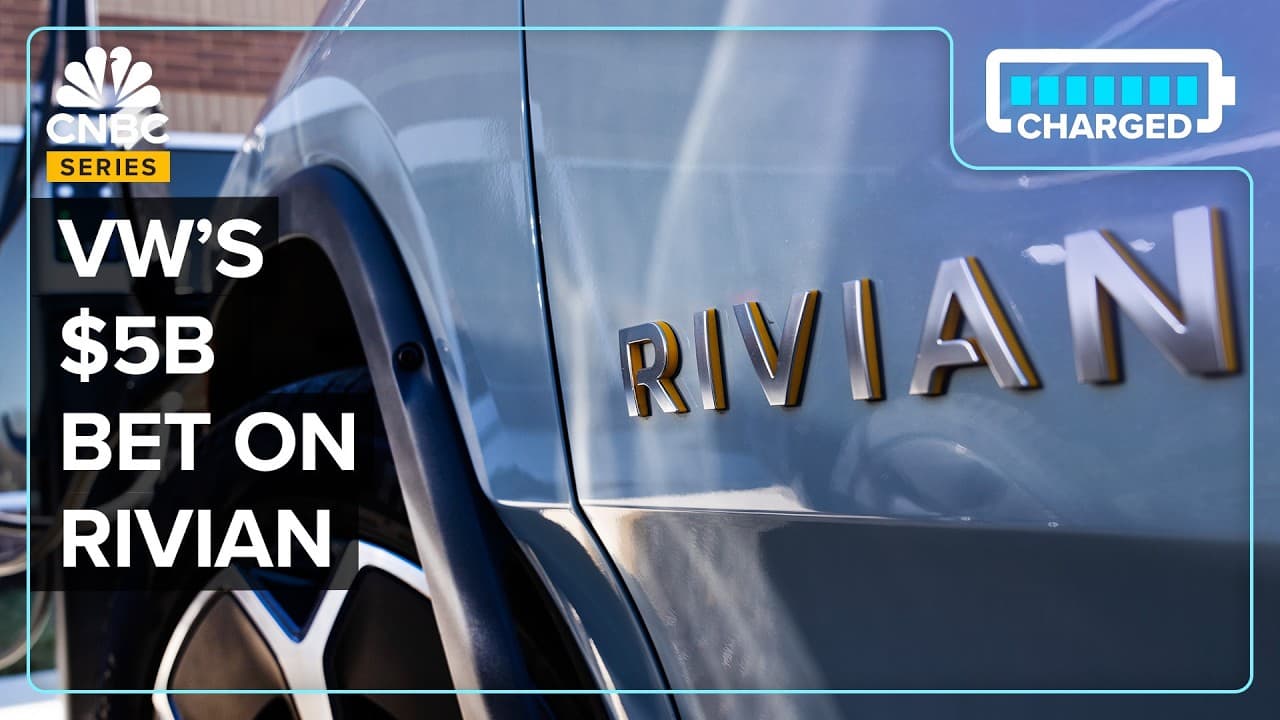
Why Did Volkswagen Invest $5 Billion in Rivian?
TL;DR
Volkswagen invested $5 billion in cash-strapped Rivian, which loses about $1.5 billion per quarter, to gain access to Rivian's software-defined vehicle architecture. Rivian consolidated its car computers from 70-100 down to just seven, something VW's own $2.4 billion software unit CARIAD failed to achieve. In return, Rivian gets cash and Volkswagen's supplier bargaining power.
Transcript
Once a much hyped EV startup, Rivian faces a severe cash crunch. It's losing about $1.5 billion per quarter. Rivian lost between $30,000 and $43,000 on every truck it sold in the past five quarters. There are potentially 1 or 2 programs away from potential bankruptcy. In March 2024, Rivian announced it would pause a plan to build a $5 billion facto... Read More
Key Insights
- Rivian faces a severe cash crunch, losing about $1.5 billion per quarter and between $30,000 and $43,000 on every truck sold across the past five quarters, leaving it potentially one or two programs away from bankruptcy.
- Volkswagen's $5 billion investment in Rivian, announced in 2024, could form a joint venture as early as fall 2024, serving as Rivian's saving grace while giving VW access to modern vehicle software.
- A software-defined vehicle is controlled through software that can be updated throughout the car's life, letting the automaker diagnose problems, fix them, and add features remotely without touching the car, as Tesla pioneered.
- Rivian's value to VW is its centralized electronic architecture, reducing computers from 70-100 ECUs in a typical car to 17 in its first-generation vehicles and just seven in its second generation.
- Legacy automakers rely on 70 to 100 electronic control units per car, each running isolated software written by different suppliers that doesn't connect to the internet or communicate with other vehicle systems.
- VW's software subsidiary CARIAD, founded in 2020, became a major disaster, reporting €2.4 billion and €2.1 billion operating losses in 2023 and 2022 and delaying launches for Porsche and Audi.
- Rivian's scale advantage from VW is bargaining power: Volkswagen sells about 9 million vehicles per year, so suppliers offer far more favorable pricing to a multi-million-unit order than to Rivian selling solo.
- Rivian added more than 500 features through over 30 over-the-air updates in two and a half years, enabled by a middleware layer that lets it update software and hardware independently.
Install to Summarize YouTube Videos and Get Transcripts
Explore YouTube Video Summarizer or Get YouTube Transcript Extractor
Questions & Answers
Q: Why did Volkswagen invest $5 billion in Rivian?
Volkswagen invested $5 billion in Rivian in 2024 to gain access to Rivian's software-defined vehicle technology, which VW struggled to build in-house. VW's own software subsidiary CARIAD became a major disaster, reporting €2.4 billion and €2.1 billion operating losses in 2023 and 2022 and delaying launches for profitable brands like Porsche and Audi. Partnering with Rivian lets VW piggyback off the work companies like Rivian are doing on modern vehicle architecture.
Q: How much money is Rivian losing?
Rivian faces a severe cash crunch, losing about $1.5 billion per quarter. It lost between $30,000 and $43,000 on every truck it sold across the past five quarters. The company still expects to lose $2.7 billion in adjusted earnings for the year. When it went public, Rivian had almost $19 billion in cash, and it has burned through about 75% of that, driven by heavy spending on R&D, new products, and a second factory while volumes stayed too low to sustain the spend rate.
Q: What is a software-defined vehicle?
A software-defined vehicle is one that is more or less controlled through software that can be updated throughout the life of the vehicle. Tesla pioneered this approach, which can diagnose problems on cars, fix them, and add new features remotely without touching the car. Famously in 2018, Tesla fixed a Model 3 braking issue flagged by Consumer Reports through a remote update, securing the group's recommendation. This capability requires a centralized architecture and a middleware layer connecting the software and hardware.
Q: Why did Rivian's stock and valuation fall so much?
Rivian IPO'd in 2021 at a valuation that could reach $65 billion, met with huge fanfare right after the pandemic when money was chasing IPOs. Its market cap shrank from $150 billion to about $16 billion by September 2024. Investors extrapolated Tesla's success, but Tesla was the only game in town when it started, whereas Rivian faced an EV slowdown at the worst possible time. High interest rates, replacing the low rates that fueled early excitement, made selling very expensive vehicles far harder.
Q: How does Rivian's vehicle architecture differ from legacy automakers?
Legacy automakers use somewhere between 70 and 100 electronic control units per car, each with its own software written by suppliers, isolated from the internet and from other vehicle systems. A simple task like engaging a driver profile could involve dozens of ECUs. Rivian instead owns its electronics and uses one centralized platform with code it wrote itself. Its first-generation vehicles had just 17 ECUs, and its second generation reduced that to seven, which would not have been possible while coordinating across many tier-one suppliers.
Q: What does Rivian gain from the Volkswagen deal besides cash?
Beyond much-needed cash, Rivian gains the benefit of partnering with an established automaker, especially supplier bargaining power. Rivian is a drop in the bucket, targeting at best 200,000-plus units from its Illinois factory, leaving it low on the totem pole for favorable supplier pricing. Volkswagen sells about 9 million vehicles worldwide per year, so when VW stands behind Rivian promising a multi-million-unit order, suppliers offer far more favorable pricing than Rivian could get on its own.
Q: Why did Volkswagen's in-house software effort fail?
Volkswagen founded a software subsidiary called CARIAD in 2020, intending to do most of its software in-house like many automakers. It turned into a major disaster, with software problems delaying several product launches from profitable brands like Porsche and Audi. CARIAD reported €2.4 billion and €2.1 billion in operating losses in 2023 and 2022. The struggles led to a management shakeup affecting even CEO Herbert Diess, who ultimately left, with Oliver Blume becoming co-CEO of both the Porsche brand and the Volkswagen Group.
Q: What role does middleware play in software-defined vehicles?
Rivian, like Tesla and basically every smartphone maker, uses a layer called middleware to tweak software and hardware independently. It can send updates to the vehicle's software without changing out all the hardware, or vice versa. That middleware layer is essential to a software-defined vehicle, and it is where everybody is having a lot of challenges. Thanks to this capability, Rivian added more than 500 features through over 30 over-the-air updates in the previous two and a half years.
Summary & Key Takeaways
-
Rivian, once a hyped EV startup, faces a cash crunch, losing roughly $1.5 billion per quarter and $30,000-$43,000 per truck. After a $65 billion IPO valuation, its market cap shrank from $150 billion to about $16 billion by September 2024 amid an EV slowdown and high interest rates.
-
Volkswagen's $5 billion investment gives Rivian much-needed cash and supplier bargaining clout. VW sells about 9 million vehicles yearly, so its backing wins Rivian far more favorable supplier pricing than the smaller company, targeting 200,000-plus units, could secure on its own.
-
In return, VW gains Rivian's software-defined vehicle expertise. VW's in-house CARIAD unit lost billions and delayed launches, contributing to CEO changes. Rivian's centralized architecture cut ECUs from 70-100 to seven, validating a new philosophy of what automakers must control in-house.
Read in Other Languages (beta)
Share This Summary 📚
Summarize YouTube Videos and Get Video Transcripts with 1-Click
Try YouTube Summary with ChatGPT & Claude or YouTube Transcript Generator
Explore More Summaries from CNBC 📚




Summarize YouTube Videos and Get Video Transcripts with 1-Click
Try YouTube Summary with ChatGPT & Claude or YouTube Transcript Generator