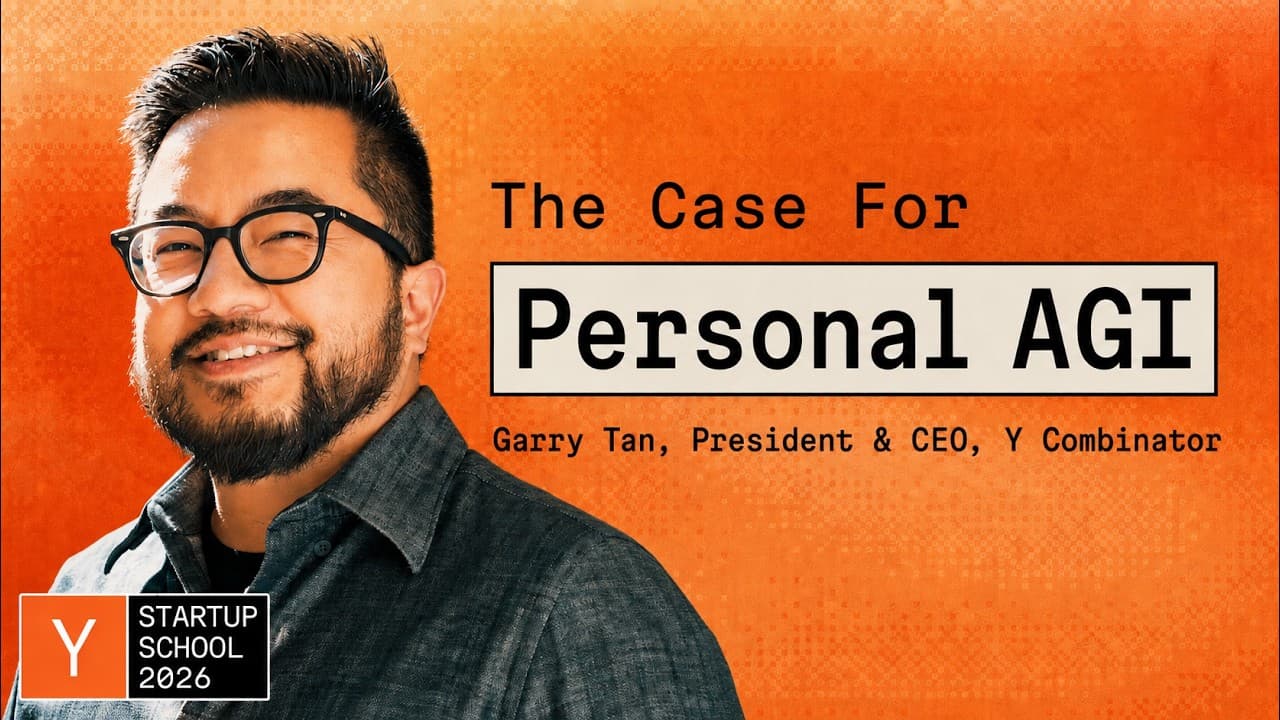
Garry Tan: What Is Personal AGI and Why Should You Own Your Intelligence?
TL;DR
Personal AGI is an agent that runs on your infrastructure, uses memory you own, follows procedures you wrote, and improves as it learns more of your life. Garry Tan contrasts this compounding asset with a rented corporate assistant that can reset or change on someone else’s schedule. His vision centers on terminals, markdown files, personal context, and jobs that finish while you sleep. Read on to see why ownership matters.
Transcript
So the internet calls me one of the most AI psychotic people online. So it's only right that I start my talk with a story about one of the most cancelled men in history. His name was Baroo Spininoza. And in case the philosophy elective wasn't your thing, here are the highlights you need to know. In 1929, a New York rabbi challenged Einstein by tele... Read More
Key Insights
- Personal AGI is about owning your AI infrastructure and using it to enhance personal productivity and knowledge retention.
- Spinoza's philosophy emphasizes striving and independence, relevant to building personal systems that operate under one's own power.
- AI agents can dramatically increase an individual's output by automating and optimizing tasks across various domains.
- The concept of personal AGI involves creating a library of personal knowledge that AI agents can access and utilize.
- Markdown files serve as the code for personal AGI, allowing non-programmers to create and manage AI-driven tasks.
- The distinction between latent space and deterministic code is crucial for effective AI agent operations.
- Ownership of skill files is essential to ensure personal growth and prevent exploitation by external entities.
- Open sourcing personal AGI tools democratizes access to powerful technologies, enabling broader innovation and independence.
Install to Summarize YouTube Videos and Get Transcripts
Explore YouTube Video Summarizer or Get YouTube Transcript Extractor
Questions & Answers
Q: What does Garry Tan mean by personal AGI?
Personal AGI means general intelligence built for one person rather than artificial general intelligence delivered to everyone at once. Tan defines it as an agent that runs on your infrastructure, reads from memory you own, executes procedures you wrote, and compounds through use.
Q: Why should you own your personal intelligence instead of renting it?
Tan argues that rented corporate AI remains controlled by the company providing it. It may reset when you close the tab or change when the company pivots, while a personally owned system can preserve your memory, procedures, and accumulated context.
Q: How is personal AGI different from a chatbot subscription?
Tan says personal AGI is not a chatbot costing $20 per month, better autocomplete, or an assistant that only knows your calendar. Those are products you consume, whereas personal AGI is an asset you build on infrastructure and memory you control.
Q: How does personal AGI improve over time?
A corporate system improves when its company ships an update, according to Tan. Personal AGI gets better every day it is used because it accumulates more knowledge about the owner’s life and work.
Q: What does personal AGI look like in practice?
Tan describes it as infrastructure rather than a single dramatic AGI event. It can look like a terminal window, a folder of markdown files, or a job that finishes while you sleep using your context to perform your work.
Q: What role do markdown files play in personal AGI?
Markdown files can hold plain-English task instructions and procedures for AI agents. The page’s summary describes them as the code for personal AGI, allowing users to manage AI-driven work and build a personal knowledge library.
Q: How does Spinoza’s philosophy relate to personal AGI?
Tan connects personal AGI to Spinoza’s concept of striving: the drive to keep going and increase one’s power to act. He presents personally owned tools as a way to amplify that striving and operate with greater independence.
Q: Why does Garry Tan say AGI is already arriving?
Tan rejects the idea that AGI must appear as one singular event or announcement. He says it is arriving in a diffused form through agents that run on personal context, perform individual work, and operate across everyday infrastructure.
Q: How much more productive is Garry Tan with AI coding agents?
Garry Tan says his coding output is about 400 times what it was in 2013, when he shipped roughly 14 useful lines of code per day. Even after heavily discounting the raw output for bloated code, scaffolding, and possible overestimation, he puts the absolute floor at 8 times his earlier productivity.
Q: What does Garry Tan mean when he says founders should treat AI as a workforce?
He means using AI agents across the business rather than treating AI as autocomplete. He says the fastest-growing YC founders use agents for code, design, product management, growth, and other knowledge work, with leverage coming from the context supplied, its relevance, and when it appears in the workflow.
Q: What is Spinoza’s conatus in Garry Tan’s talk?
Conatus means your striving: the drive in every living thing to keep going and increase its power to act. Tan presents AI agents as tools that amplify this drive, connecting their ability to complete a week of work in an afternoon with Spinoza’s definition of joy as the feeling of increased power to act.
Summary & Key Takeaways
-
Garry Tan discusses the importance of building and owning a personal AGI system that leverages AI agents to enhance individual productivity and knowledge retention. By running AI on personal infrastructure, individuals can compound their knowledge and operate independently from corporate control. This empowers people to create startups and achieve unprecedented growth with minimal resources.
-
The talk draws inspiration from Spinoza's philosophy, emphasizing the importance of striving and maintaining independence. By owning their intelligence, individuals can build systems that amplify their capabilities and transform how they work. Tan shares his personal workflows and tools, highlighting the potential for personal AGI to revolutionize productivity.
-
Markdown files are central to personal AGI, allowing users to write task instructions in plain English. This democratizes programming and enables non-engineers to manage AI-driven tasks. Tan advocates for open sourcing personal AGI tools to democratize access to powerful technologies and foster innovation, ultimately enabling individuals to operate at a new scale.
Read in Other Languages (beta)
Share This Summary 📚
Summarize YouTube Videos and Get Video Transcripts with 1-Click
Try YouTube Summary with ChatGPT & Claude or YouTube Transcript Generator
Explore More Summaries from Y Combinator 📚





Summarize YouTube Videos and Get Video Transcripts with 1-Click
Try YouTube Summary with ChatGPT & Claude or YouTube Transcript Generator