How to Clean Sodium Metal for Storage
TL;DR
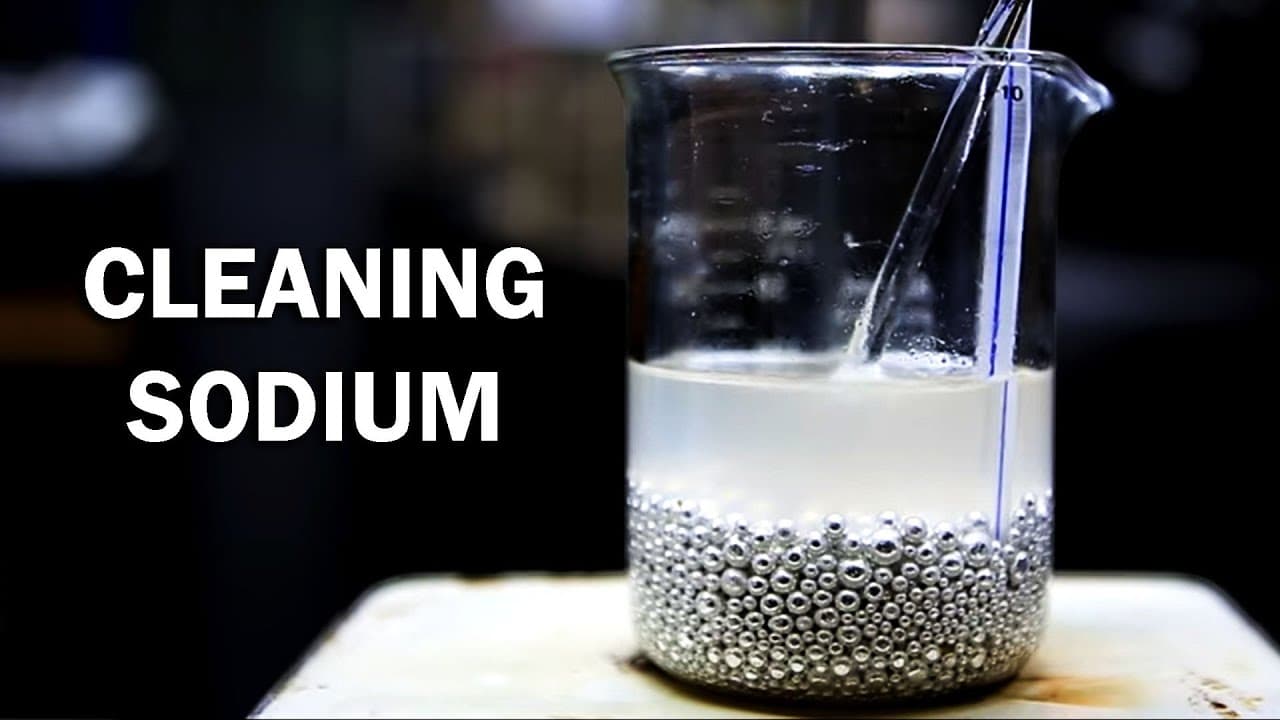
To clean sodium metal, wash it several times with heated mineral oil to remove oxidized surfaces, resulting in shiny beads. For one large piece, add isopropyl alcohol after initial washes to coalesce the sodium into a solid chunk. Finally, store the cleaned sodium in airtight containers with mineral oil to prevent tarnishing.
Transcript
Sodium is quite reactive and it spontaneously reacts with both moisture and oxygen in the air. Because of this the surface of the sodium can become quite dirty. This here is about a hundred grams of my very very dirty sodium metal. Depending what you want the final form of sodium to be the technique to clean it will vary a little bit. If you want s... Read More
Key Insights
- 🥺 Sodium metal spontaneously reacts with moisture and oxygen, leading to a dirty surface.
- 🕰️ Cleaning sodium involves washing it with mineral oil, either multiple times for small pieces or once for one large piece.
- 🛢️ Heating mineral oil, adding sodium, and stirring it results in clean beads of sodium.
- 🕰️ To coalesce sodium into one large piece, isopropyl alcohol is added, causing the sodium to become dark and discolored.
- 🌥️ By stirring and adding more isopropyl alcohol, the majority of the sodium becomes shiny, and larger spheres start to appear.
- 👱 Sodium quickly tarnishes in air, so it should be stored in airtight containers with mineral oil.
- 👁️🗨️ Bubbles produced by sodium reacting with moisture in mineral oil need to be vented off during the first few weeks of storage.
Install to Summarize YouTube Videos and Get Transcripts
Explore YouTube Video Summarizer or Get YouTube Transcript Extractor
Questions & Answers
Q: Why does sodium metal become dirty?
Sodium reacts with both moisture and oxygen in the air, leading to the accumulation of oxidation products on its surface, making it dirty.
Q: How can sodium metal be cleaned?
Sodium metal can be cleaned by washing it with mineral oil, either through multiple washings for small pieces or a single washing for one large piece.
Q: Can sodium be cleaned with other solvents besides mineral oil?
Mineral oil is commonly used to clean sodium due to its properties, such as higher boiling point than the melting point of sodium. However, other solvents like xylene or toluene can also be used.
Q: How can sodium be coalesced into one large piece?
To coalesce sodium into one large piece, a small amount of isopropyl alcohol is added, which causes the sodium to become dark and discolored. By stirring and adding more isopropyl alcohol, the majority of the sodium becomes shiny, and larger spheres start to appear.
Summary & Key Takeaways
-
Sodium metal reacts with moisture and oxygen, making its surface dirty.
-
Cleaning sodium involves washing it with mineral oil, either multiple times for small pieces or once for a single piece.
-
Heating mineral oil, adding sodium, and stirring it results in clean beads of sodium.
Read in Other Languages (beta)
Share This Summary 📚
Summarize YouTube Videos and Get Video Transcripts with 1-Click
Try YouTube Summary with ChatGPT & Claude or YouTube Transcript Generator
Explore More Summaries from NileRed 📚
Summarize YouTube Videos and Get Video Transcripts with 1-Click
Try YouTube Summary with ChatGPT & Claude or YouTube Transcript Generator