Why Future Robots Won't Look Like Humans
TL;DR
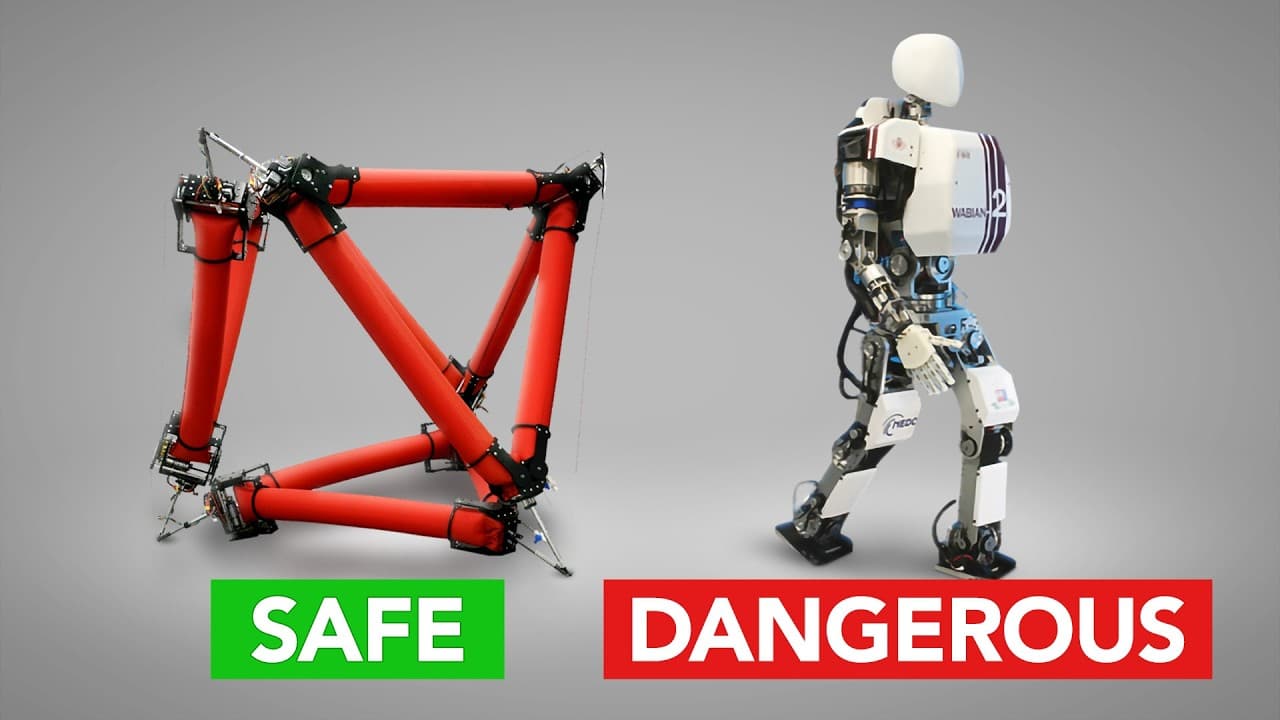
Advanced robots are likely to be soft, flexible, and non-humanoid because that makes them safer to interact with and lets them master abilities no human can. Vine robots that grow from their tip using compressed air can squeeze through tight spaces, survive punctures, and lift heavy objects, powering uses from search-and-rescue to medical intubation.
Transcript
- When people think about robots, they usually imagine something like a Boston Dynamics robot, metallic and humanoid. But the robots we'll see in the future might not look like that at all. I mean, if humans are interacting with something on a daily basis, it's probably best not to make it sharp, delicate, and heavy. - How rude. - [Derek] Instead, ... Read More
Key Insights
- Non-humanoid robots are often safer for daily human interaction because designers avoid making them sharp, delicate, and heavy, favoring soft and flexible forms like Baymax from Big Hero 6 over metallic humanoids like Boston Dynamics machines or Sonny from I, Robot.
- The vine robot works by growing from its tip, powered by compressed air, which lets it pass through tight spaces and over sticky surfaces where a normal object would get stuck, such as in a car's wheels.
- The vine robot's design is elegantly simple: airtight tubing is folded in on itself like a water wiggly toy, and inflating it with compressed air makes it grow outward from the tip.
- The idea came from a real vine in Dr. Elliot Hawkes' office that slowly grew a tendril around a shelf toward sunlight over about a year, inspiring the question of whether that motion could be done robotically.
- Low pressure over a large area produces huge force: just a tenth of an atmosphere across a square meter can lift roughly a thousand kilograms, and a 600-square-inch pillow section at one PSI lifts 600 pounds while staying soft.
- Vine robots are ideal for search and rescue because they are hard to stop, extremely cheap, and can be grown by the hundreds into a collapsed building with sensors, where even one reaching a trapped person is a success.
- Steering is achieved with three pneumatic muscles made of ripstop nylon fabric braided at 45 degrees, which shorten and lengthen the sides so the robot turns as it extends, similar to tendons moving a hand.
- The vine robot has real-world applications including archeology, where it explored three narrow tunnels at a 1,500 to 500 BC temple in the Peruvian Andes, and medicine, where a miniature version aims to speed up intubation.
Install to Summarize YouTube Videos and Get Transcripts
Explore YouTube Video Summarizer or Get YouTube Transcript Extractor
Questions & Answers
Q: Why shouldn't robots look like humans?
Because humans interact with robots on a daily basis, it is best not to make them sharp, delicate, and heavy like a metallic humanoid. Instead, advanced robots can be made safer if they are soft, flexible, and come in all kinds of shapes and sizes. Something like Baymax from Big Hero 6 is closer to our future than a rigid humanoid like Sonny from I, Robot, because soft designs reduce the risk of hurting the people around them.
Q: How does a vine robot move and grow?
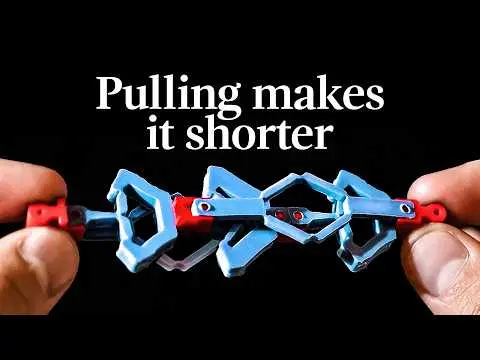
A vine robot grows from its tip, powered by compressed air. It is made by taking airtight tubing and folding it in on itself, kind of like a water wiggly toy, then inflating it with compressed air so it extends outward from the tip. This growing motion lets it pass through tight, curvy, and twisted passageways effortlessly and travel over sticky surfaces that would trap an ordinary object. To retract it in a constrained space, you pull on the tail so the material inverts back inside itself.
Q: What is the biggest advantage of non-humanoid robots over traditional robots?
One of their biggest advantages is that they don't just do things humans already do but better. Instead, they are specialized to master entirely new abilities, often ones no human can tackle. For example, a vine robot can grow to hundreds of times its size, cannot easily be stopped by adhesives or spikes, and can navigate spaces a person could never enter. These robots can be made from almost any material yet follow the same basic principle of growing from the tip using compressed air.
Q: How can a soft robot lift heavy objects with such low pressure?
It relies on the paradoxical nature of pressure: you can get a large overall force with very low pressure as long as the area is large enough. Just a tenth of an atmosphere applied over a large area, like a square meter, can lift something as heavy as a thousand kilograms while remaining soft. As demonstrated, a 600-square-inch pillow section produces 600 pounds of force at one PSI and 1,200 pounds at two PSI, all while staying soft to the touch.
Q: How is a vine robot steered?
Steering is done with artificial pneumatic muscles attached along the robot's sides. Older versions used muscles that expand sideways and contract in length, but newer ones use simple tubes of ripstop nylon fabric with the braid oriented at 45 degrees. Three pneumatic muscles are each connected to their own air supply and regulators. As the robot extends from its tip, inflating a muscle on one side shortens that side and turns the robot that way, much like shortening a tendon in your arm moves your hand.
Q: What happens if a vine robot gets punctured?
Punctures are not necessarily the downfall of these inflatable robots. Even if the robot is punctured by spikes or sharp objects, it keeps going as long as you have sufficient air pressure. In the demonstration, the robot was audibly leaking, so the operator simply turned up the pressure to compensate and it continued to function. This resilience, combined with its ability to fit through tight spaces and avoid getting stuck, makes the vine robot well suited for cluttered and hazardous environments.
Q: How are vine robots used in search and rescue?
Vine robots are useful in search and rescue because they are really hard to stop and can be grown into clutter such as a collapsed building. Because they are extremely cheap, essentially free, you could grow a hundred of them into a collapsed structure with sensors, and even if only one finds a trapped person, that is a huge success. A camera can be attached to the front using an end cap or an interlocking internal and external frame, similar to how a roller coaster's wheels wrap around the track, so it stays on as the robot grows.
Q: What real-world applications have vine robots been used for?
Vine robots have been applied to archeology and medicine. In Peru, a vine robot explored an ancient temple built between 1,500 and 500 BC in the Andes Mountains, successfully investigating three narrow ducts, or tunnels, that branched off large rooms called galleries and were too small for a person to enter. In medicine, researchers are developing a miniature version to perform intubation, the process of putting a breathing tube into a patient, aiming to make it faster since every second counts when someone isn't breathing.
Summary & Key Takeaways
-
Future robots may not look humanoid like Boston Dynamics machines. Because people interact with them daily, it is safer to avoid sharp, delicate, heavy designs and instead build soft, flexible robots of all shapes, closer to Baymax than to Sonny from I, Robot.
-
The vine robot grows from its tip using compressed air by folding airtight tubing in on itself. It navigates tight, twisted passages, survives punctures if air pressure is maintained, retracts by pulling its tail, and steers using three pneumatic ripstop-nylon muscles.
-
By applying low pressure over a large area, the robot lifts enormous loads while staying soft, enabling uses like freeing trapped people, cheap search and rescue at scale, archeological exploration of narrow Peruvian temple tunnels, and faster medical intubation.
Read in Other Languages (beta)
Share This Summary 📚
Summarize YouTube Videos and Get Video Transcripts with 1-Click
Try YouTube Summary with ChatGPT & Claude or YouTube Transcript Generator
Explore More Summaries from Veritasium 📚





Summarize YouTube Videos and Get Video Transcripts with 1-Click
Try YouTube Summary with ChatGPT & Claude or YouTube Transcript Generator