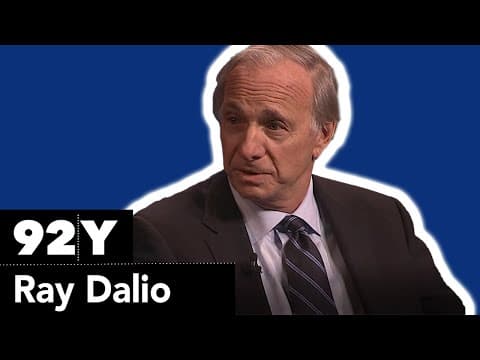
How Countries Go Broke Explained by Ray Dalio

TL;DR
Debt dynamics drive sovereign distress, not just defaults. When a country’s debt rises relative to income, debt service constrains other spending and asset prices. Central banks respond by printing money to avoid higher rates, while a three part fix trims deficits through spending cuts, tax revenue improvements, and careful rate management.
Transcript
So, thank you very much for doing this. Um, how long did it take you to write this book? This is How many books have you now written? Four. Four. Okay. And how long did it take to write a book like this? This is research that I've done over a long period of time. So putting it together and getting it out, you know, I would say a part-time basis, ma... Read More
Key Insights
- Countries experience debt dynamics similar to individuals when debt rises relative to income.
- Debt service can squeeze out other spending and curtail economic activity.
- Central banks often print money to prevent default driven by rate hikes.
- Printing money tends to devalue currency rather than default through outright default.
- The United States spends around seven trillion dollars annually but only collects about five trillion in revenue.
- Debt stabilization requires a three part solution focused on spending, taxes, and interest rates, not a single fix.
- Diversification of revenue streams and prudent decision-making improve resilience against debt shocks.
- Historical debt compromises show how policy choices shape debt outcomes over time.
Install to Summarize YouTube Videos and Get Transcripts
Explore YouTube Video Summarizer or Get YouTube Transcript Extractor
Questions & Answers
Q: What is the core mechanism by which a country goes broke according to Dalio?
The core mechanism is that debt rises relative to income, creating debt service that crowds out other consumption and investment. When debt becomes large enough, even if deficits are manageable in theory, the combination of growth constraints and higher financing costs can force a country to adopt policy responses, which in turn affect currency value and asset prices. This feedback loop can lead to a loss of confidence and slower growth, increasing vulnerability to shocks.
Q: How does Dalio differentiate between debt and devaluation for countries?
Dalio explains that countries can print money and use taxes as tools to manage debt. The effect is not default, but devaluation through currency depreciation. By expanding the money supply or adjusting tax policies, a country can ease debt burden gradually, though at the cost of currency value and inflation pressures, which then influence purchasing power and financial stability.
Q: What three elements form the three part solution to stabilize debt according to Dalio?
The three part solution comprises spending control, tax revenue adjustments, and managing interest rates. Each element affects the debt-to-income ratio differently: spending cuts reduce the deficit, enhancing revenue improves the income side of the equation, and careful rate management influences the cost of servicing existing debt and future borrowing conditions.
Q: Why does Dalio emphasize diversification in investment during debt crises?
Diversification reduces risk without necessarily sacrificing returns. By spreading investments across uncorrelated return streams, a portfolio or a government financing strategy can dampen the impact of any single shock. This concept is extended metaphorically to national policy and the way a country might balance growth, inflation, and debt service to maintain stability.
Q: What historical example related to debt is mentioned in the discussion?
The discussion references the early United States debt and the compromise involving Alexander Hamilton, the southern states, and the capital relocation, illustrating that debt has been a feature of government finance since the country’s beginnings. This historical context shows that debt management has long been a central policy challenge for nations.
Q: What does Dalio say about the role of central banks when debt risks rise?
Dalio notes that central banks intervene to prevent a spike in interest rates that would cripple economic activity. They often resort to printing money to keep rates low and asset prices supported, thus delaying painful adjustments. This intervention can sustain debt levels but risks currency devaluation and inflation if pursued too aggressively.
Q: According to the talk, what counts as a sustainable path for debt relative to income?
A sustainable path involves reducing the deficit to a level compatible with the country’s income and growth prospects, achieving this through a combination of spending controls, improved tax revenues, and prudent debt management. The goal is to prevent debt service from crowding out essential spending while maintaining economic stability and growth.
Q: How does the book described aim to influence readers’ feelings about debt and concern?
The book aims to convey the mechanics and cause effects behind debt so readers understand what is going on and how to navigate it. It seeks to inform rather than simply scare, providing a framework that helps people worry in a constructive way, so they can take preventive actions without succumbing to panic.
Summary & Key Takeaways
-
This summary explains the core mechanism of how debt accumulation and the need to finance it can push a country toward financial strain, and why the author emphasizes the role of central banks and policy adjustments in avoiding a full debt crunch.
-
The discussion traces the parallels between country, corporate, and personal debt dynamics, highlighting the universal impact of debt service on budgets and the importance of diversification of revenues and spending controls.
-
The conversation uses historical context and current fiscal dynamics to illustrate how a country might navigate debt pressure through structural policy changes and prudent financial planning.
Read in Other Languages (beta)
Share This Summary 📚
Summarize YouTube Videos and Get Video Transcripts with 1-Click
Try YouTube Summary with ChatGPT & Claude or YouTube Transcript Generator
Explore More Summaries from The 92nd Street Y, New York 📚

Summarize YouTube Videos and Get Video Transcripts with 1-Click
Try YouTube Summary with ChatGPT & Claude or YouTube Transcript Generator