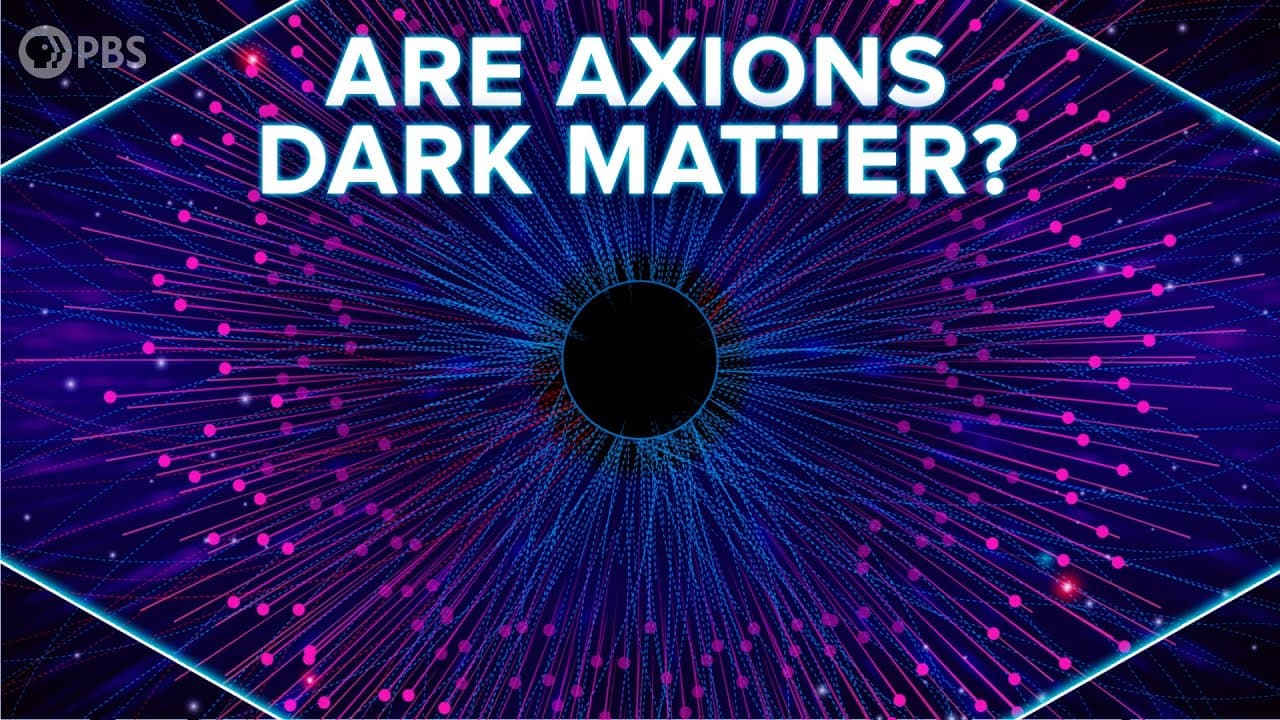
Are Axions Dark Matter?
TL;DR
Axions may solve the strong CP problem and explain dark matter.
Transcript
Thank you to NORD VPN for supporting PBS. What does the strong nuclear force, the fundamental symmetries of nature, and a laundry detergent have in common? Well, they’re all important parts of the tale of the axion - a tale which may take us beyond the standard model and solve one of the most vexing mysteries in astrophysics. The history of the axi... Read More
Key Insights
- The axion is a hypothetical particle proposed to solve the strong CP problem in quantum chromodynamics (QCD), which predicts CP violation that hasn't been observed.
- Symmetry is a fundamental concept in physics, and CP symmetry violation is observed in the weak nuclear force but not in the strong force, leading to the strong CP problem.
- The theta parameter in QCD could explain CP violation; Peccei and Quinn proposed it as a dynamic field, leading to the axion particle.
- Axions, if they exist, could interact with the electromagnetic field and produce photons via the Primakoff effect, providing a potential method for detection.
- Experiments like the CERN Axion Solar Telescope (CAST) aim to detect axions by observing potential axion-to-photon conversion in magnetic fields.
- Axions have properties that make them a candidate for dark matter: they are light, neutral, and interact weakly with other forces, possibly existing in large numbers since the Big Bang.
- Current experiments have not confirmed the existence of axions, but they continue to narrow down the possible properties of these particles.
- Theoretical predictions and experimental efforts continue to explore axions' role in solving major physics problems, including the nature of dark matter.
Install to Summarize YouTube Videos and Get Transcripts
Explore YouTube Video Summarizer or Get YouTube Transcript Extractor
Questions & Answers
Q: What is the strong CP problem in physics?
The strong CP problem arises from the prediction of CP violation in quantum chromodynamics (QCD), the theory describing the strong nuclear force. Despite theoretical expectations, no CP violation has been observed in the strong force. This discrepancy between theory and experimental observation is known as the strong CP problem.
Q: How do axions relate to the strong CP problem?
Axions are proposed as a solution to the strong CP problem. The Peccei-Quinn theory suggests that the theta parameter in QCD, which could cause CP violation, is not a constant but a dynamic field. This field could naturally settle to zero, eliminating CP violation and giving rise to axions as a new particle.
Q: What are the properties of axions?
Axions are hypothetical particles with no electric charge, no quantum spin, and extremely low mass, much lighter than electrons. They interact weakly with the strong and weak nuclear forces and gravity. These properties make axions difficult to detect but also potential candidates for dark matter.
Q: How might axions be detected experimentally?
Axions could be detected through their interaction with electromagnetic fields, converting into photons via the Primakoff effect. Experiments like the CERN Axion Solar Telescope (CAST) attempt to detect axions by observing axion-to-photon conversions in strong magnetic fields. However, no conclusive evidence has been found yet.
Q: Why are axions considered a candidate for dark matter?
Axions are considered a candidate for dark matter because they have properties that match the requirements: they do not interact directly with light, are extremely light, and could exist in large numbers since the Big Bang. These characteristics make them a potential explanation for the invisible source of gravity known as dark matter.
Q: What challenges exist in detecting axions?
Detecting axions is challenging due to their weak interactions and extremely low mass. Current experiments may not have strong enough magnetic fields to facilitate axion-to-photon conversions. Additionally, axions might be lighter or more weakly interacting than current detection methods can observe, requiring more sensitive experiments.
Q: What role does symmetry play in the discussion of axions?
Symmetry is central to the discussion of axions because the strong CP problem is rooted in the lack of observed CP symmetry violation in the strong force. Theories involving axions propose changes to the symmetry properties in QCD, potentially resolving the discrepancy between theoretical predictions and experimental observations.
Q: What are the implications if axions are confirmed to exist?
If axions are confirmed to exist, it would have significant implications for physics. It would solve the strong CP problem and provide a viable candidate for dark matter, addressing two major unresolved issues. Additionally, it would enhance our understanding of fundamental forces and particles, potentially leading to new physics beyond the standard model.
Summary & Key Takeaways
-
The axion is a theoretical particle that could solve the strong CP problem in quantum chromodynamics by explaining the lack of observed CP violation in the strong nuclear force. This particle, if it exists, might also account for dark matter due to its unique properties.
-
Symmetry plays a crucial role in physics, and the unexpected lack of CP violation in the strong force led to the proposal of the axion. The theta parameter in QCD, if dynamic, could naturally fall to zero, resolving the strong CP problem.
-
Axions are challenging to detect due to their weak interactions, but experiments like CAST are designed to observe axion-to-photon conversions. Although not yet confirmed, axions remain a promising candidate for dark matter, potentially solving two major physics mysteries.
Read in Other Languages (beta)
Share This Summary 📚
Summarize YouTube Videos and Get Video Transcripts with 1-Click
Try YouTube Summary with ChatGPT & Claude or YouTube Transcript Generator
Explore More Summaries from PBS Space Time 📚




Summarize YouTube Videos and Get Video Transcripts with 1-Click
Try YouTube Summary with ChatGPT & Claude or YouTube Transcript Generator