Why Does Claude Code Now Have Weekly Limits?
TL;DR
Claude Code Pro and Max subscriptions are getting weekly usage limits because a small number of power users created inference costs far beyond their monthly fees. A flat subscription cannot sustainably cover continuous, token-heavy agentic coding, especially when expensive Anthropic models generate large outputs and Claude Code cannot substitute cheaper models for suitable tasks.
Transcript
Remember like 2 weeks ago when everybody was mad at Cursor for changing their price tiers and they were saying you should move to Claude Code cuz it's way cheaper and you get much more for the money. I do. And I tried to give y'all a warning that that wasn't going to last. There is no such thing as free lunch in a GPU powered industry that costs as... Read More
Key Insights
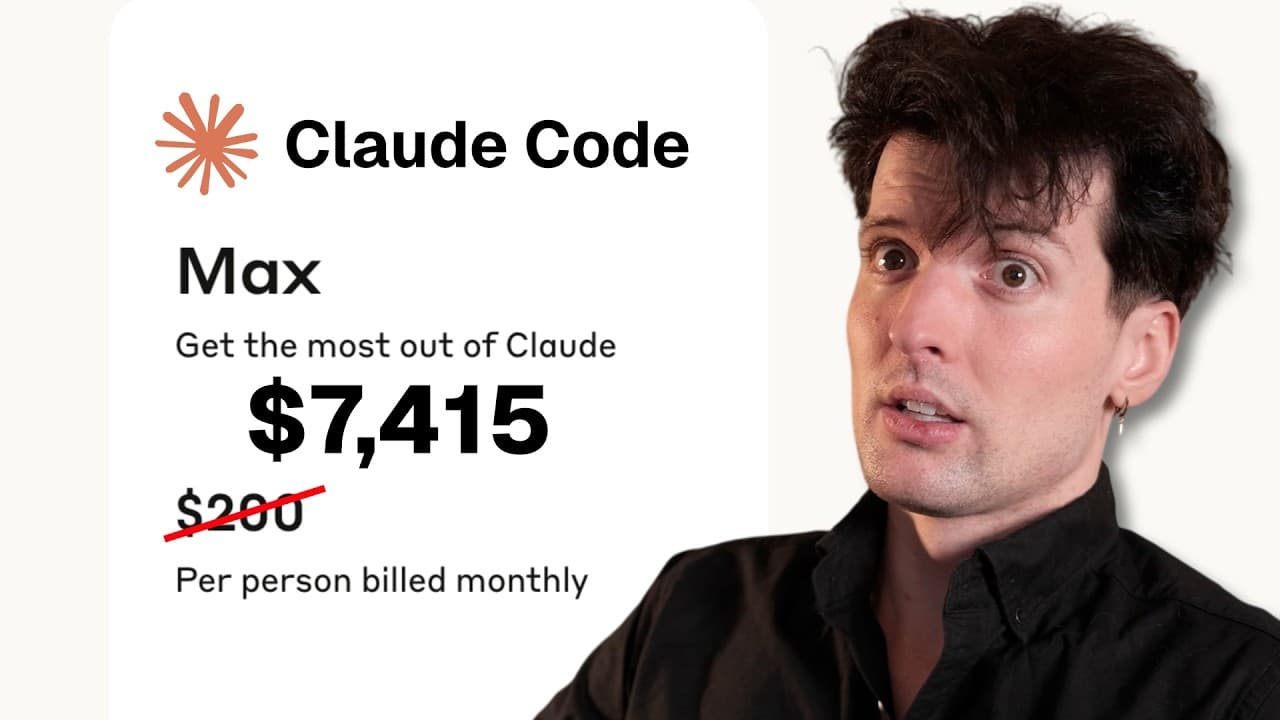
- Claude Code Pro and Max plans are receiving weekly limits because a few unusually heavy users generated costs that greatly exceeded their subscription payments, including one reported user whose model usage reached tens of thousands of dollars on the $200 plan.
- AI subscriptions cannot guarantee economically unlimited inference when customers run coding agents continuously in the background. The underlying GPU-powered computation still has a cost, even when a subscription temporarily hides per-token billing from the customer.
- Model cost is determined by both token prices and token volume. A model with a tolerable published rate can still be expensive when it generates large quantities of reasoning and output tokens to complete each response.
- Output tokens tend to cost more than input tokens, and hidden reasoning generation can also be billed. Users may therefore see only a short answer while the model produces a much larger, more expensive internal generation process.
- Grok 4 averaged more than 2,000 output tokens per message in T3 Chat usage discussed in the transcript. Its high generation volume caused bills to exceed what its published token rates alone appeared to predict.
- Claude Code must use Anthropic models because it is an Anthropic product and closed source. The speaker argues that this prevents it from assigning routine codebase traversal or planning work to cheaper models from other providers.
- The $200 Max tier encouraged Claude Code adoption by replacing unpredictable direct usage costs with a subscription. Before that tier, users paid API-style charges based on the input and output tokens consumed during inference.
- A higher flat monthly price would not necessarily solve the power-user problem. The speaker argues that people willing to pay $2,000 for unlimited access may already be consuming far more than $2,000 in underlying model usage.
Install to Summarize YouTube Videos and Get Transcripts
Explore YouTube Video Summarizer or Get YouTube Transcript Extractor
Questions & Answers
Q: Why is Anthropic adding weekly Claude Code limits?
Anthropic is adding weekly limits because a few extreme usage patterns made the Pro and Max subscriptions costly to sustain. Some customers reportedly ran Claude Code continuously in the background, and one user consumed tens of thousands of dollars in model usage while subscribed to the $200 plan. The limits are intended to constrain these unusually expensive cases rather than preserve effectively unlimited inference.
Q: Was the $200 Claude Code Max plan truly unlimited?
The transcript says many customers treated the $200 monthly Max tier as fully unlimited, but Anthropic is now rolling out weekly limits for Pro and Max users. The subscription reduced the need to monitor direct token charges, yet it did not eliminate Anthropic's inference expenses. Extremely heavy users could consume model resources worth far more than the amount they paid each month.
Q: How do token prices affect the cost of AI coding?
AI APIs commonly charge separately for input and output tokens, which are chunks used to process prompts and generate responses. Output tokens tend to be more expensive, and the total bill depends on how many tokens a model produces. Agentic coding can require substantial context, reasoning, tool use, and repeated generations, making a single coding change unexpectedly expensive.
Q: Why can a short AI answer still cost a lot?
A short visible response does not reveal all the generation performed by a reasoning model. The transcript notes that users can receive only two sentences while still paying for a much larger amount of reasoning generation that they never see. Consequently, real cost depends on the complete token workload, not merely the length of the final answer displayed in the interface.
Q: Why did Grok 4 usage produce unexpectedly high bills?
Grok 4 produced unexpectedly high bills because it generated an unusually large number of tokens per response. In the T3 Chat data described, it averaged more than 2,000 output tokens per message. That volume included reasoning that users did not necessarily see, so its actual operating cost was much higher than an estimate based only on visible response length or headline token prices.
Q: How did Claude Code become widely popular?
Claude Code grew from an internal Anthropic coding tool into a released product, initially gaining users slowly before its popularity accelerated. Anthropic's $200 Max tier made adoption more attractive because customers could use Claude Code through a predictable subscription instead of paying raw API charges for every token. Heavy use and abuse increased as the product became more popular.
Q: Why can Claude Code not use cheaper competing models?
Claude Code uses Anthropic models because it is Anthropic's closed-source coding product. According to the transcript, that means it cannot select cheaper models from other providers for tasks such as traversing a codebase and planning a solution. It can use Claude 3 Haiku as a cheaper option, but the speaker considers that model weak for this part of the workflow.
Q: Would a $2,000 unlimited Claude Code plan solve the issue?
A $2,000 unlimited plan would not necessarily cover the most demanding users. The speaker argues that customers actively seeking a much higher flat fee for unrestricted use may already consume model resources costing far more than $2,000. Raising the subscription price without metering or limits would therefore preserve the same mismatch between customer payments and the underlying inference expense.
Summary & Key Takeaways
-
Anthropic is introducing weekly limits for Claude Pro and Max users after extreme usage made flat-rate access economically unsustainable. Some users reportedly ran Claude Code continuously in the background, and one person consumed tens of thousands of dollars in model usage while paying for the $200 monthly plan.
-
AI model costs depend on more than published input and output token prices. Reasoning models may generate substantial hidden output, so two models with similar visible answers can produce very different bills. The benchmark examples show that model efficiency and total generated tokens materially affect the real cost of completing work.
-
Claude Code became popular after Anthropic introduced a $200 Max tier that replaced direct API-style billing for many users. Subscribers often interpreted the plan as unlimited, but costly outliers undermined that expectation. Sustainable pricing will require limits, metering, higher effective charges, or more efficient use of models for different coding tasks.
Read in Other Languages (beta)
Share This Summary 📚
Summarize YouTube Videos and Get Video Transcripts with 1-Click
Try YouTube Summary with ChatGPT & Claude or YouTube Transcript Generator
Explore More Summaries from Theo - t3․gg 📚






Summarize YouTube Videos and Get Video Transcripts with 1-Click
Try YouTube Summary with ChatGPT & Claude or YouTube Transcript Generator