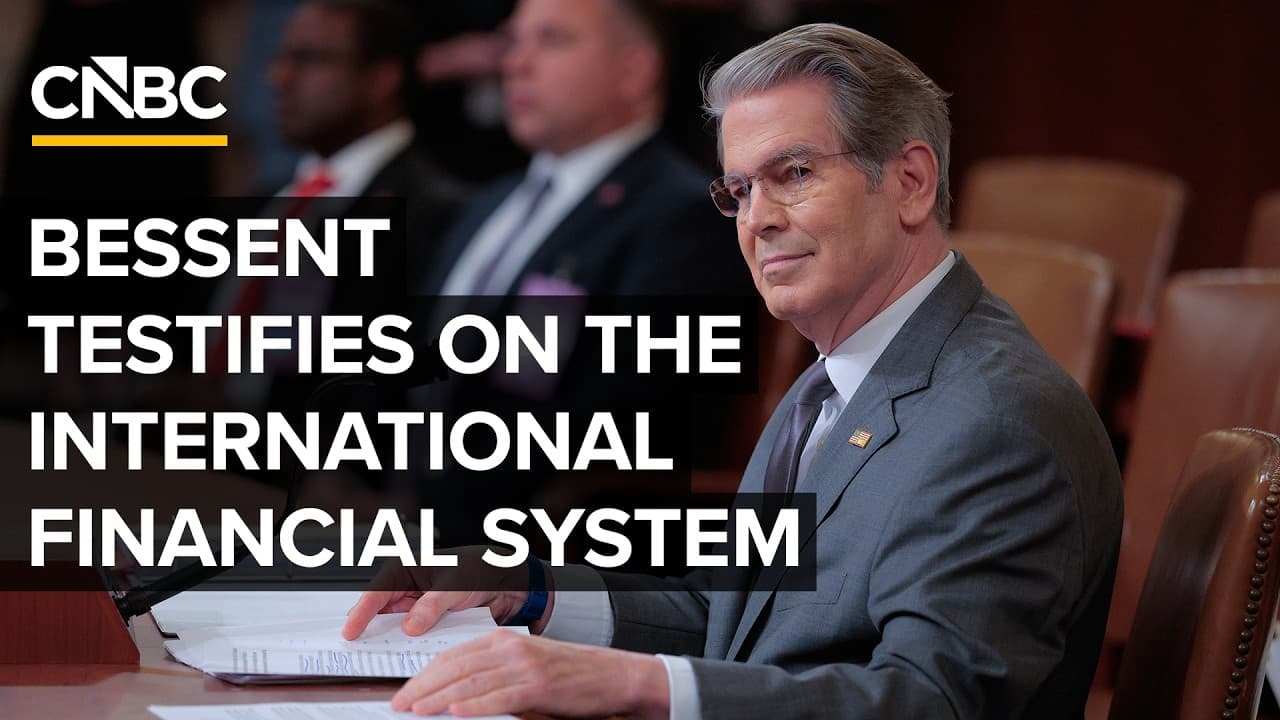
How the U.S. shapes the international financial system
TL;DR
The Treasury Secretary outlines America’s leadership role in global finance and oversight of institutions like the IMF and World Bank. He argues for accountability, transparency, and focus on core missions, while noting China’s evolving role and the World Bank's steps on energy and nuclear energy. The hearing highlights policy directions and legislative context for development financing.
Transcript
Committee on Financial Services will come to order. Without objection, the chair is authorized to declare a recess of the committee at any time. Today's hearing is entitled the annual testimony of the Secretary of the Treasury on the state of the International Financial System. Without objection, all members will have five legislative days within w... Read More
Key Insights
- The World Bank has begun to phase out its lending to China by 2031, signaling a shift in how development finance is allocated and the focus on other economies that genuinely require assistance.
- The International Nuclear Energy Financing Act HR1474 spurred the World Bank to engage nuclear energy efforts by partnering with the IAEA to support reactors and small modular reactors, reflecting a practical pro growth energy policy.
- America’s leadership in global finance is tied to its role as a major shareholder in IMF and World Bank and to ensuring these institutions stay focused on their core missions, with governance subject to oversight.
- The hearing emphasizes that the World Bank should direct resources to countries in genuine need and avoid backstopping China, which is described as a major global creditor and strategic competitor.
- Policy shifts are framed as returning to accountability and discipline at both the IMF and the World Bank, countering mission creep observed under prior administrations, according to the testimony.
- Energy policy clarity is urged, with positive notes on re engagement with nuclear energy and the expansion of energy financing as essential for developing economies to grow with reliable electricity.
- There is explicit concern about China drawing on its own financial resources while the IMF monitors external imbalances and exchange rate depreciation affecting its partners.
- The secretary notes progress in making energy financing more practical and growth oriented, including new funds for nuclear energy assistance and a push for more project financing globally.
Install to Summarize YouTube Videos and Get Transcripts
Explore YouTube Video Summarizer or Get YouTube Transcript Extractor
Questions & Answers
Q: What is the World Bank doing about China lending and why is it significant?
The World Bank is phasing out its lending to China by 2031, a move presented as an important step in the right direction. The reasoning is to focus development finance where it is truly needed and to avoid backing Beijing, which is described as a major global creditor. This shift reflects a broader aim to realign World Bank activities with core development objectives and prudent allocation of capital.
Q: What role does HR1474 play in the World Bank energy policy?
HR1474, the International Nuclear Energy Financing Act, helped trigger a shift in the World Bank’s energy policy by pushing it to re engage with nuclear energy. It supported the World Bank’s agreement with the IAEA to access nuclear expertise, back existing reactors, and explore small modular reactors, signaling a practical, growth oriented energy strategy.
Q: How is the IMF viewed in relation to China according to the testimony?
The IMF is viewed as facing a major test of its ability to fulfill its mission of promoting monetary cooperation and financial stability. The committee notes that China presents a significant challenge for the IMF to demonstrate rigorous oversight, transparency, and to manage external imbalances and exchange rate issues in its partners.
Q: What oversight themes are emphasized for IMF and World Bank governance?
The testimony emphasizes accountability, discipline, transparency, and ensuring that these institutions remain focused on their core missions. It argues against mission creep and calls for governance that aligns with practical development outcomes, including poverty reduction, economic growth, and reliable energy provision.
Q: Why is China described as a major global creditor in the hearing?
China is described as a major global creditor that uses state directed investment to advance its economic and geopolitical interests. The implication is that U.S. taxpayers should not backstop China through World Bank financing and that the Bank should reduce or end lending to China as part of aligning with genuine development needs.
Q: What are the stated benefits of focusing on pro growth energy policy?
Pro growth energy policy, including nuclear energy collaboration and support for new energy projects, aims to provide reliable and affordable electricity to developing economies. This approach is framed as directly supporting growth, improving development outcomes, and aligning with the Bank’s mission to reduce poverty and promote growth through targeted financing.
Q: What balance is the administration seeking in World Bank reform?
The administration seeks a return to core missions with measurable results and transparency, ensuring resources are used effectively. It aims to rebalance financing toward countries that genuinely need support, while guiding the Bank away from climate driven mission creep and toward practical energy and development projects.
Q: What concerns are raised about energy and development finance in the hearing?
Concerns center on ensuring development finance is targeted and does not subsidize ineffective lending. The hearing supports practical energy solutions, like nuclear energy and modular reactors, to provide reliable electricity for growth while ensuring that financing aligns with a pragmatic, pro growth, governance focused strategy across international financial institutions.
Summary & Key Takeaways
-
The United States remains a leading shareholder in the IMF and World Bank, with a responsibility to ensure governance aligns with core missions and oversight. The Secretary emphasizes transparency and prudent use of resources across these institutions.
-
World Bank policy shifts include phasing out lending to China by 2031 and re engaging with nuclear energy through cooperation with IAEA for small modular reactors, aligning with pro growth and energy reliability goals.
-
The IMF faces scrutiny over its approach to China, with concerns about external imbalances and the need for rigorous oversight and transparency in its assessments and reviews.
Read in Other Languages (beta)
Share This Summary 📚
Summarize YouTube Videos and Get Video Transcripts with 1-Click
Try YouTube Summary with ChatGPT & Claude or YouTube Transcript Generator
Explore More Summaries from CNBC Television 📚


Summarize YouTube Videos and Get Video Transcripts with 1-Click
Try YouTube Summary with ChatGPT & Claude or YouTube Transcript Generator