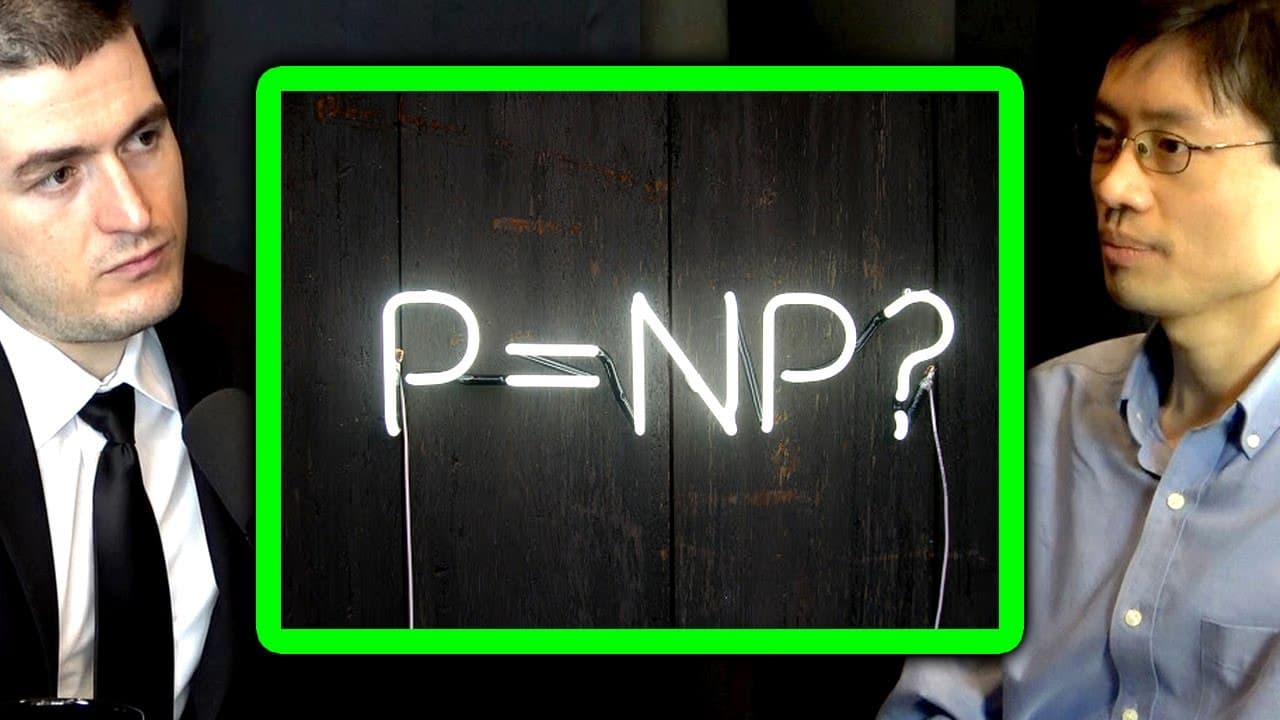
What Are the Odds P Equals NP?
TL;DR
The probability of P not equaling NP is estimated at around three percent, influencing many researchers to explore this question. This discussion emphasizes the complexity of the topic and highlights how humor and quantified uncertainty, like Scott Aaronson's estimate, can motivate further exploration and understanding within the field.
Transcript
uh let me ask the most ridiculous question you think p equals np wow i don't know i mean i would say i i know there are enough people who have very strong interest in trying to show that it is i'm talking about government agencies for security purposes repurposing and most computer scientists which would say believe that p equals np uh my question ... Read More
Key Insights
- 👍 There are enough people, including government agencies, who strongly believe that P equals NP and are interested in proving it.
- 🔝 Humor and confident declarations, like Scott Aaronson's three percent probability, can motivate researchers and have a ripple effect on the belief in P not equaling NP.
- 🎴 Human psychology plays a role in our perception of probabilities and our ability to think about low probability events.
- 🎙️ More videos with Po-Shen Loh:
Install to Summarize YouTube Videos and Get Transcripts
Explore YouTube Video Summarizer or Get YouTube Transcript Extractor
Questions & Answers
Q: What kind of discoveries could potentially prove that P does not equal NP?
Discoveries in computer science or theoretical computer science that challenge our current understanding of computation could lead to the belief that P does not equal NP. These discoveries could uncover misunderstandings or gaps in knowledge that flatten all problems.
Q: Why is the speaker uncertain about the answer to whether P equals NP?
The speaker acknowledges their limited knowledge on the topic and suggests that being surrounded by theoretical computer scientists at Carnegie Mellon University keeps them aware of what they don't know. They prioritize humility and avoiding incorrect answers.
Q: Who estimates the probability of P not equaling NP at three percent?
Scott Aaronson, a computer scientist formerly at MIT and currently at UT Austin, has estimated the probability of P not equaling NP at three percent. This estimate is given with a touch of humor and confidence despite the uncertainty surrounding the topic.
Q: How does the speaker link the number 42 to the belief in P not equaling NP?
The speaker compares the use of the number 42 in humor and storytelling, specifically in books like "The Hitchhiker's Guide to the Galaxy," to the belief in P not equaling NP. They suggest that the number's presence creates a meme effect that influences our perception of reality and motivates researchers.
Summary & Key Takeaways
-
The speaker ponders the possibility of proving that P does not equal NP and explores the potential discoveries or gaps in knowledge that could lead to this.
-
They acknowledge their limited understanding of the topic but emphasize the importance of humility and leaving room for uncertainty.
-
The probability of P not equaling NP is estimated to be around three percent, which has influenced researchers to work on it.
Read in Other Languages (beta)
Share This Summary 📚
Summarize YouTube Videos and Get Video Transcripts with 1-Click
Try YouTube Summary with ChatGPT & Claude or YouTube Transcript Generator
Explore More Summaries from Lex Clips 📚





Summarize YouTube Videos and Get Video Transcripts with 1-Click
Try YouTube Summary with ChatGPT & Claude or YouTube Transcript Generator