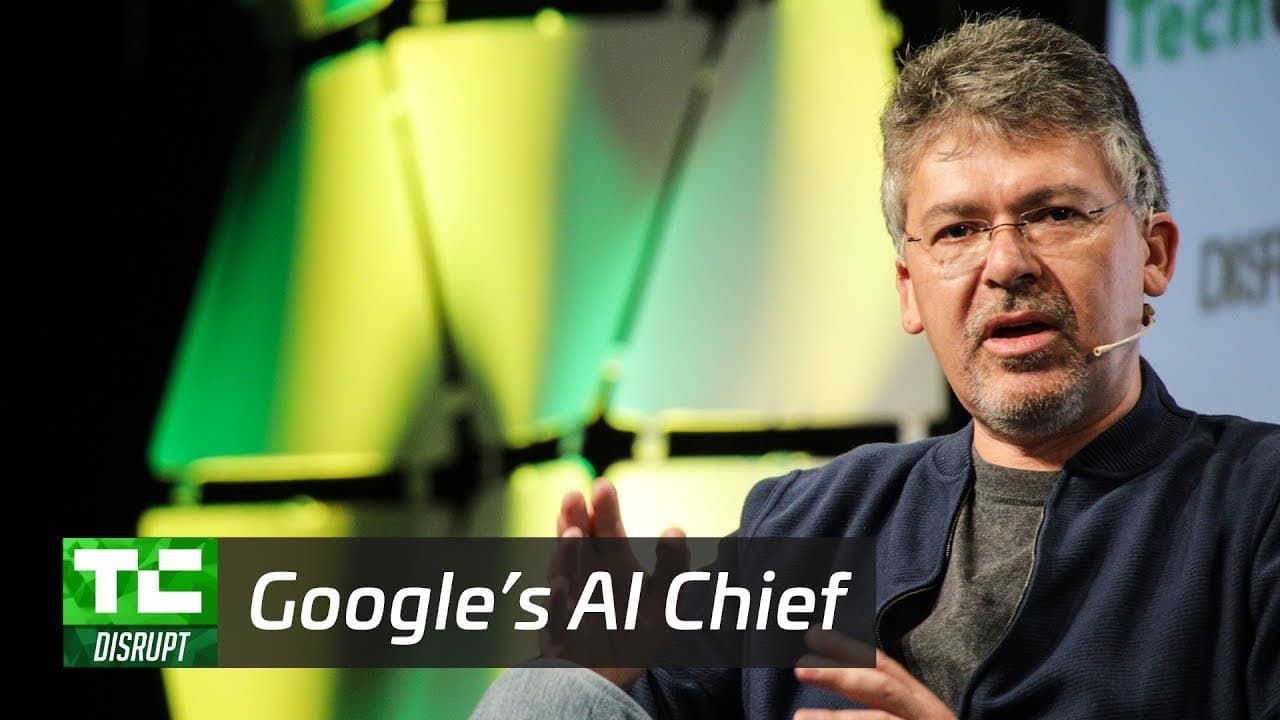
Making Computers Smarter with Google's AI chief John Giannandrea | Disrupt SF 2017
Transcript
[Applause] good morning good morning you don't do a lot of days I do not it's uh nice to see you here sure you've you've been in this business for a few years you were at general magic back in the 90s I'm not saying you old I'm just saying you've may have done this for a while you were gentle magic in the 90s you did a speech recognition startup te... Read More
Install to Summarize YouTube Videos and Get Transcripts
Explore YouTube Video Summarizer or Get YouTube Transcript Extractor
Summary
In this video, Google's Senior Vice President of Engineering, John Giannandrea, discusses the company's focus on humanizing technology through machine learning and artificial intelligence. He explains the importance of teaching computers to be smarter and augmenting human intellect rather than replacing it. Giannandrea also addresses the misconceptions and hype surrounding AI, emphasizing the need for ethical considerations and the impact of machine learning on privacy. He highlights areas such as healthcare and fraud detection as promising opportunities for startups entering the AI space.
Questions & Answers
Q: Why does Giannandrea believe that computers need to be taught to be smarter?
Giannandrea believes that while computers are powerful, they are also limited in their capabilities. By teaching computers to be smarter, they can fulfill their potential and become more valuable tools for enhancing human thinking and productivity. This aligns with the philosophy of augmenting human intellect rather than replacing it, which Giannandrea attributes to the ideas of Doug Engelbart.
Q: When did Google decide to go all in on machine learning and AI?
According to Giannandrea, Google saw the increasing importance of machine learning on a daily basis. While the company had been using machine learning since its inception, the last four to five years have witnessed a significant acceleration in the impact of machine learning, particularly deep learning and deep neural networks. These advancements have transformed various industries and driven Google to become an AI first company.
Q: What does it mean for Google to be an AI first company?
Being an AI first company for Google means focusing on building products that have advanced features necessitating advanced computer science. One example of such a product is the Google Assistant, which relies on language understanding, dialogue, and speech recognition to provide users with an exceptional experience. By prioritizing AI, Google aims to create the next generation of products that work better and provide users with amazing features.
Q: Why did Google invest in AI hardware, specifically the tensor processing unit?
Google's investment in AI hardware, such as the tensor processing unit (TPU), stemmed from the computational expenses associated with training machine learning models. Some models took weeks to train, which hindered the innovation cycle. To address this, Google developed custom hardware like TPUs to accelerate the training process. However, it's important to note that various technology companies, including Google's competitors, also leverage other hardware, such as GPUs, to harness AI's potential.
Q: Is Google's dominance in AI causing an imbalance in the ecosystem?
Giannandrea dismisses the notion that Google's focus on AI is creating a talent or energy imbalance in the ecosystem. While Google has a significant investment in AI and employs many talented individuals, there is a vast number of intelligent people working on machine learning outside any single tech company. Large research conferences like NIPS attract thousands of researchers each year, and many startups are leveraging open-source machine learning technologies to compete in different verticals.
Q: Are startups disadvantaged by not having access to the same scale of data as Google?
Giannandrea explains that startups actually have access to the latest cutting-edge machine learning techniques and software because most of it is open-source. Google, along with other companies, releases datasets to encourage startups and academia to contribute to the machine learning community. While Google possesses vast amounts of data, there are many large open datasets available to startups that they can use to train their models.
Q: If someone were to start a machine learning startup today, what areas should they focus on?
Giannandrea suggests that healthcare is an area ripe for applying machine learning. For example, recognizing different breeds of dogs with accuracy could translate into building decision support tools for analyzing medical images, such as radiology and pathology. He also mentions fraud detection and financial verticals as potential areas where machine learning can have a significant impact. Ultimately, there are numerous verticals with opportunities for machine learning to revolutionize existing processes.
Q: What are some of the challenges in making machine learning systems more advanced?
Giannandrea acknowledges there are several challenges to address. For instance, teaching computers to learn from a small number of examples, an ability natural to humans, remains a problem for machines. Additionally, transfer learning, which involves applying knowledge from one domain to another, is an ongoing research area without substantial breakthroughs. These challenges, along with others, require incremental steps and continuous research to make machine learning more successful and accessible.
Q: Will achieving artificial general intelligence (AGI) be a revolutionary step or a series of incremental advancements?
Giannandrea believes that achieving AGI, or general artificial intelligence, will come through a series of incremental steps rather than a single revolutionary breakthrough. The field of machine learning is continuously advancing, with more research papers published each year. These papers lead to quick reproductions of successful results, facilitating incremental progress. While breakthroughs can come from different sources, the overall progress is driven by continuous improvement and innovation.
Q: Is Google focusing on improving language understanding in AI research?
Yes, Google has a significant research effort focused on language understanding, which, according to Giannandrea, is the holy grail of applied AI. The goal is to enable computers to read, understand, and summarize vast amounts of written content, such as documents, websites, and news articles. Progress in this area would revolutionize the technology's ability to make sense of complex data, effectively enhancing productivity and accessibility.
Q: How concerned should we be about the ethical implications of AI and machine learning?
Giannandrea emphasizes that while ethical considerations are essential, there is currently an unwarranted hype and concern surrounding AI. Ethical questions around machine intelligence are real, and Google collaborates with various groups to study and address them. He mentions ML fairness as a significant ethical concern, highlighting the importance of avoiding biased learning systems. Google actively works on unbiased training data and tools to identify inherent bias within datasets. Overall, ethical discussions are necessary, but they should not overshadow the positive impact that AI can bring.
Q: Is privacy a concern in the AI world, given the need for extensive data to train models?
Privacy is a question that Google takes seriously, and most of their AI features are opt-in. Giannandrea argues that machine learning can actually enhance privacy since it often relies on aggregating data points to learn without exposing individuals' personal data. For example, in Google Maps, the busy hour information for coffee shops is derived from aggregated data without revealing any individual's location. Thus, machine learning can provide valuable products while still preserving privacy.
Q: Will machine learning's advancement benefit attackers more than defenders in terms of security?
Giannandrea acknowledges that advanced technologies like machine learning can be exploited by both attackers and defenders in the security space. While he is not aware of the specific asymmetry mentioned by Google's Director of IT Security, he asserts that machine learning is currently used extensively on the defensive side to identify and mitigate security risks. In general, machine learning offers opportunities for both sides, but advancements in security and defense are actively being pursued.
Q: What does the future hold for Google's products in the near term?
Giannandrea highlights the trend towards pervasive computing as a significant focus for Google's future products. Instead of relying solely on smartphones, Google is expanding into new devices, enabling intelligent products to work together seamlessly. Google Home, for example, integrates various smart features and personalization. Users can interact via voice commands to perform tasks such as checking the weather, adding items to a to-do list, or viewing information across different devices. The aim is to enhance productivity and personalized experiences through pervasive computing.
Q: What happened to Google Lens, and is Google still working on it?
Google is indeed still working on Google Lens. Giannandrea explains that Google Lens represents a broader effort to leverage advances in machine learning to enhance computer vision. The goal is to enable computers to understand what they see, whether through a camera viewfinder or analyzing photos. Google has already introduced features in Google Photos where the system can comprehend images without explicit labeling. Google Lens encompasses a range of planned products that will continue to emerge, building on the progress made so far.
Q: What is the biggest myth surrounding AI today?
According to Giannandrea, the term "artificial intelligence" itself is a broad, ill-defined concept. He prefers using the term "machine intelligence," which refers to making machines slightly more intelligent or less dumb. The term "AI" encompasses everything from data science to artificial general intelligence, making it challenging to pinpoint a specific myth. The focus should be on practical, applied progress rather than getting caught up in sensationalized portrayals of AI.
Q: Is privacy a concern in the AI world, given the need for extensive data to train models?
Privacy is a question that Google takes seriously, and most of their AI features are opt-in. Giannandrea argues that machine learning can actually enhance privacy since it often relies on aggregating data points to learn without exposing individuals' personal data. For example, in Google Maps, the busy hour information for coffee shops is derived from aggregated data without revealing any individual's location. Thus, machine learning can provide valuable products while still preserving privacy.
Q: Will machine learning's advancement benefit attackers more than defenders in terms of security?
Giannandrea acknowledges that advanced technologies like machine learning can be exploited by both attackers and defenders in the security space. While he is not aware of the specific asymmetry mentioned by Google's Director of IT Security, he asserts that machine learning is currently used extensively on the defensive side to identify and mitigate security risks. In general, machine learning offers opportunities for both sides, but advancements in security and defense are actively being pursued.
Q: What does the future hold for Google's products in the near term?
Giannandrea highlights the trend towards pervasive computing as a significant focus for Google's future products. Instead of relying solely on smartphones, Google is expanding into new devices, enabling intelligent products to work together seamlessly. Google Home, for example, integrates various smart features and personalization. Users can interact via voice commands to perform tasks such as checking the weather, adding items to a to-do list, or viewing information across different devices. The aim is to enhance productivity and personalized experiences through pervasive computing.
Q: What happened to Google Lens, and is Google still working on it?
Google is indeed still working on Google Lens. Giannandrea explains that Google Lens represents a broader effort to leverage advances in machine learning to enhance computer vision. The goal is to enable computers to understand what they see, whether through a camera viewfinder or analyzing photos. Google has already introduced features in Google Photos where the system can comprehend images without explicit labeling. Google Lens encompasses a range of planned products that will continue to emerge, building on the progress made so far.
Q: What is the biggest myth surrounding AI today?
According to Giannandrea, the term "artificial intelligence" itself is a broad, ill-defined concept. He prefers using the term "machine intelligence," which refers to making machines slightly more intelligent or less dumb. The term "AI" encompasses everything from data science to artificial general intelligence, making it challenging to pinpoint a specific myth. The focus should be on practical, applied progress rather than getting caught up in sensationalized portrayals of AI.
Q: Is Google concerned about an AI apocalypse?
Giannandrea dismisses concerns about an AI apocalypse and labels them as unwarranted hype. While he acknowledges that some people worry about it, he believes that such fears are overblown and not based on current evidence. Instead, he argues that the focus should be on the positive effects and the ethical considerations surrounding AI. As with any powerful technology, ethical questions are real, but the idea of a superhuman intelligence taking over is not something he finds compelling.
Q: What are the ethical concerns Google is addressing with ML fairness?
Google invests a lot of effort in AI fairness. One ethical concern they focus on is ML fairness, which involves addressing biases in learned systems. If the training data contains bias, it can result in biased AI systems, leading to significant ethical consequences. Google collaborates with several groups and research initiatives to ensure unbiased training data and develop tools to identify inherent biases in datasets. ML fairness and the impartial functioning of AI are major ethical concerns that Google takes seriously.
Takeaways
John Giannandrea's emphasis on humanizing technology through machine learning and AI highlights the importance of augmenting human intelligence rather than replacing it. He underlines the need to make computers smarter and fulfill their potential. While dismissing the hype surrounding AI, Giannandrea acknowledges the ethical considerations of machine learning, particularly fair ML practices and explainability. He addresses concerns about privacy, emphasizing the potential for machine learning to enhance privacy rather than compromise it. Giannandrea sees immense opportunities for startups in various verticals such as healthcare and fraud detection. Overall, he emphasizes incremental progress and continuous research as the driving forces behind advancements in AI.
Read in Other Languages (beta)
Share This Summary 📚
Summarize YouTube Videos and Get Video Transcripts with 1-Click
Try YouTube Summary with ChatGPT & Claude or YouTube Transcript Generator
Explore More Summaries from TechCrunch 📚



Summarize YouTube Videos and Get Video Transcripts with 1-Click
Try YouTube Summary with ChatGPT & Claude or YouTube Transcript Generator