Why Saudi PIF Is Betting $55B to Take EA Private
TL;DR
Electronic Arts is being taken private for $55 billion at $210 per share, a 25% premium, in the largest take-private deal in history. The buyers are Saudi Arabia's PIF, Silver Lake, and Jared Kushner's Affinity Partners. The thesis treats gaming as the anchor of internet usage, with roughly 3 billion daily players, and positions AI-driven experiences as the future of entertainment.
Transcript
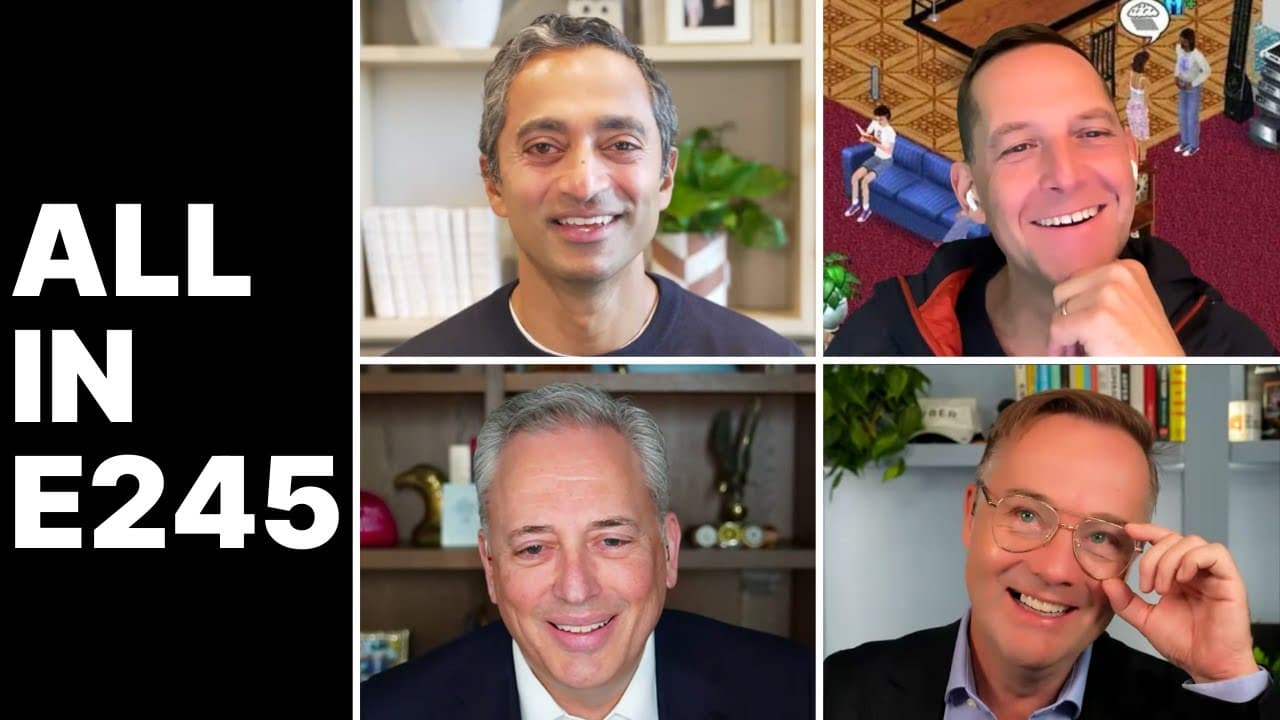
All right, everybody. Welcome back to the number one podcast in the world. Of course, that's the All-In podcast. I'm your host, Jason Caliganis. With me again, your chairman, dictator, Chimath Polyhapatia, and the Sultan of Science, David Freeberg, David Saxs, will be calling in from the skiff. He's in some deep negotiations uh for the United State... Read More
Key Insights
- The EA take-private is valued at $55 billion, the largest take-private deal in history, exceeding prior benchmarks like Texas Power Company in 2007 and HCA Healthcare at $33 billion. Buyers pay $210 per share, a 25% premium.
- Saudi Arabia's PIF, Silver Lake, and Jared Kushner's Affinity Partners lead the deal. The PIF, which already owned 10% of EA, becomes majority owner, while Affinity holds about 5% of the company post-transaction.
- Gaming is described as the anchor pillar of internet usage, with roughly 3 billion daily active users playing games, making it as big as or bigger than social networking and social media in reach.
- Distribution gatekeepers are raising prices to grab share. Xbox hiked its subscription service 50%, and so many users tried to cancel that the site went down, illustrating tension between platforms and IP owners.
- Chamath's bear case is that the value of patents, IP, and copyrights will erode, splitting content holders into winners and losers. He places gaming among the winners and traditional studios like Disney, Hulu, and Netflix among the losers.
- AI is expected to accrue more to video game entertainment than to social or traditional media because it enables dynamic, back-and-forth experiences. Fortnite tunes AI opponents to be easier for new players, cutting churn and raising retention.
- The PIF has pursued gaming aggressively through Savvy Games, buying Scopely for $4.9 billion in 2023 and Niantic for $3.5 billion. It also owns 4% of Nintendo, 6% of Take-Two, and a stake in Activision Blizzard.
- Taking EA private lets owners ignore quarter-to-quarter earnings and make a 10-year bet aligned with the Saudi 2030 vision, cleaning up the opex model and finding distribution outside Xbox and PlayStation.
Install to Summarize YouTube Videos and Get Transcripts
Explore YouTube Video Summarizer or Get YouTube Transcript Extractor
Questions & Answers
Q: How much was EA acquired for and why is the deal significant?
Electronic Arts is being taken private for $55 billion, which the hosts call the largest take-private deal in history. Buyers are paying $210 per share, a 25% premium over the stock price. For comparison, they cite the Texas Power Company deal in 2007 and HCA Healthcare at $33 billion. The size marks what they describe as a high watermark for private equity, and it signals a major bet on gaming as a durable, internet-scale asset class.
Q: Who are the investors buying Electronic Arts?
The take-private group includes Saudi Arabia's Public Investment Fund (PIF), Silver Lake, and Jared Kushner's Affinity Partners. The PIF, which had already owned 10% of EA before the deal, becomes the majority owner. Affinity is set to hold about 5% of the company post-transaction, and the PIF is also a large limited partner in Affinity. The PIF has historically invested over $900 billion across assets like Lucid Motors, LIV Golf, the SoftBank Vision Fund, Uber, and Newcastle in the Premier League.
Q: Why do investors see gaming as the future of entertainment?
Gaming is described as the anchor pillar of internet usage, with roughly 3 billion daily active users playing games, making it as large as or bigger than social networking and social media. About 60% of US adults play games every week. The panel argues that as AI improves productivity and gives people more free time, the overall entertainment market grows, and gaming, powered by AI, captures the largest share of that growing attention and engagement.
Q: How is AI changing video game engagement and retention?
AI enables dynamic, back-and-forth experiences that are harder to replicate in traditional content or social media. A concrete example is Fortnite, where new players are largely matched against AI opponents tuned to be easier to beat. Early on, beginners were paired with better human players, lost repeatedly, got frustrated, and quit, creating high churn. By using AI to ease newcomers in, the platform raised engagement and retention, a pattern the hosts say is spreading across many gaming platforms.
Q: What is the bear case against the EA deal?
Chamath's bear case extends his view that the value of patents, IP, and copyrights will erode over time, creating winners and losers among content holders. The risk is that new AI tool chains let the number of games built increase by two, three, or four orders of magnitude, with distribution shifting to social media platforms, undercutting EA's gatekeeper position. However, he considers this a low-probability outcome and believes gaming sits on the winning side of the IP shift.
Q: What other gaming investments has Saudi Arabia's PIF made?
Through its Savvy Games division, the PIF bought Scopely for $4.9 billion in 2023 and spent $3.5 billion earlier this year to acquire Niantic, the maker of Pokémon Go. It also owns 4% of Nintendo, 6% of Take-Two, and a sizable stake in Activision Blizzard. The panel frames these moves as a coherent, long-term thesis that gaming is central to the future of entertainment and to Saudi Arabia's economic diversification away from oil.
Q: Why take EA private instead of leaving it public?
Taking EA private lets the owners avoid quarter-to-quarter earnings pressure and make a patient 10-year bet aligned with Saudi Arabia's 2030 vision. Private ownership provides time to clean up the operating expense model, clarify who does what, adopt the best next-generation tools, and find distribution channels outside the scope of Xbox and PlayStation. If executed well, the panel argues EA could become a multi-hundred-billion-dollar asset and a major win for the buyers.
Q: What other topics does this All-In episode cover?
Beyond the EA leveraged buyout and its implications for private equity, the episode covers the IPO market and a possible SPAC 2.0, the AI rollup opportunity, and OpenAI and Meta launching short-form video apps debated as AI slop or the future of content. It also addresses open source AI, including DeepSeek's new model and pressure on the US AI industry, plus a state AI regulation frenzy involving states' rights versus federal control and concerns about overregulation.
Summary & Key Takeaways
-
Electronic Arts, founded at Sequoia's office in 1982 in San Mateo and still headquartered in Redwood City, is being taken private for $55 billion at $210 per share, a 25% premium. This is the largest take-private deal in history, dwarfing HCA Healthcare's $33 billion.
-
The buyers are Saudi Arabia's PIF, Silver Lake, and Jared Kushner's Affinity Partners. The PIF, which had already invested over $900 billion across Lucid, LIV Golf, Uber, and Newcastle, moves from a 10% EA stake to majority ownership, with Affinity holding roughly 5%.
-
The bull case treats gaming, with about 3 billion daily players and 60% of US adults playing weekly, as the future of entertainment, supercharged by AI-driven engagement. Private ownership allows a patient 10-year bet aligned with Saudi Arabia's 2030 diversification vision.
Read in Other Languages (beta)
Share This Summary 📚
Summarize YouTube Videos and Get Video Transcripts with 1-Click
Try YouTube Summary with ChatGPT & Claude or YouTube Transcript Generator
Explore More Summaries from All-In Podcast 📚
Summarize YouTube Videos and Get Video Transcripts with 1-Click
Try YouTube Summary with ChatGPT & Claude or YouTube Transcript Generator