How to Learn Faster Through Projects and Feedback
TL;DR
Start a meaningful project before consuming extensive tutorials, then use mistakes and knowledge gaps to decide what to study next. Learning accelerates when a clear goal creates feedback, filters information for relevance, and requires useful output, while passive consumption, excessive memorization, and unmanaged note collection can create only a false sense of progress.
Transcript
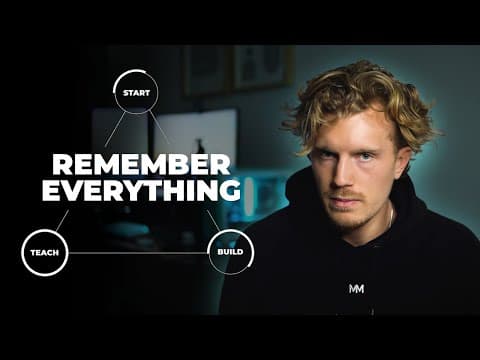
If you need to remember it, it's not important. If it's important, you will remember it. For some reason it's become an obsession to just remember everything you read. There are videos on YouTube with millions of views. It is a very popular and viral topic. and nothing against the people that I'm flashing on the screen. I'm friends with quite a few... Read More
Key Insights
- Learning is an output-driven process because attempting to create or perform exposes the input that is actually needed. A project produces concrete problems, allowing the learner to search for targeted answers instead of consuming broad material without knowing whether it will ever become useful.
- A meaningful goal creates the error signal required for learning. When a desired result matters deeply, the learner can compare present performance with the target, recognize behaviors that interfere with progress, and adjust those behaviors instead of treating setbacks as disconnected events.
- Cybernetic learning is a continuous cycle of setting a target, perceiving the current state, measuring the gap, and acting to reduce it. Like a helmsman correcting a ship's course, the learner improves through repeated observation and adjustment rather than one perfect initial plan.
- Relevance strengthens retention because the mind has a reason to register information connected to an active problem. A goal creates errors, errors create a filter, and that filter distinguishes useful knowledge from noise, making practical information more likely to remain available.
- Memorization is not the same as understanding. Trying to remember every word of a book can serve the desire to appear intelligent, but useful articulation comes from grasping ideas well enough to apply them, make decisions, and create better outcomes.
- Passive self-improvement consumption can create a false sense of progress. Continually scrolling educational material still provides easy stimulation when no action follows, so consuming supposedly valuable information may resemble other passive media habits more than genuine learning.
- Socially assigned goals shape attention and behavior by determining which errors and opportunities a person notices. Someone following an unquestioned default path may filter out business, creative, health, or AI opportunities because those possibilities are unrelated to the destination guiding their actions.
- AI is presented as a tool for removing friction rather than replacing personal thought and writing. The creation process still requires choosing a topic, capturing ideas that represent the desired mind, producing a braindump, forming an outline, drafting, and publishing the result.
Install to Summarize YouTube Videos and Get Transcripts
Explore YouTube Video Summarizer or Get YouTube Transcript Extractor
Questions & Answers
Q: How can I learn a new skill faster through projects?
Start the project before watching a large collection of tutorials. Attempting real work will reveal the exact concepts, techniques, and decisions you do not understand. Try to solve each obstacle, search for an answer when the gap becomes clear, apply what you find, and publish the project. Repeating this cycle connects study to immediate use and creates feedback for the next attempt.
Q: Why does active creation improve learning?
Active creation forces the mind to produce an outcome, and that demand exposes missing knowledge. Instead of guessing which material might matter someday, you encounter specific problems that require specific input. The resulting information has context, relevance, and an immediate application. Creation also generates errors and feedback, which allow you to adjust your behavior and improve through repeated attempts.
Q: What is the cybernetic model of learning?
The cybernetic model treats learning as continuous course correction. It includes a reference signal, which is the goal, a sensor that perceives the current state, a comparator that identifies the gap between the current and target states, and behavior that reduces the error. Learning occurs as the person repeatedly observes results, notices deviations, acts, and checks the new result.
Q: Why is a meaningful goal necessary for effective learning?
A meaningful goal provides the standard against which actions and results can be judged. Without that standard, a mistake may not register as a problem and useful opportunities may not attract attention. When the goal matters intrinsically, setbacks produce an error signal, information can be filtered according to its usefulness, and behavior can be adjusted toward the desired result.
Q: Why is memorizing everything I read ineffective?
Memorizing every word is unnecessary because acquiring facts is not the same as understanding them. The useful purpose of knowledge is to improve decisions, develop skills, and support better outcomes. Understanding grows through application, struggle, and feedback. If an idea becomes important to an active goal or problem, its relevance gives the mind a stronger reason to retain and use it.
Q: Can self-improvement content become unproductive?
Self-improvement content becomes unproductive when consumption replaces action. Scrolling educational material may provide the same easy stimulation as other passive content while adding a false sense of progress. Information is compared to food for the mind: continuous intake without corresponding output can create intellectual obesity. Its value depends on whether it supports a goal, decision, project, or behavioral change.
Q: Why can note-taking systems and bookmarks fail to support learning?
Note-taking systems, bookmarks, highlights, and second-brain collections can become largely useless when maintaining and organizing information becomes the main activity. A large archive does not guarantee understanding, retention, or application. Captured ideas should represent the mind you want to build and should feed creation. The practical test is whether the information helps you think, decide, draft, publish, or solve an active problem.
Q: How should AI be used in a learning and writing process?
AI should remove friction from the process rather than perform the thinking and writing for you. The learner still chooses a topic, captures ideas aligned with an ideal mind, makes a braindump, creates an outline, drafts, and publishes. Used this way, AI can support movement through the workflow while preserving the struggle, judgment, and creation that make learning meaningful.
Summary & Key Takeaways
-
Effective learning begins with a meaningful goal and an attempt to produce something. Starting a project reveals specific gaps, errors, and obstacles that passive study cannot expose. Searching for information at the moment it becomes necessary makes that information relevant, easier to retain, and directly connected to improved performance.
-
Learning operates as a cybernetic feedback process. A learner holds a target state, observes the current state, compares the two, and changes behavior to reduce the difference. Without a clear direction, errors have little significance, opportunities are easily filtered out, and information consumption lacks a practical standard for relevance.
-
Memorizing books, collecting bookmarks, and organizing a second brain are not substitutes for understanding or creation. Information becomes valuable when it supports decisions, projects, and skill development. The recommended cycle is to choose a topic, capture representative ideas, braindump, outline, draft, publish, receive feedback, and repeat throughout life.
Read in Other Languages (beta)
Share This Summary 📚
Summarize YouTube Videos and Get Video Transcripts with 1-Click
Try YouTube Summary with ChatGPT & Claude or YouTube Transcript Generator
Explore More Summaries from Dan Koe 📚


Summarize YouTube Videos and Get Video Transcripts with 1-Click
Try YouTube Summary with ChatGPT & Claude or YouTube Transcript Generator