What Is Rutherfordium and Who Was Ernest Rutherford?
TL;DR
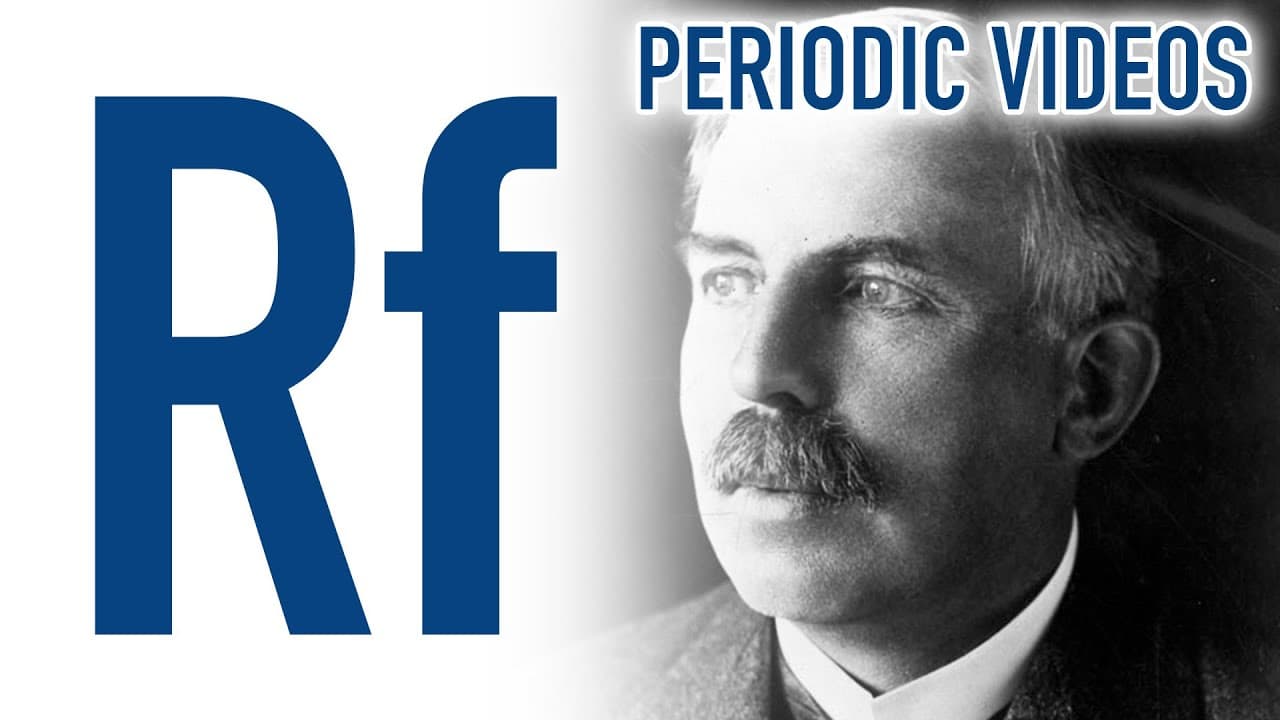
Rutherfordium, element 104, is named after Ernest Rutherford, who elucidated atomic structure and won the Nobel Prize in Chemistry. His strict lab hours limited work to before 6 PM, yet led to the remarkable success of his students, 11 of whom also received Nobel Prizes. The exhibition at the Royal Society highlights both Rutherford's scientific achievements and his personal life.
Transcript
We are here in the basement of the Royal Society in London, The Royal Society is the UK National Academy for Sciences and we are here because there is an exhibition about Rutherford. We are interested in the element Rutherfordium which is right here at the bottom of the periodic table number 104, and with these elements only tiny amounts, relativel... Read More
Key Insights
- 🥺 Rutherford's groundbreaking experiments explained atomic structure, leading to a better understanding of the periodic table.
- 😉 He won a Nobel Prize in Chemistry, despite his favoritism towards physics.
- 💦 Rutherford's strict lab working hours resulted in exceptional student success, with 11 Nobel Prizes.
- 💦 His lab's success baffled visitors due to the unconventional work schedule.
- 🥼 Rutherford's lab culture displayed a mix of discipline and eventual success.
- ❓ The exhibition at the Royal Society showcases Rutherford's human side through postcards.
- 🧑🔬 Famous scientists like Rutherford also took leisure time outside the lab.
Install to Summarize YouTube Videos and Get Transcripts
Explore YouTube Video Summarizer or Get YouTube Transcript Extractor
Questions & Answers
Q: What was Rutherford's key contribution to science?
Rutherford's experiments elucidated the structure of atoms and made the periodic table comprehensible for the first time by demonstrating the presence of a nucleus in atoms.
Q: How did Rutherford's lab working hours influence his students' success?
Rutherford's strict rule of not working after 6 pm in the lab resulted in 11 of his students winning Nobel Prizes, showcasing his effective leadership and mentoring style.
Q: Why did Rutherford win the Nobel Prize in Chemistry despite his dislike for the field?
The irony of Rutherford winning a Nobel Prize in Chemistry, a field he disrespected, could be seen as a playful revenge by chemists for his dismissal of their discipline.
Q: How did Rutherford's lab culture differ from traditional scientific work environments?
Rutherford's lab, with its limited working hours and seemingly relaxed atmosphere, puzzled visiting scientists who couldn't understand the lab's success despite the unconventional working schedule.
Summary & Key Takeaways
-
The Royal Society's exhibition on element Rutherfordium showcases Rutherford's contribution to atomic structure understanding.
-
Rutherford won a Nobel Prize in Chemistry despite his preference for physics over chemistry.
-
Rutherford's strict lab working hours led to 11 of his students winning Nobel Prizes.
Read in Other Languages (beta)
Share This Summary 📚
Summarize YouTube Videos and Get Video Transcripts with 1-Click
Try YouTube Summary with ChatGPT & Claude or YouTube Transcript Generator
Explore More Summaries from Periodic Videos 📚


Summarize YouTube Videos and Get Video Transcripts with 1-Click
Try YouTube Summary with ChatGPT & Claude or YouTube Transcript Generator