18.2.5 Weak Priorities
TL;DR
Latency in a real-time system can be reduced by implementing priority-based scheduling algorithms, such as Earliest Deadline, to ensure timely execution of tasks.
Transcript
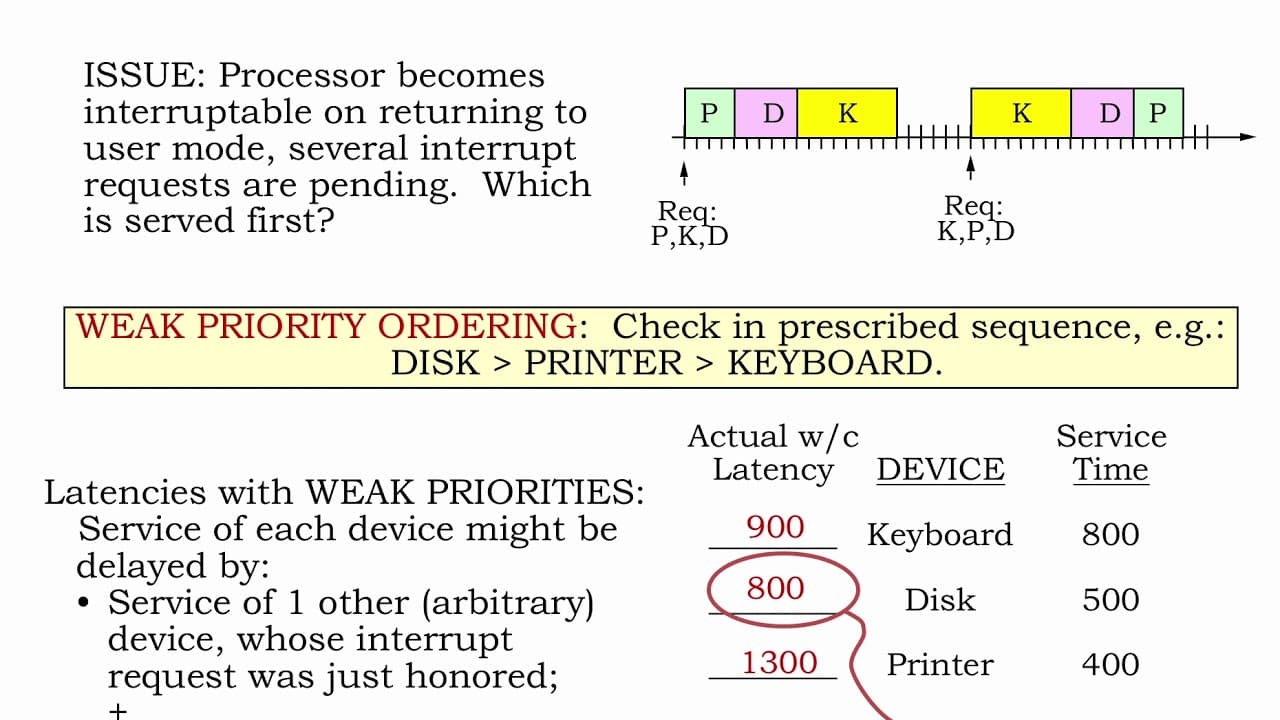
Suppose we have a real-time system supporting three devices: a keyboard whose interrupt handler has a service time of 800 us, a disk with a service time of 500 us, and a printer with a service time of 400 us. What is the worst-case latency seen by each device? For now we'll assume that requests are infrequent, i.e., that each request only happens o... Read More
Key Insights
- 🏃 Long-running handlers have a significant impact on worst-case latency in a real-time system.
- 🦡 Prioritizing requests based on deadlines can reduce worst-case latencies.
- ✋ A weak priority system ensures timely execution of higher-priority requests.
- ⌛ Earliest Deadline scheduling is a simple and intuitive strategy for priority assignment in real-time systems.
- ⚾ Assigning priorities based on earliest deadline can guarantee meeting deadlines if any priority assignment can do so.
- 🎟️ Implementing different priority assignments may be necessary when the system is overloaded to minimize the total number of missed requests.
- 🐕🦺 The assignment of priorities becomes complex when considering pending requests and their service times.
Install to Summarize YouTube Videos and Get Transcripts
Explore YouTube Video Summarizer or Get YouTube Transcript Extractor
Questions & Answers
Q: What is the impact of long-running handlers on worst-case latency in a real-time system?
Long-running handlers delay the execution of other handlers, increasing their worst-case latency. For example, the start of the keyboard handler can be delayed by the execution of the disk and printer handlers.
Q: What are the possibilities for reducing worst-case latencies in a real-time system?
One strategy is to assign priorities to pending requests and serve them in priority order instead of using first-come-first-served. This can be done by implementing a weak priority system.
Q: What is a weak priority system in real-time scheduling?
In a weak priority system, priorities are used to select the next task to be run at the completion of the current task. The current task always runs to completion, even if a higher-priority request arrives during its execution.
Q: How does Earliest Deadline scheduling work?
Earliest Deadline is a strategy that assigns priorities based on the deadlines of pending requests. Requests are sorted by their deadlines, and the highest priority is given to the request with the earliest deadline.
Summary & Key Takeaways
-
Real-time systems supporting three devices - keyboard, disk, and printer - can experience worst-case latency when requests are served in first-come-first-served order.
-
Long-running handlers significantly impact the worst-case latency of other devices.
-
Prioritizing requests based on deadlines and implementing a weak priority system can reduce worst-case latencies in a real-time system.
Read in Other Languages (beta)
Share This Summary 📚
Summarize YouTube Videos and Get Video Transcripts with 1-Click
Try YouTube Summary with ChatGPT & Claude or YouTube Transcript Generator
Explore More Summaries from MIT OpenCourseWare 📚






Summarize YouTube Videos and Get Video Transcripts with 1-Click
Try YouTube Summary with ChatGPT & Claude or YouTube Transcript Generator