Is probability conserved? Hermiticity of the Hamiltonian
TL;DR
The Hermitian operator is a key concept in quantum mechanics that ensures the conservation of probability.
Transcript
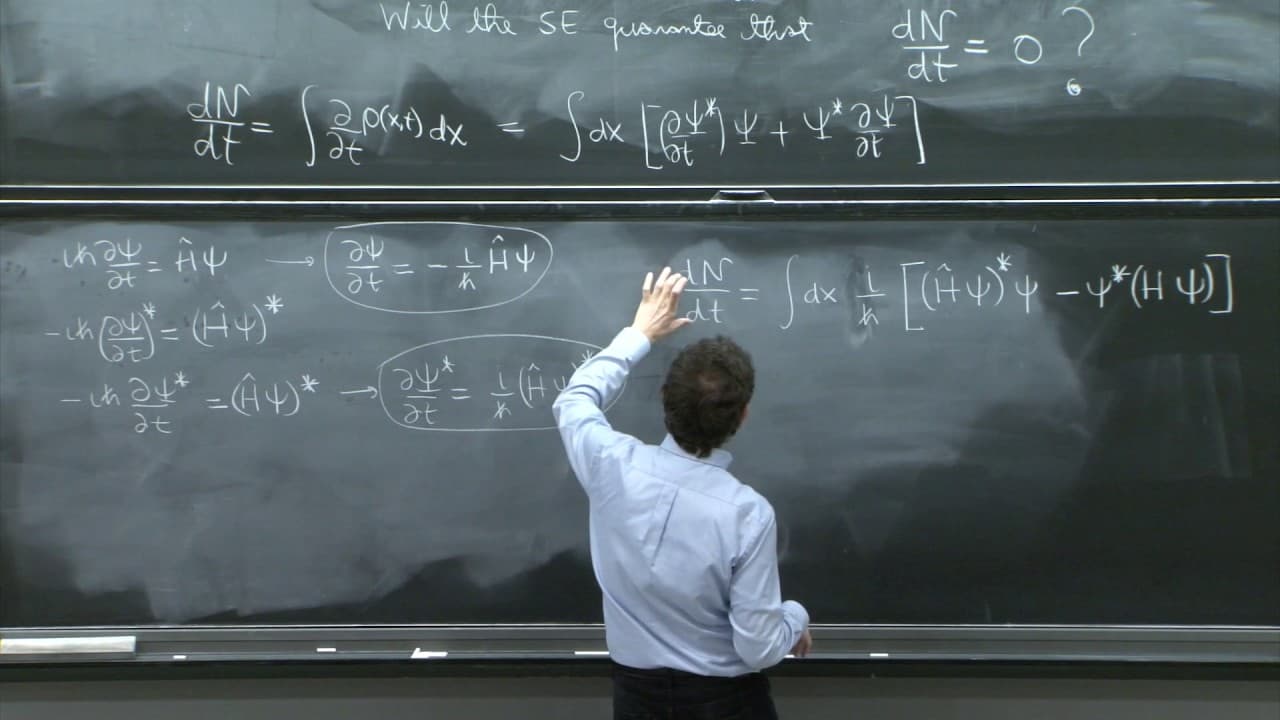
PROFESSOR: Let's do a work check. So main check. If integral psi star x t0, psi x t0 dx is equal to 1 at t equal to t0, as we say there, then it must hold for later times, t greater than t0. This is what we want to check, or verify, or prove. Now, to do it, we're going to take our time. So it's not going to happen in five minutes, not 10 minutes, m... Read More
Key Insights
- 🦾 The conservation of probability in quantum mechanics is ensured by the Schrodinger equation.
- 👋 The probability density function is defined as the product of the complex conjugate of the wave function and the wave function itself.
- 👋 The Hermitian operator plays a crucial role in the conservation of probability, as it must satisfy certain conditions related to the integral of its action on wave functions.
Install to Summarize YouTube Videos and Get Transcripts
Explore YouTube Video Summarizer or Get YouTube Transcript Extractor
Questions & Answers
Q: What is the purpose of the probability density function in quantum mechanics?
The probability density function gives the probability of finding a particle at a specific position in space. By integrating the probability density function over space, we can determine the total probability.
Q: Why is it necessary to assume that the normalization at a specific time is 1?
Assuming a normalization of 1 means that the total probability of finding the particle somewhere in space is 100%. This assumption allows us to investigate if the Schrodinger equation guarantees the conservation of probability.
Q: What is the significance of a Hermitian operator in quantum mechanics?
A Hermitian operator satisfies the condition that the integral of its action on two different wave functions is equal to the integral of the complex conjugate of the first wave function acting on the second wave function. This condition is crucial for the conservation of probability.
Q: How does the Hermitian operator relate to the Schrodinger equation?
The Hermitian operator appears in the Schrodinger equation, and for the conservation of probability to hold, the Hermitian operator needs to satisfy certain conditions. Specifically, the integral of the Hermitian operator acting on the wave function is equal to the integral of the wave function acting on the Hermitian conjugate of the operator.
Summary & Key Takeaways
-
The main goal is to prove that if the integral of the probability density function is equal to 1 at a specific time, it will remain 1 for all later times.
-
The probability density function is defined as the product of the complex conjugate of the wave function and the wave function itself.
-
The Schrodinger equation guarantees that the derivative of the integral of the probability density function is zero, ensuring the conservation of probability.
Read in Other Languages (beta)
Share This Summary 📚
Summarize YouTube Videos and Get Video Transcripts with 1-Click
Try YouTube Summary with ChatGPT & Claude or YouTube Transcript Generator
Explore More Summaries from MIT OpenCourseWare 📚


Summarize YouTube Videos and Get Video Transcripts with 1-Click
Try YouTube Summary with ChatGPT & Claude or YouTube Transcript Generator