5.1 Voyager Program: How Long Is the Journey to Proxima B for Alice and Bob?
TL;DR
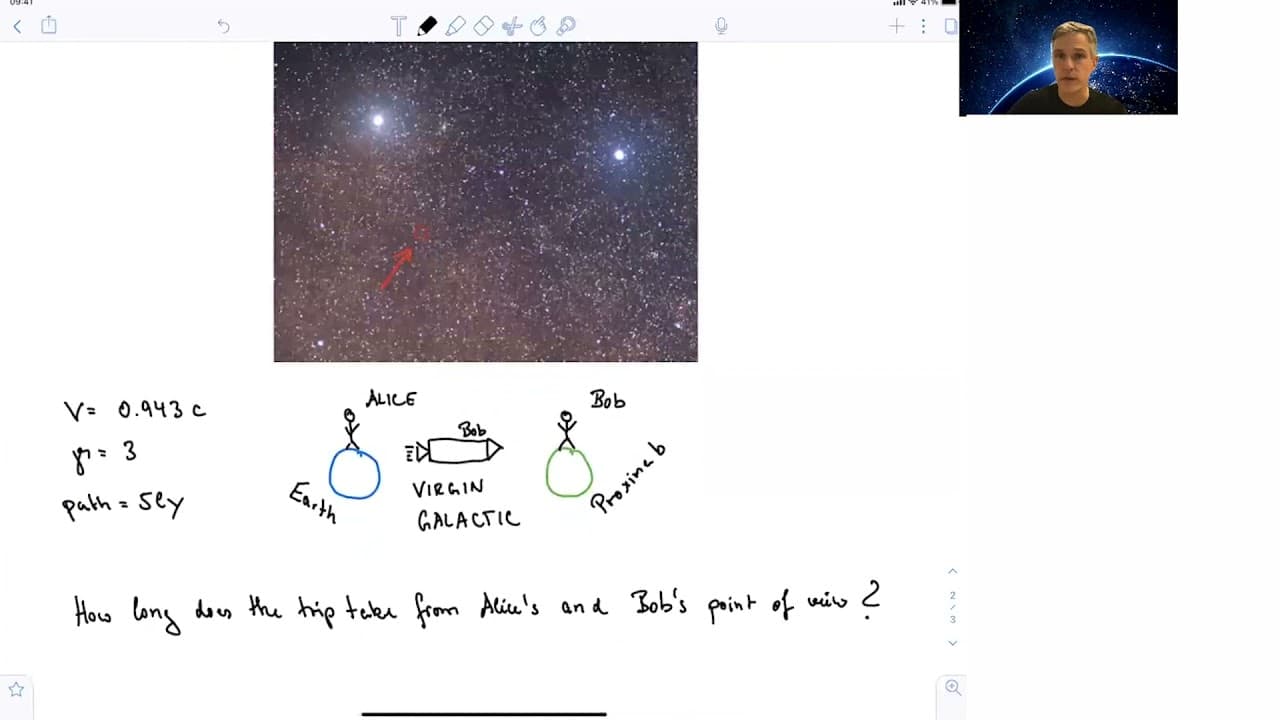
The journey to Proxima B takes 5.3 years from Alice’s Earth-based perspective but only 1.77 years for Bob aboard the spacecraft. The example uses a five-light-year path, a speed of 0.943 times the speed of light, and a gamma factor of 3 to demonstrate Lorentz contraction and the different elapsed times experienced by two observers. Read on to see each calculation and its connection to the twin paradox.
Transcript
[SQUEAKING] [RUSTLING] [CLICKING] MARKUS KLUTE: Welcome back to 8.20, Special Relativity. In this section, you're going to take a journey through our solar system and beyond. 1977 marks the first flight of the Voyager program. Voyager is an MIT-led program with the original mission to study planetary systems. Now, Voyager 1 and Voyager 2, two space... Read More
Key Insights
- 💁 The Voyager program has provided valuable information even after 40 years of its original mission.
- 🤩 Alpha Centauri is not just a star but a planetary system, and the closest planet, Proxima B, is the destination in 8.20.
- ⌛ The concept of time dilation and Lorentz contraction in special relativity leads to different time experiences for observers in motion.
Install to Summarize YouTube Videos and Get Transcripts
Explore YouTube Video Summarizer or Get YouTube Transcript Extractor
Questions & Answers
Q: How long does the journey to Proxima B take for Alice and Bob?
Alice observes the journey taking 5.3 years from Earth. Bob experiences only 1.77 years because the five-light-year path is Lorentz contracted in his frame of reference.
Q: How is the 5.3-year travel time calculated from Alice’s perspective?
For Alice, the spacecraft travels a five-light-year path at 0.943 times the speed of light. Dividing five light years by that velocity gives a travel time of 5.3 years.
Q: How is Bob’s 1.77-year travel time calculated?
Bob measures the path as five light years divided by the gamma factor of 3, giving 1.67 light years. Dividing that contracted distance by 0.943 times the speed of light gives a journey time of 1.77 years.
Q: Why do Alice and Bob experience different travel times?
Alice remains on Earth, while Bob travels at 0.943 times the speed of light. In Bob’s frame, Lorentz contraction shortens the path, so he experiences less elapsed time for the same journey.
Q: What are the spacecraft’s speed, route length, and gamma factor?
The spacecraft travels at a constant velocity of 0.943 times the speed of light. Its path is five light years long, and the gamma factor is 3.
Q: Where is the spacecraft traveling in the Voyager Program example?
The mission travels to Proxima B, a planet in the Alpha Centauri system. Alpha Centauri is described as the closest star and planetary system to our solar system and contains multiple stars.
Q: What was the original mission of the Voyager program?
The Voyager program began in 1977 with an original mission to study planetary systems. Voyager 1 and Voyager 2 later continued studying interstellar space.
Q: What information are Voyager 1 and Voyager 2 still providing?
More than 40 years later, the two probes are still sending measurements of their surroundings back to Earth. They are described as the two furthest-away objects the program can track, and their continuing work provides the backdrop for the special-relativity journey.
Summary & Key Takeaways
-
The Voyager program, initiated in 1977, sent two spacecrafts to study planetary systems and are now exploring interstellar space, providing valuable information back to Earth.
-
In the course 8.20, the mission is to reach the closest star system, Alpha Centauri, and its planet, Proxima B, using a spacecraft that can travel at 0.943 times the speed of light.
-
Alice, on Earth, observes Bob's journey taking 5.3 years, while Bob experiences a Lorentz contracted journey, taking only 1.67 years due to the effects of special relativity.
Read in Other Languages (beta)
Share This Summary 📚
Summarize YouTube Videos and Get Video Transcripts with 1-Click
Try YouTube Summary with ChatGPT & Claude or YouTube Transcript Generator
Explore More Summaries from MIT OpenCourseWare 📚


Summarize YouTube Videos and Get Video Transcripts with 1-Click
Try YouTube Summary with ChatGPT & Claude or YouTube Transcript Generator