You Are Shrunk to the Height of a Nickel: How Do You Solve Google's Blender Interview Question?
TL;DR
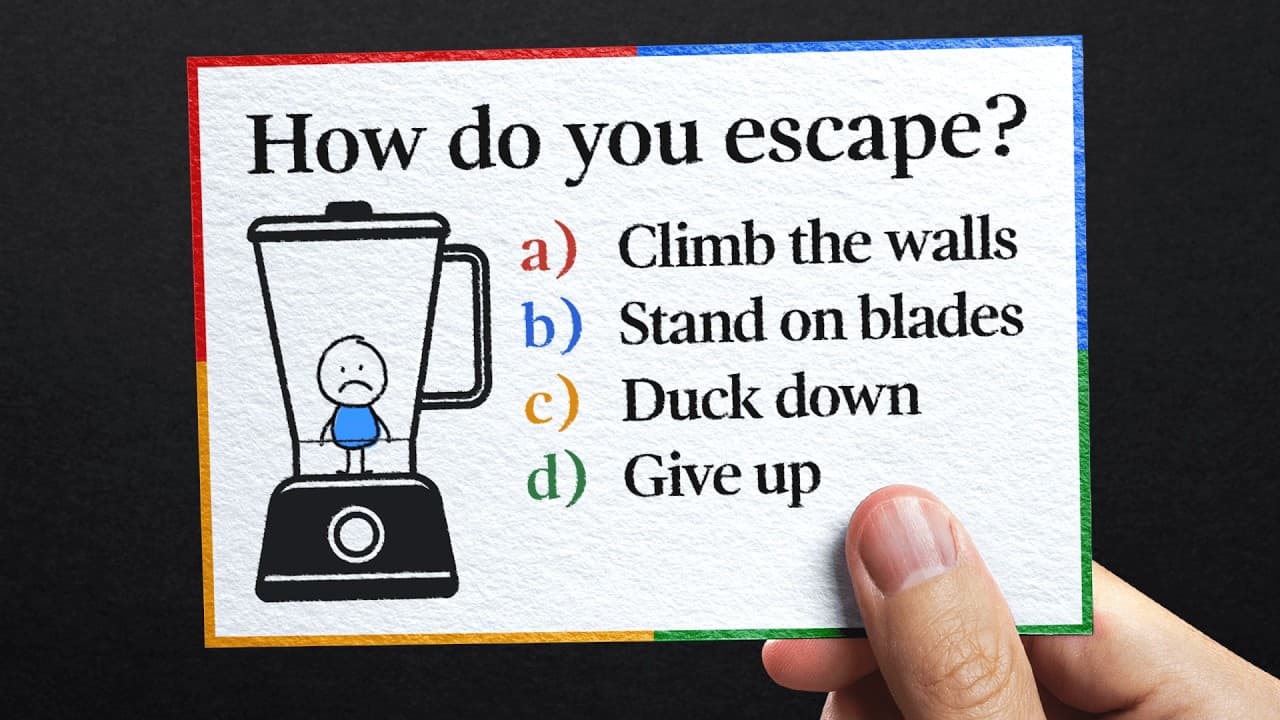
If you are shrunk to the height of a nickel and put in a blender, the proposed solution is to jump out because your strength-to-weight ratio increases as your size decreases. The blades start spinning in 60 seconds, making slow wall-climbing impractical. Biological limitations make the scenario unrealistic, but the square-cube law explains the intended answer. Read on to see why other escape plans fail.
Transcript
There is this famous Google interview question that everyone gets wrong. You're shrunk down to the size of a nickel and put into a blender. The blades will start spinning in 60 seconds, so what do you do? I would like to think I could duck down and miss the blades Break the thing at the bottom maybe? Push the blades? Ask nicely for the blender not ... Read More
Key Insights
- The 'blender question' was used by Google to assess candidate problem-solving skills.
- Van der Waals forces explain how geckos stick to walls, but are too weak for humans to scale blender walls.
- The square-cube law explains why smaller creatures have higher strength-to-weight ratios.
- Smaller animals like ants can lift heavy weights due to their high strength-to-weight ratio.
- Air resistance affects jump height significantly at smaller scales, impacting escape feasibility.
- Biological constraints, like heart and lung function, prevent shrunken humans from surviving.
- Google abandoned brainteasers in interviews, finding them ineffective for assessing candidates.
- Thought experiments, while impractical, stimulate creative and scientific thinking.
Install to Summarize YouTube Videos and Get Transcripts
Explore YouTube Video Summarizer or Get YouTube Transcript Extractor
Questions & Answers
Q: What should you do if you are shrunk to the height of a nickel and put in a blender?
You should try to jump out of the blender. As your size decreases, your strength-to-weight ratio increases, theoretically giving you enough relative jumping ability to escape before the blades start spinning in 60 seconds.
Q: What is the answer to the stuck-in-a-blender interview question?
The intended answer is to jump out of the blender. The square-cube law suggests that shrinking increases your strength relative to your weight, although biological constraints make the scenario unrealistic.
Q: Why would a miniature person be able to jump out of the blender?
Strength scales with cross-sectional area, while weight scales with volume. Because weight decreases faster than strength as size decreases, a miniature person would have a higher strength-to-weight ratio and could jump higher relative to their size.
Q: Why is hiding beneath the blender blades not a complete solution?
Hiding beneath the blades may protect you when they first start spinning. It does not help you escape, so you would remain trapped inside a running blender.
Q: Could a shrunken person climb the blender walls within 60 seconds?
Climbing would likely take longer than the available 60 seconds because each hand and foot would need careful placement. Once the blades started spinning, a single mistake could be fatal.
Q: Could Van der Waals forces help a miniature human climb the glass?
Van der Waals forces are too weak to make ordinary human hands stick to the glass. Geckos succeed because millions of tiny branches on their feet increase surface area and mold to surfaces, structures humans do not have.
Q: How do ants and cockroaches climb surfaces without Van der Waals forces?
They use specialized claws and sophisticated frictional attachment. At insect scale, tiny imperfections in glass become significant enough for those claws to grip.
Q: Why did Google ask the blender interview question?
Google used brainteasers to screen applicants and assess problem-solving rather than factual recall. The transcript says Google received about 3 million applications each year and hired only 7,000 people, an acceptance rate of 0.2%.
Summary & Key Takeaways
-
Google's 'blender question' was designed to assess problem-solving skills, not factual correctness. Theoretically, smaller size increases strength-to-weight ratio, enabling a jump out of the blender. However, biological limitations, such as heart and lung function, render survival impossible, highlighting the question's purpose as a creative exercise.
-
The square-cube law explains why smaller creatures can lift more relative to their size, impacting the 'blender question' answer. While miniature humans could theoretically jump out due to increased strength, practical limitations, including air resistance and biological constraints, make the scenario unrealistic.
-
Google used brainteasers like the 'blender question' to gauge problem-solving abilities, but found them ineffective for predicting job performance. Despite this, such questions encourage creative thinking, similar to thought experiments used in scientific discoveries, illustrating the importance of embracing unconventional ideas.
Read in Other Languages (beta)
Share This Summary 📚
Summarize YouTube Videos and Get Video Transcripts with 1-Click
Try YouTube Summary with ChatGPT & Claude or YouTube Transcript Generator
Explore More Summaries from Veritasium 📚



Summarize YouTube Videos and Get Video Transcripts with 1-Click
Try YouTube Summary with ChatGPT & Claude or YouTube Transcript Generator